

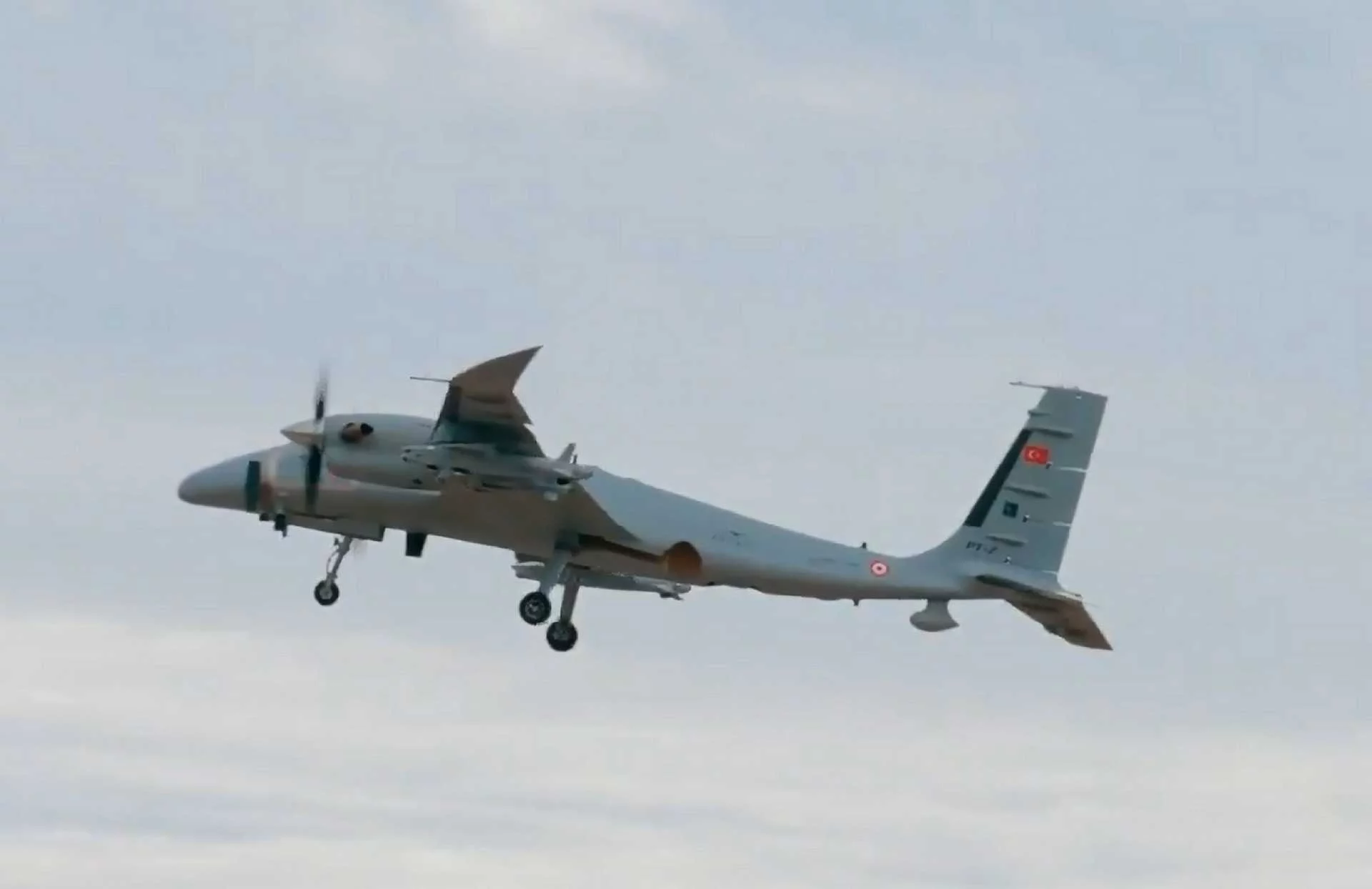
Turkish defense company Baykar has successfully carried out the first live-fire test of its AI-guided KEMANKEŞ-1 mini cruise missile, launched from the Bayraktar Akıncı unmanned combat aircraft. The successful strike marks a major step forward in Türkiye’s autonomous weapons development and demonstrates its growing self-sufficiency in advanced munitions.
First Live-Fire Success
According to Türkiye Today on October 31, 2025, Baykar’s test saw the KEMANKEŞ-1 missile launched from an Akıncı UCAV successfully destroy airborne targets. Türkiye’s defense ministry confirmed the test, describing it as a landmark achievement for the nation’s indigenous unmanned strike capability.
Fully Autonomous Mission Profile
Baykar announced that the missile completed all mission phases — autonomous launch, cruise, and terminal dive — while engaging fast-moving targets. Conducted under realistic operational conditions, this was the first recorded instance of an AI-powered cruise missile fired from a UCAV to engage airborne threats rather than static ground targets, signaling a major tactical shift in drone warfare.
“Master Archer” Design and Capabilities
Named after the Ottoman word for “master archer,” the KEMANKEŞ-1 is a jet-propelled, miniaturized cruise missile designed for precision strikes with a minimal radar signature. It features AI-assisted autopilot, computer vision, and GNSS/INS navigation, enabling it to maneuver in complex airspace. An electro-optical seeker and electronic warfare countermeasures enhance its survivability in contested areas.
Historic Integration with the Akıncı UCAV
The missile was launched from Baykar’s twin-engine Bayraktar Akıncı, which can stay airborne for over 24 hours and carry more than 1,350 kilograms of payload. Integrating KEMANKEŞ-1 with this platform enables Turkish forces to carry out long-range precision strikes from unmanned systems far behind the front lines.
From TB2 to Akıncı
Earlier iterations of the missile were tested on the smaller Bayraktar TB2, which in March 2025 achieved a 100-kilometer flight. The Akıncı-based test expands the missile’s role to include operations in layered air-defense zones and interception of enemy drones and low-flying aircraft.
Strategic Implications
This test represents the convergence of key trends in modern warfare: AI-driven weapons, unmanned air dominance, and precision strike capability. Baykar is now delivering complete autonomous strike systems, not just drones. For Türkiye, it underscores the goal of reducing reliance on foreign suppliers and boosting defense exports.
Naval Expansion and Future Deployment
Baykar confirmed that the KEMANKEŞ-1 will also be compatible with the Bayraktar TB3, designed for carrier operations aboard TCG Anadolu. This capability will extend Türkiye’s reach across the Aegean, Eastern Mediterranean, and Black Sea, enabling sea-launched drone strikes with precision cruise munitions.
Production and Global Outlook
Serial production is expected to follow. With proven combat performance in Libya, Syria, and Ukraine, Baykar’s integration of autonomous munitions into its UCAV family could redefine unmanned warfare not just regionally but globally.
