

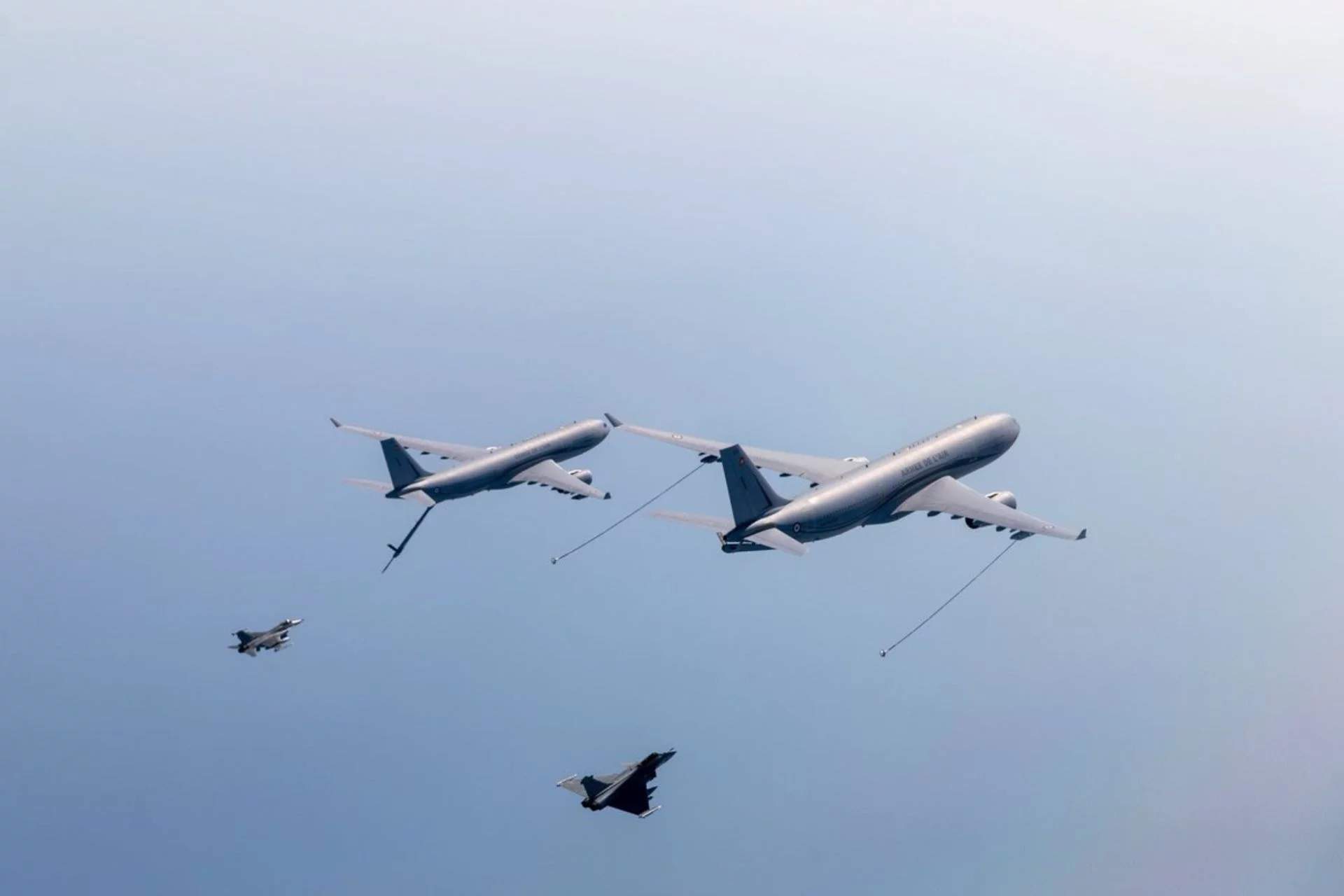
In a coordinated demonstration of allied vigilance, the Belgian Defence and French Armed Forces shared images of their recent joint air operation over the Black Sea. The exercise involved two Belgian F-16A fighters, two French Rafales, a French E-3F AWACS, and three A330 MRTT aerial refueling aircraft — two from France and one NATO-operated MRTT crewed by Belgian personnel. While the United Kingdom also participated, the UK Ministry of Defence has not released details regarding its contribution or deployed assets.
During the mission, the E-3F and three MRTTs orbited safely over Bulgaria, while the four fighter aircraft carried out aerial surveillance of international airspace above the Black Sea. The main goal of the exercise was to enhance allied situational awareness and demonstrate a united commitment to the principle of freedom of navigation in international waters. No additional operational details were disclosed.
The French E-3F Sentry AWACS (Airborne Warning and Control System), based on the Boeing 707 airframe, is a long-standing command and control (C2) asset within the French Air Force. Operated by the 36th Airborne Command and Control Wing out of Avord Air Base, the E-3F provides real-time tracking of air, sea, and ground-based threats, relaying critical battlefield data to command centers and friendly forces alike.
Also featured in the operation was the Airbus A330 MRTT, a dual-role aerial refueler and transport aircraft derived from the A330-200. Since its entry into service in 2011, the platform has logged over 310,000 flight hours across 15 user nations. Its ability to refuel a wide array of Western fighter aircraft makes it an indispensable logistics asset in multinational operations.
Belgium’s participating F-16s are upgraded F-16AM/BM Block 15 aircraft, modernized under the Mid-Life Update (MLU) program. These enhancements introduced improved avionics, radar systems such as the AN/APG-66(V2), and structural reinforcements, keeping the decades-old fighter relevant in modern combat scenarios.
The exercise comes amid heightened awareness of vulnerabilities in global trade routes, as recent conflicts in Ukraine and the Red Sea have exposed the ease with which maritime logistics can be disrupted. Against this backdrop, NATO’s recommitment to defending freedom of navigation through exercises like this one underscores the strategic value of persistent air presence in contested regions.
