

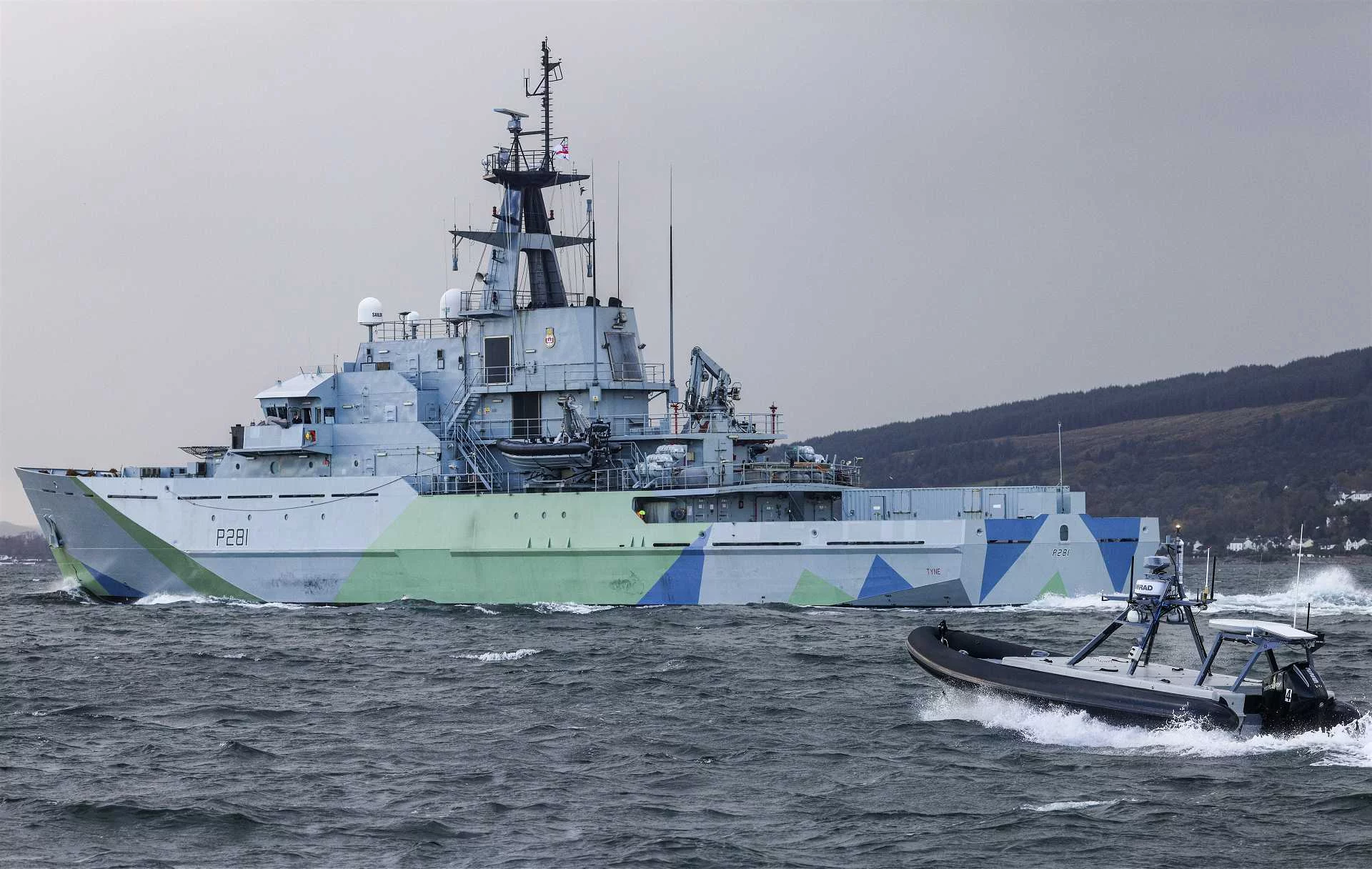
The British Royal Navy conducted a momentous trial showcasing the zenith of naval autonomy, using seven Rattler Unmanned Surface Vessels (USVs) to escort warships operating off the coast of Scotland. These “remote-controlled escorts” were piloted from over 500 miles (800 kilometers) away, marking a historic benchmark for autonomous fleet operations and future maritime defense strategy.
The Fleet’s Invisible Shield: The Rattler Mission
- 72 Hours of Autonomous Protection: During the 72-hour exercise on October 28, 2025, the Rattler USVs successfully executed coordinated escort, formation keeping, and continuous surveillance for HMS Tyne and its accompanying ships. The mission validated the potential for enhancing the security of crewed vessels in high-risk or contested waters.
- The 7.2-Meter “Super Versatile Soldier”: The Rattler is a 7.2-meter fully autonomous platform, based on a Rigid Inflatable Boat (RIB) hull, custom-built to operate in hazardous environments without endangering personnel. Its modular architecture allows for rapid configuration with advanced sensors, radar, and electronic warfare payloads, making it an exceptionally flexible asset for reconnaissance and security scenarios.
- Commanded from 500+ Miles Away: Despite the Rattlers prowling the North Sea, the entire operation was orchestrated from the innovation testbed ship XV Patrick Blackett at HMNB Portsmouth, over 500 miles away. This demonstrates a validated capability for long-range command and control in distributed fleet operations.
A Paradigm Shift: Speed, Autonomy, and the Future
- Agile Acquisition Model: The Royal Navy, through its Disruptive Capabilities and Technology Office (DCTO), bypassed traditional procurement cycles, moving from concept to operational testing in mere months. This achievement resulted from close collaboration between military operators and local UK-based Small and Medium Enterprises (SMEs) to rapidly co-design and iterate solutions tailored to frontline requirements.
- Force Multiplication Effect: The adoption of uncrewed boats like the Rattler provides a low-cost force multiplication effect. A single manned vessel can coordinate multiple Rattlers, drastically expanding its reach and persistence at sea.
- Global Interest: The Rattler fleet is already attracting attention from NATO allies, who are looking to replicate the model for missions outside UK waters. The role of Rattlers in grey-zone operations, persistent surveillance, and electronic warfare is expected to grow dramatically over the next 24 months.
This demonstration clearly signals that the British Royal Navy is not just experimenting with naval autonomy; it is rapidly operationalizing it as a core capability.
