

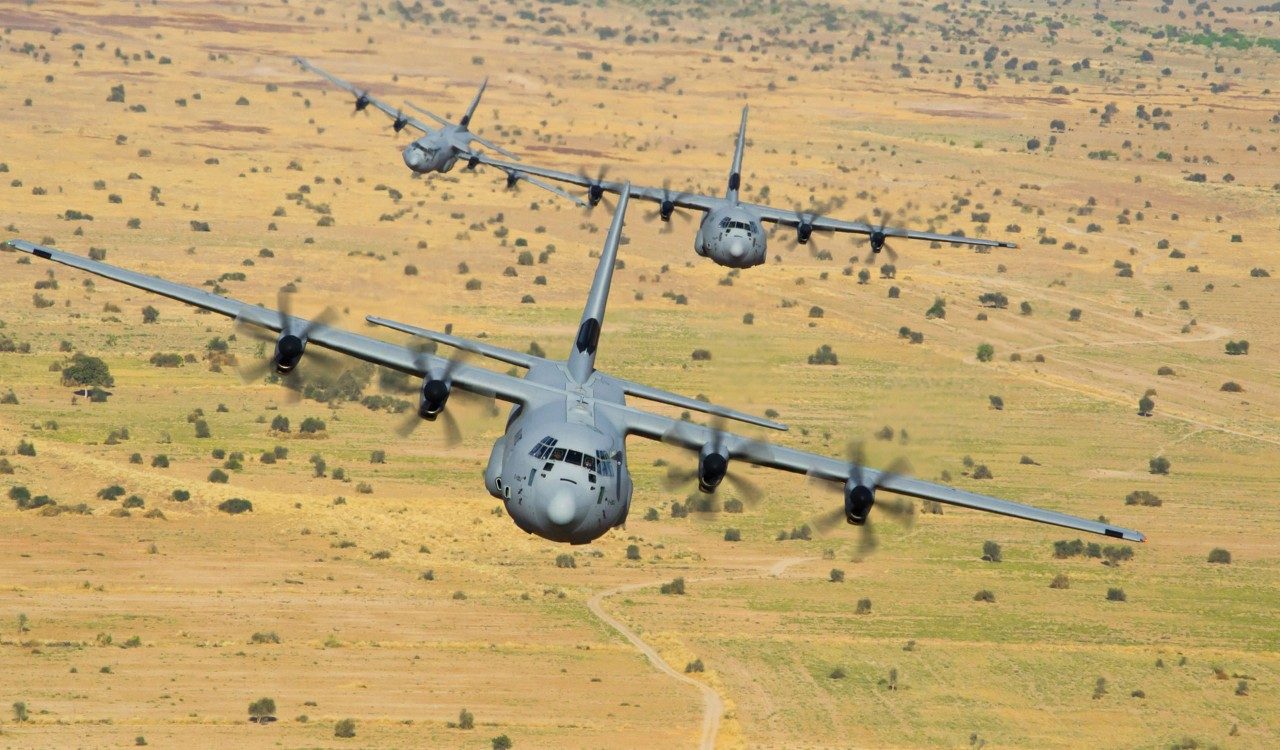
The C-130J Super Hercules represents the most advanced evolution of the iconic C-130 Hercules family, purpose-built to execute the tactical segment of airlift operations. Renowned for its ability to operate from short, unprepared, or rugged airstrips, it is the U.S. Air Force’s primary aircraft for delivering troops, equipment, and supplies into austere or hostile environments.
The aircraft operates across multiple commands within the U.S. Air Force, including Air Mobility Command, Air Force Special Operations Command, theater commands, the Air National Guard, and the Air Force Reserve Command. It supports a broad spectrum of operations in both peace and wartime scenarios — ranging from humanitarian assistance and medical evacuation to direct tactical resupply missions.
The C-130 platform is highly versatile, capable of performing diverse tasks such as Antarctic resupply, aeromedical evacuation, weather reconnaissance, aerial spraying, firefighting for the U.S. Forest Service, and emergency humanitarian relief in natural disaster zones.
Features
With its rear loading ramp and cargo door, the C-130J can carry a wide array of oversized cargo — from utility helicopters and six-wheeled armored vehicles to standard pallets and military personnel. In an airdrop role, it can release up to 42,000 pounds of cargo and, with its reinforced landing gear, can operate from rough and dirt strips with ease.
The Super Hercules’ modular design allows the same aircraft to perform multiple missions. Specialized mission systems can be easily installed or removed, enabling rapid reconfiguration between roles such as palletized cargo delivery, vehicle transport, airdrop operations, personnel transfer, or aeromedical evacuation.
As the latest generation of the Hercules family, the C-130J is replacing older C-130H models. Its state-of-the-art avionics and propulsion systems significantly reduce crew workload, maintenance costs, and operational expenses, resulting in substantial lifecycle savings. Compared to earlier variants, the J-model climbs faster, flies higher and farther, cruises at greater speeds, and requires shorter takeoff and landing distances. The stretched C-130J-30 adds 15 feet to the fuselage, expanding cargo space for larger payloads.
Key system upgrades in the C-130J/J-30 include:
- Advanced two-pilot digital flight deck with integrated avionics,
- Color multifunction LCDs and head-up displays,
- Modern navigation suite with dual INS/GPS,
- Integrated defensive systems and low-power color radar,
- Digital moving map display,
- New Rolls-Royce AE2100D3 turboprop engines with six-blade composite propellers,
- Digital autopilot, improved fuel and environmental control systems, ice protection,
- Enhanced cargo-handling and monitoring systems.
Background
Despite more than four decades since its original Air Force design specification, the C-130 platform remains in continuous production. The initial C-130A model, equipped with four Allison T56-A-11 or -9 engines, entered service in 1956 with a total of 219 aircraft produced.
The subsequent C-130B, powered by Allison T56-A-7 engines, entered service in 1959 with 134 units built. The C-130E variant, introduced in 1962, utilized the same engine but featured two 1,290-gallon external fuel tanks and higher maximum takeoff weight.
The C-130H, introduced in 1974 with more powerful Allison T56-A-15 engines, brought significant performance improvements while retaining the external design of its predecessor.
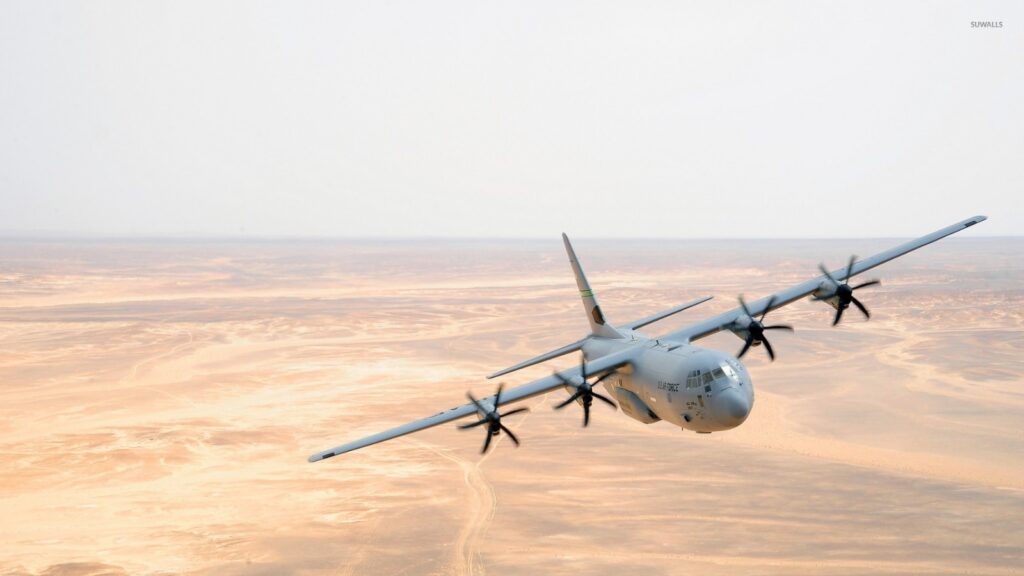
The latest production model, the C-130J, joined the fleet in February 1999. Distinguished by six-bladed composite propellers and Rolls-Royce AE2100D3 engines, it delivers dramatic enhancements in range, climb rate, and efficiency. The extended C-130J-30 variant, featuring a 15-foot longer fuselage, was selected to replace aging C-130H aircraft.
General Characteristics
Primary Function: Global airlift
Contractor: Lockheed Martin Aeronautics Company
Power Plant:
- C-130E: Four Allison T56-A-7 turboprops, 4,200 shp
- C-130H: Four Allison T56-A-15 turboprops, 4,591 shp
- C-130J: Four Rolls-Royce AE2100D3 turboprops, 4,700 shp
Length:
- C-130E/H/J: 97 ft 9 in (29.3 m)
- C-130J-30: 112 ft 9 in (34.69 m)
Height: 38 ft 10 in (11.9 m)
Wingspan: 132 ft 7 in (39.7 m)
Cargo Compartment:
- C-130E/H/J: 40 ft (12.31 m) long × 119 in (3.12 m) wide × 9 ft (2.74 m) high
- C-130J-30: 55 ft (16.9 m) long × 119 in (3.12 m) wide × 9 ft (2.74 m) high
Speed:
- C-130E: 345 mph (Mach 0.49)
- C-130H: 366 mph (Mach 0.52)
- C-130J: 417 mph (Mach 0.59)
- C-130J-30: 410 mph (Mach 0.58)
Ceiling:
- C-130J: 28,000 ft (8,615 m) with 42,000 lb payload
- C-130J-30: 26,000 ft (8,000 m) with 44,500 lb payload
Max Takeoff Weight:
- C-130E/H/J: 155,000 lb (69,750 kg)
- C-130J-30: 164,000 lb (74,393 kg)
Max Payload:
- C-130E/H/J: 42,000 lb (19,090 kg)
- C-130J-30: 44,000 lb (19,958 kg)
Range:
- C-130E: 1,000 nm
- C-130H: 1,050 nm
- C-130J: 1,800 nm
- C-130J-30: 1,700 nm
Maximum Load:
- C-130E/H/J: 6 pallets, 74 litters, 16 CDS bundles, 92 combat troops or 64 paratroopers
- C-130J-30: 8 pallets, 97 litters, 24 CDS bundles, 128 troops or 92 paratroopers
Crew:
- C-130E/H: 5 (two pilots, navigator, flight engineer, loadmaster)
- C-130J/J-30: 3 (two pilots and loadmaster)
Aeromedical Evacuation:
A minimum crew of three (one flight nurse, two medical technicians), expandable to two nurses and four technicians depending on mission requirements.
