

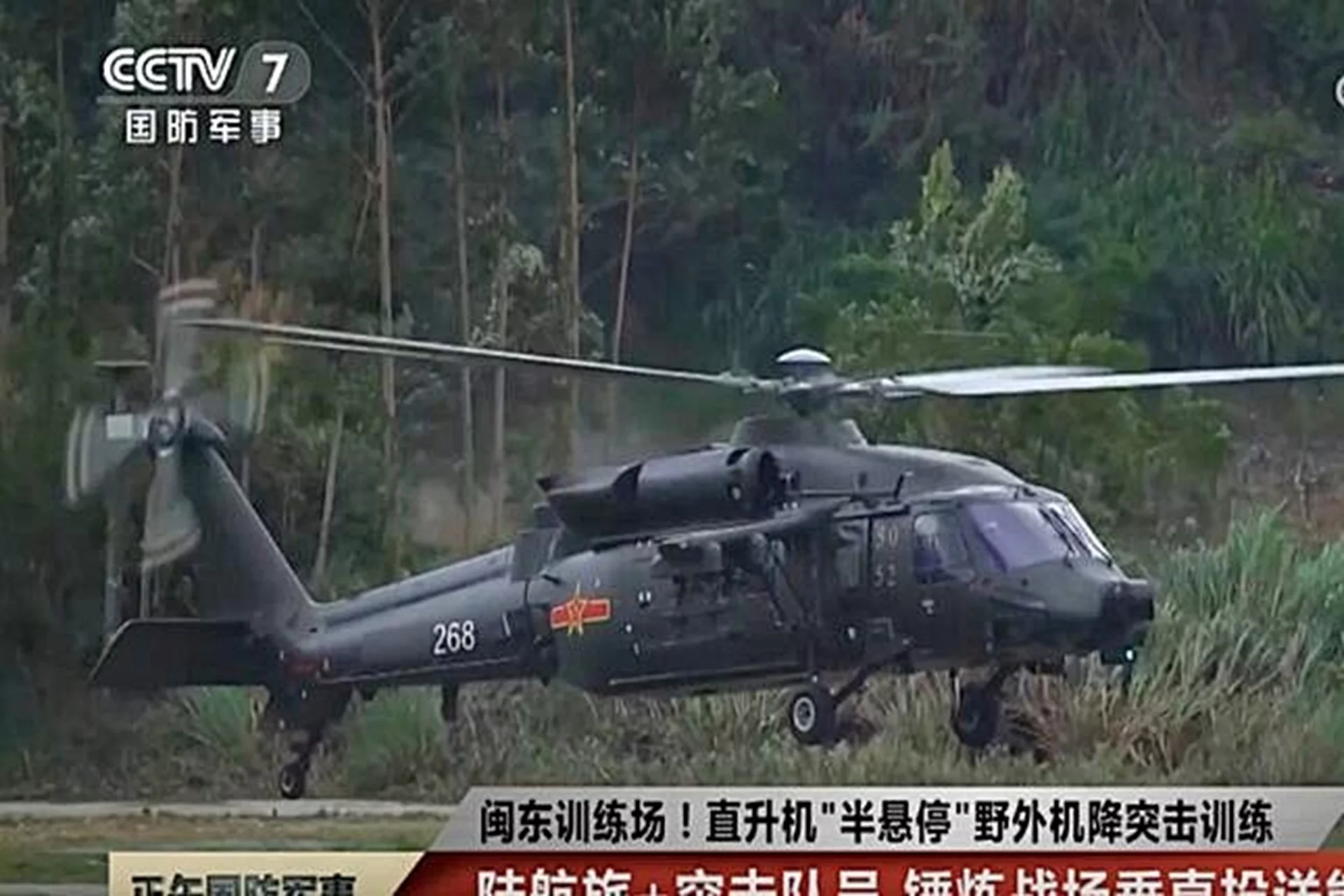
China has conducted the first publicly reported air-assault drill using its new Z-20T “Assault Eagle” helicopter, signaling a major leap in the People’s Liberation Army’s (PLA) vertical mobility and rapid-insertion capability. The exercise, held on November 24, 2025, in eastern Fujian—directly facing Taiwan—highlights China’s evolving ability to conduct U.S.-style vertical envelopment operations across contested airspace.
Footage released by CCTV shows the PLA’s 71st Group Army employing the Z-20T in low-altitude penetration, semi-hover single-wheel landings, and rapid troop insertion under realistic battlefield conditions. Unlike past ceremonial appearances, the drill demonstrates how China intends to fight with its newest helicopter platforms.
Z-20T: China’s Armed Assault Variant in the Black Hawk Class
The Z-20T is an assault-optimized derivative of the Harbin Z-20 medium-lift helicopter—the backbone of PLA Army aviation. Comparable to the U.S. UH-60 Black Hawk in size and lift capacity, the Z-20T features:
- Twin WZ-10 turboshaft engines
- A five-blade main rotor
- High-altitude performance above 4,000 meters
- Stub wings with multiple hardpoints
- An enlarged nose sensor turret
- Upgraded defensive systems
-Compatibility with AKD-10 anti-tank missiles and rocket pods
This combination allows a single aircraft to transport an assault team, deliver suppressive fire, and exfiltrate—all while flying at low altitude over complex terrain.
A Rapidly Maturing Platform
The Z-20 family represents China’s transition from imported S-70s to an indigenous 10-ton helicopter.
The Z-20T’s rapid sequence—parade debut, flight demonstrations, and now an operational air-assault drill—suggests technical maturity and expanding deployment across army aviation brigades.
Chinese analysts note that the progression mirrors the U.S. UH-60’s evolution into MH-60 special-operations variants, but on a faster Chinese timeline.
Single-Wheel Landing: A Tactical Game Changer
CCTV highlighted a semi-hover single-wheel landing technique, enabling troops to deploy in:
- Narrow urban spaces
- Terraced slopes
- Small island clearings
- Uneven or restricted landing zones
This method shortens time on the ground, reduces vulnerability, and allows the helicopter to depart immediately at ultra-low altitude—ideal for vertical envelopment missions.
Strategic Implications Across the Indo-Pacific
The Z-20T’s introduction carries far-reaching implications:
- In a Taiwan Strait conflict, mixed Z-20/Z-20T formations could insert forces behind beachheads, seize road junctions, or support airborne and amphibious units.
- In the South China Sea, they could conduct rapid outpost reinforcement or raids on contested features.
- Along the Himalayas, they enhance China’s high-altitude response capability against India.
As the PLA expands its rotary-wing fleet and refines its doctrine, regional militaries must now account for helicopter-borne rapid assault in addition to missiles and naval power.
A Turning Point in China’s Vertical Lift Doctrine
Unlike scripted parade flyovers, the Z-20T’s appearance in a realistic training scenario marks a new phase in China’s approach to air assault operations. By integrating armored firepower, troop lift, and advanced insertion techniques into one platform, Beijing is laying the foundations of a joint operations model that could reshape security planning from Taipei to New Delhi.
