

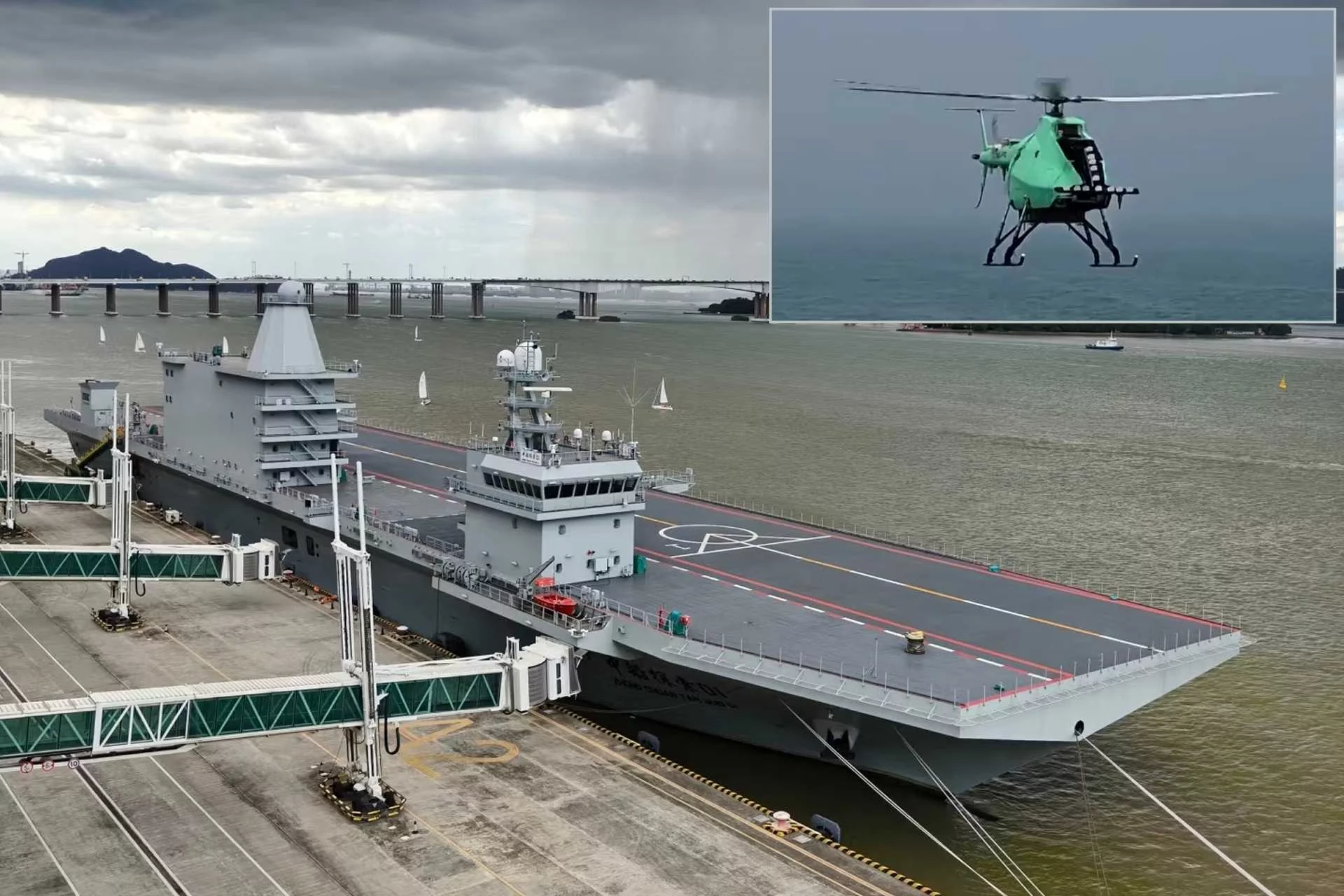
China successfully conducted sea trials of the AR-500CJ unmanned helicopter aboard the CSSC Explorer 01 (Zhongchuan Tansuo 01) drone carrier, validating autonomous takeoff and landing under sea state 4–5 conditions. Broadcast footage from CCTV-7 on October 30, 2025, showed the aircraft performing stable launch, flight, and recovery sequences amid moderate waves, marking a significant milestone toward shipborne UAV integration.
From Land Simulations to Operational Validation
Developed by the AVIC Helicopter Research and Development Institute, the AR-500CJ is a navalized evolution of the AR-500B and high-altitude AR-500C models. With a maximum takeoff weight of 600 kg and a payload capacity of 150 kg, it can sustain 6–7 hours of flight and reach altitudes up to 5,000 meters. The UAV is powered by the “Lark” heavy-fuel engine—producing 150 horsepower and optimized for shipboard safety through kerosene fuel use and FADEC control.
Precision Landing and Modular Mission Payloads
The system integrates inertial, differential, and visual navigation for precision landings, reinforced by an electric harpoon-grating lock to secure the aircraft upon touchdown. Its short side wings accommodate mission payloads such as EO/IR pods, radars, and communication relay antennas, supporting multi-role missions ranging from reconnaissance to light strike operations.
Testing Under Realistic Maritime Conditions
During the trials, CSSC Explorer 01 maneuvered at various speeds and headings to replicate real frigate deck motions. Engineers evaluated the UAV’s flight stability, vibration resistance, and electromagnetic compatibility with shipboard systems. The collected data refined automated landing algorithms, power management, and safety protocols for future People’s Liberation Army Navy (PLAN) operations.
Strengthening China’s Shipborne Drone Capabilities
The AR-500CJ represents a major step in China’s vertical takeoff and landing (VTOL) UAV development. As part of a broader unmanned ecosystem—including the Zhu Hai Yun drone carrier and “Robo-Shark” underwater drones—it strengthens China’s capacity for autonomous maritime surveillance, communication relay, and coastal defense missions.
