

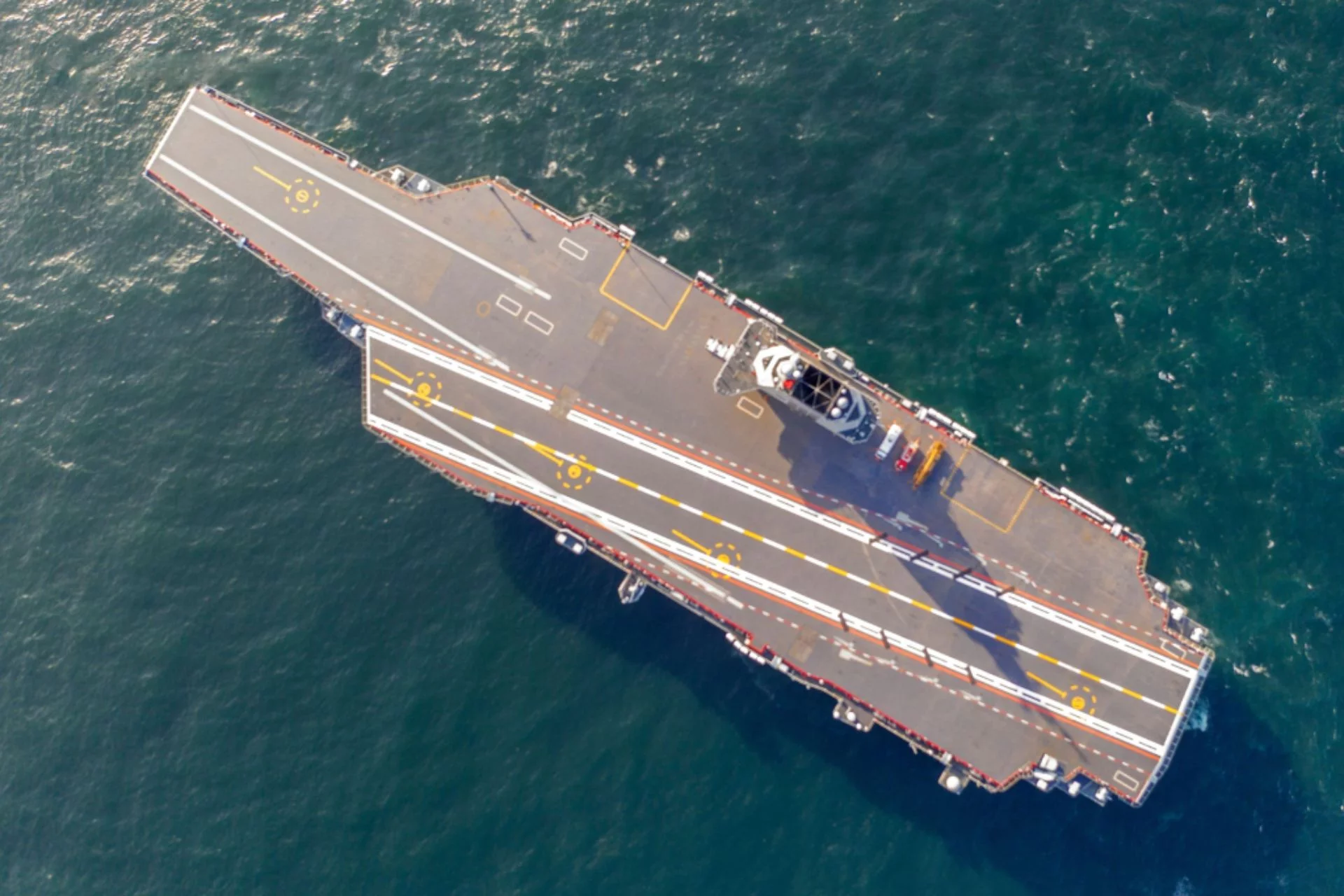
China is approaching a major milestone in its naval modernization efforts with the near-operational status of its third aircraft carrier, Fujian (Type 003). A recent documentary broadcast by China’s state-run CCTV, approved by the Central Military Commission, offered a rare look into the vessel’s development and sea trials, highlighting the first publicly shown footage of catapult-assisted takeoffs using carrier-based aircraft.
Fujian, hull number 18, is the first Chinese carrier to feature a catapult-assisted takeoff but arrested recovery (CATOBAR) system and the first to be fully designed and built domestically. Construction began at Jiangnan Shipyard, with the carrier launched in June 2022 and undergoing sea trials since May 2024. With a length of 316 meters, beam of 76 meters, and a full-load displacement between 80,000–85,000 tons, it rivals U.S. legacy carriers like the Kitty Hawk class.
The ship is powered by conventional propulsion—steam turbines driven by diesel generators—and is equipped with three electromagnetic catapults, a major leap from the ski-jump systems used on China’s previous carriers, Liaoning and Shandong. The flight deck is angled for arrested landings and houses a large hangar below deck. The air wing is expected to exceed 50 aircraft, including multirole fighters (J-15T), electronic warfare variants (J-15D), stealth fighters (J-35), early warning aircraft (KJ-600), and helicopters.
The documentary emphasized that live catapult launches now mark a critical turning point in the carrier’s development. Unlike simulations, real launches in maritime conditions test both machine reliability and pilot endurance. Commander Tian Wei, a senior officer in the carrier’s aviation division, stated that the transition from ski-jump to catapult operations is being actively refined, ensuring that pilots and ground crews adapt quickly to the new system.
Fujian is also at the heart of China’s “five-piece set” carrier aviation strategy, which includes a stealth fighter, multirole fighter, electronic warfare jet, fixed-wing early warning aircraft, and anti-submarine helicopter. The goal is to make Fujian the first carrier capable of deploying all five components in full combat configuration. Analysts note that future operations will involve aircraft like the J-15T and J-35 flying across all three carriers, ensuring interoperability and flexibility for multi-carrier task forces.
In parallel, China is also expanding its amphibious warfare capabilities. CCTV confirmed the commissioning of Hubei, the fourth vessel in the Type 075 amphibious assault ship class. Spotted operating near the South China Sea alongside the earlier vessel Hainan, Hubei showcases the navy’s growing power projection capabilities. Type 075 ships feature full-length flight decks for helicopter operations, internal well decks for amphibious landings, and the capacity to transport armored units and landing craft.
With the Fujian nearing full operational status and additional Type 075 vessels entering service, China’s navy is now capable of sustained, long-range deployments and complex joint operations. These advancements reflect the People’s Liberation Army Navy’s evolving ability to operate further from its shores, support overseas missions, and defend national interests with enhanced autonomy and reach.
