

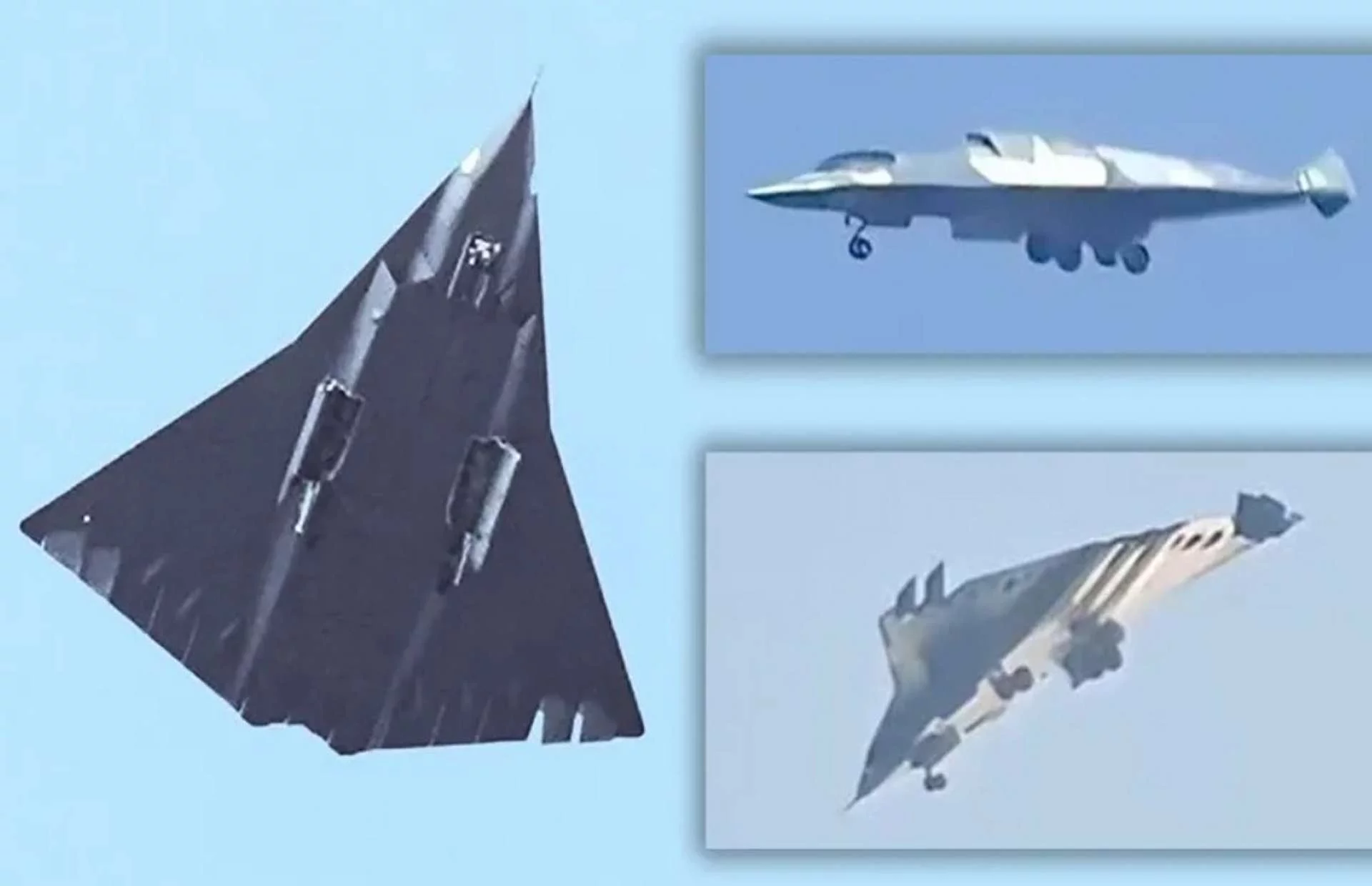
Fresh images of China’s sixth-generation fighter prototypes reveal significant design updates — including a heavy, tailless tri-engine jet now featuring angular, two-dimensional exhausts reminiscent of the F-22. The visible evolution suggests Beijing is accelerating its push toward a formal flight test campaign, compressing development timelines in the global air superiority race.
According to the South China Morning Post (3 November 2025), a second prototype tied to the Chengdu design bureau now features revised intakes, landing gear, and exhausts, about ten months after the first sightings. The tempo of visible testing indicates a program moving from factory trials to active airfield operations at western Chinese ranges.
Rapid Iteration and Tri-Engine Innovation
Imagery since late August shows both the heavy tailless airframe and a slimmer variant conducting taxi and flight runs, confirming an unusually open development cadence. The tri-engine layout and adoption of 2D thrust-vectoring exhausts point to a design focused on balancing low observability, control authority, and heat management at high performance levels.
Early flight articles are believed to use WS-10 class engines, transitioning to WS-15 powerplants once maturity is achieved — mirroring China’s approach with the J-20.
Unconfirmed “J-36” Label
Beijing has not officially named the aircraft, though state-linked media continue to reference it informally as the J-36. While imagery authenticity remains under review, official silence coupled with public sightings effectively confirms that a heavy, stealthy, tailless fighter is in active development.
Stealth Materials and Propulsion Advances
In late 2024, China published a new stealth material testing standard emphasizing wideband radar absorption while minimizing thickness and weight — a benchmark aligning with sixth-generation requirements. At the same time, research institutes announced superalloy cooling improvements to support higher turbine temperatures and longer engine life, crucial for sustained thrust and onboard power generation in large stealth aircraft.
A Dual-Track Development Strategy
Open-source reporting suggests China is sustaining two sixth-generation programs — one centered on Chengdu and another on Shenyang — fostering internal competition similar to the U.S. YF-22/YF-23 era. This dual-track strategy aims to secure a diversified portfolio rather than a single platform, complicating foreign planning and test pacing.
Global Implications: Pressure on U.S. and Europe
The U.S. Air Force’s Next Generation Air Dominance (NGAD) initiative remains funded but under close scrutiny from Congress due to rising costs and timeline slippage. NGAD aims for a combat radius exceeding 1,000 nautical miles, higher speeds than the F-22, and deep integration with Collaborative Combat Aircraft (CCA). If China fields its heavy stealth jet sooner than anticipated, it could compress NGAD’s timeline and challenge U.S. aerial dominance assumptions.
Europe’s parallel efforts are also in flux. The UK-Italy-Japan GCAP targets 2035 for entry into service, while the Franco-German-Spanish FCAS has seen delays and leadership tensions that could push operational readiness past 2040.
From Speculation to Structured Program
The redesigned exhausts on the second heavy prototype indicate that China is closing on key solutions in thrust vectoring and thermal control — two of the toughest challenges in stealth fighter engineering. Combined with tighter stealth material standards and maturing propulsion research, China’s sixth-generation program now appears systematic, deliberate, and increasingly real — a signal that the next phase of the air superiority race has already begun.
