

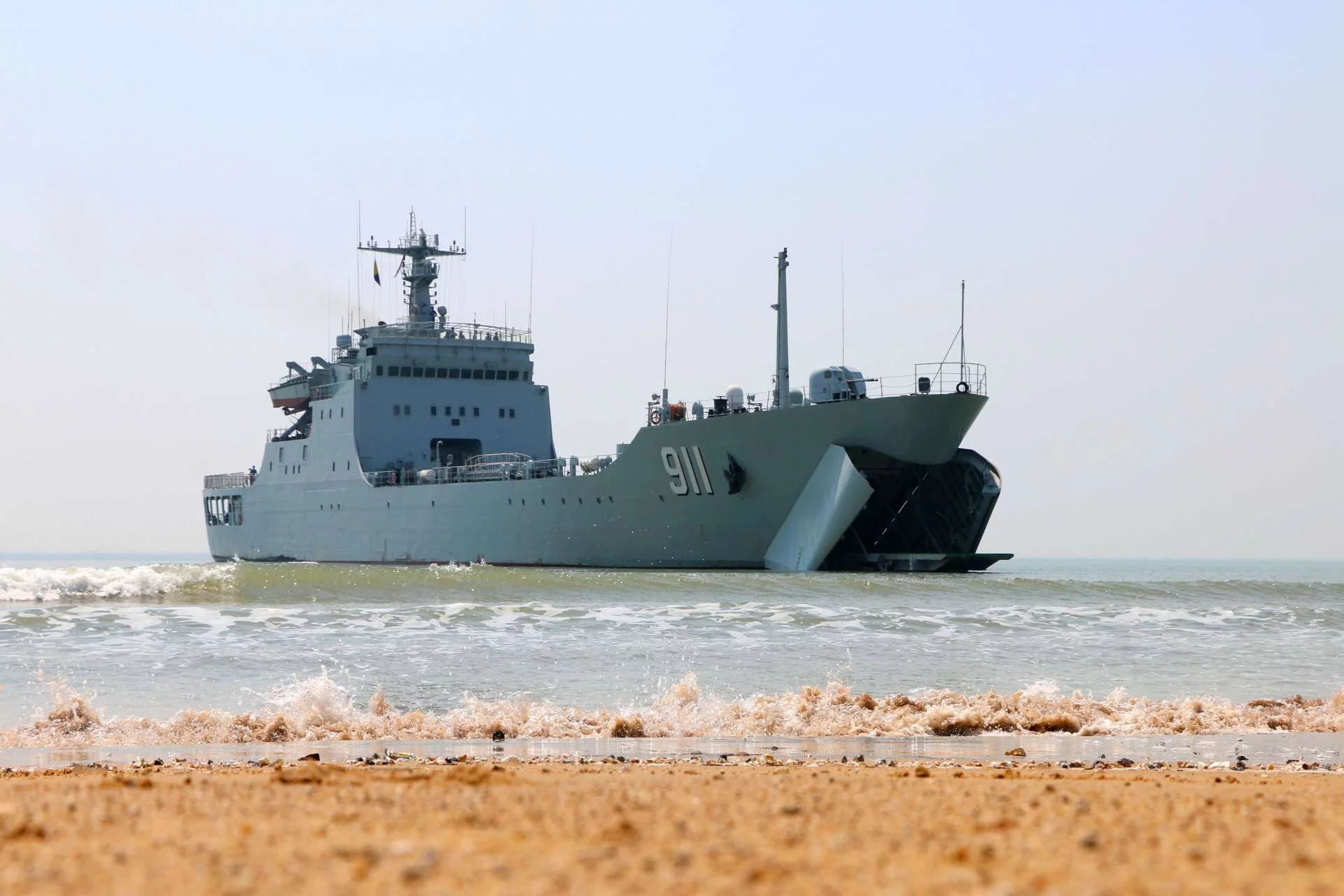
The recent detection of China’s Type 072A amphibious landing ship close to Taiwan’s northern coast has intensified discussions about Beijing’s amphibious warfare capabilities and the implications for Taiwan’s defense posture. Reports from Focus Taiwan indicate that the vessel was observed roughly 60 nautical miles northeast of Keelung, an unusually close proximity that Taiwan’s military interprets as part of China’s escalating gray-zone activities. While Taiwan’s Ministry of National Defense (MND) confirmed the ship did not breach Taiwan’s contiguous zone, it emphasized that naval, air, and ground forces closely tracked its movements. This rare close encounter with such a significant amphibious asset near northern Taiwan’s strategic locations highlights rising tensions in the Taiwan Strait. Taiwan’s Navy Chief of Staff, Chiang Cheng-kuo, acknowledged that the ship’s position places it within striking distance of key infrastructure.
Analysts suggest this maneuver aims to probe Taiwan’s surveillance and response capabilities while signaling China’s ability to conduct amphibious assaults near densely populated areas. The Type 072A landing ship is a large-scale amphibious platform with a displacement of 3,770 metric tons, capable of transporting 10 tanks, 250 troops, two medium helicopters, and four landing craft. Compared to older Type 072II and smaller Yuting-class ships, the Type 072A offers significantly greater transport capacity and operational flexibility. Its helicopter capability extends operational reach beyond immediate landing zones, enabling rapid deployment further inland.
Lin Yu-feng, a former officer at the Air Force Institute of Technology, told Focus Taiwan that forces landing from this ship could directly threaten critical military and government centers in Taipei’s Dazhi District, including the Ministry of National Defense and the Joint Operations Command Center. This underlines Taiwan’s exposure to multidomain amphibious attacks capable of bypassing coastal defenses to strike strategic inland targets.
Strategically, the Type 072A’s presence so near northern Taiwan sends a strong message amid rising cross-strait tensions. Su Tzu-yun, a research fellow at the Institute for National Defense and Security Research, emphasized that while Taiwan must remain vigilant and prepared, it should also avoid overextending naval patrols that could deplete resources over time. The Ministry of National Defense stated it will continue to respond proportionately and adaptively, leveraging joint intelligence and surveillance assets to maintain situational awareness.
This development raises broader concerns about China’s amphibious warfare strategy and its potential use of psychological pressure and gray-zone tactics to coerce Taiwan. With regional players increasingly attentive to such maritime maneuvers, the incident underscores the urgency for Taipei to upgrade coastal defenses, improve early warning systems, and strengthen regional security collaboration to deter amphibious threats.
The close approach of the Type 072A demonstrates Beijing’s ongoing efforts to sharpen and showcase its amphibious capabilities within its wider cross-strait strategy. Taiwan’s military faces the challenge of countering these threats without exhausting its naval and surveillance assets. As power dynamics evolve in the Taiwan Strait, each new Chinese maneuver serves as a stark reminder that amphibious assault remains a central security concern shaping Taiwan’s defense planning for the foreseeable future.
