

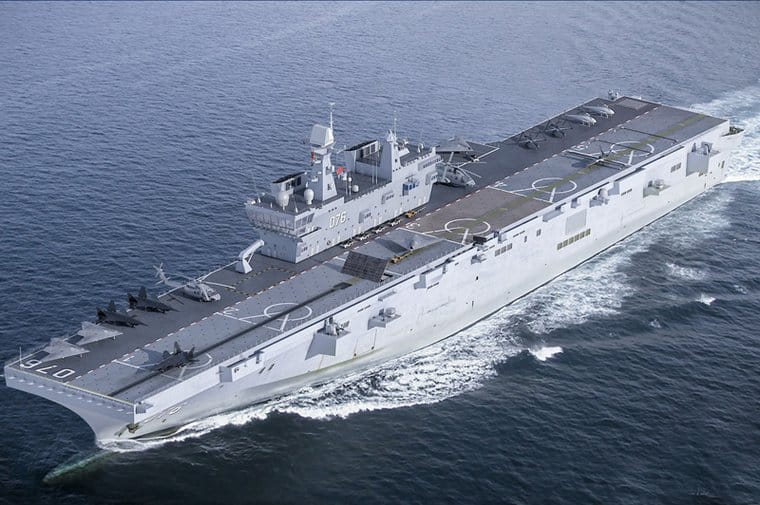
China’s newly introduced Type 076 amphibious assault carrier has captured global naval attention with its 263-meter hull length and roughly 50,000-ton displacement—figures that place it ahead of France’s nuclear-powered Charles de Gaulle in both size and tonnage. Defense analysts note that the platform represents a significant shift in China’s force projection model, emphasizing rapid, drone-enabled amphibious operations around Taiwan and the eastern coastline.
Early assessments highlight that the Type 076 is not a traditional aircraft carrier but a hybrid assault platform designed to deploy large numbers of unmanned systems, helicopters, and amphibious forces. Its expanded flight deck, deep internal hangar, and drone-oriented architecture reflect China’s intention to dominate short-range, high-intensity battlespaces within the “first island chain.”
France’s Charles de Gaulle maintains superiority in fixed-wing aviation with its CATOBAR system, enabling Rafale M fighters and E-2C Hawkeyes to conduct long-range strike, air superiority, and ISR missions. Its nuclear propulsion also grants unmatched endurance for blue-water operations across distant theaters.
The Type 076, however, serves a different strategic vision. The vessel is expected to operate 20–30 helicopters and VTOL-capable UCAVs, including the Z-8 and Z-20 transport helicopters and advanced stealth drones such as the GJ-11 Sharp Sword. These platforms will perform strike missions, electronic warfare, and persistent ISR from the sea—forming the backbone of the ship’s offensive capability.
Analysts argue that the Type 076 blends multiple roles: amphibious assault ship, drone command hub, and operational flagship. The potential inclusion of electromagnetic launch systems indicates China’s pursuit of high-tempo drone swarm operations at sea, a capability that could reshape conflict dynamics in the Taiwan Strait.
The vessel’s large well deck is designed to deploy LCACs and amphibious armored vehicles, enabling massed landings under the cover of drone-based suppression. Such an approach would allow Chinese forces to bypass chokepoints and establish beachheads rapidly during a cross-strait contingency.
The timing of the Type 076’s testing phase, coinciding with intensified PLA amphibious drills near Fujian, further underscores the platform’s expected role in future large-scale regional operations. Analysts conclude that the Type 076 is more than a new ship—it marks a doctrinal pivot toward preparing for high-intensity, regionally focused conflict. If built in numbers, the class could redefine modern amphibious warfare through integrated drone, helicopter, and mechanized assault capabilities, significantly impacting the strategic landscape around Taiwan.
