

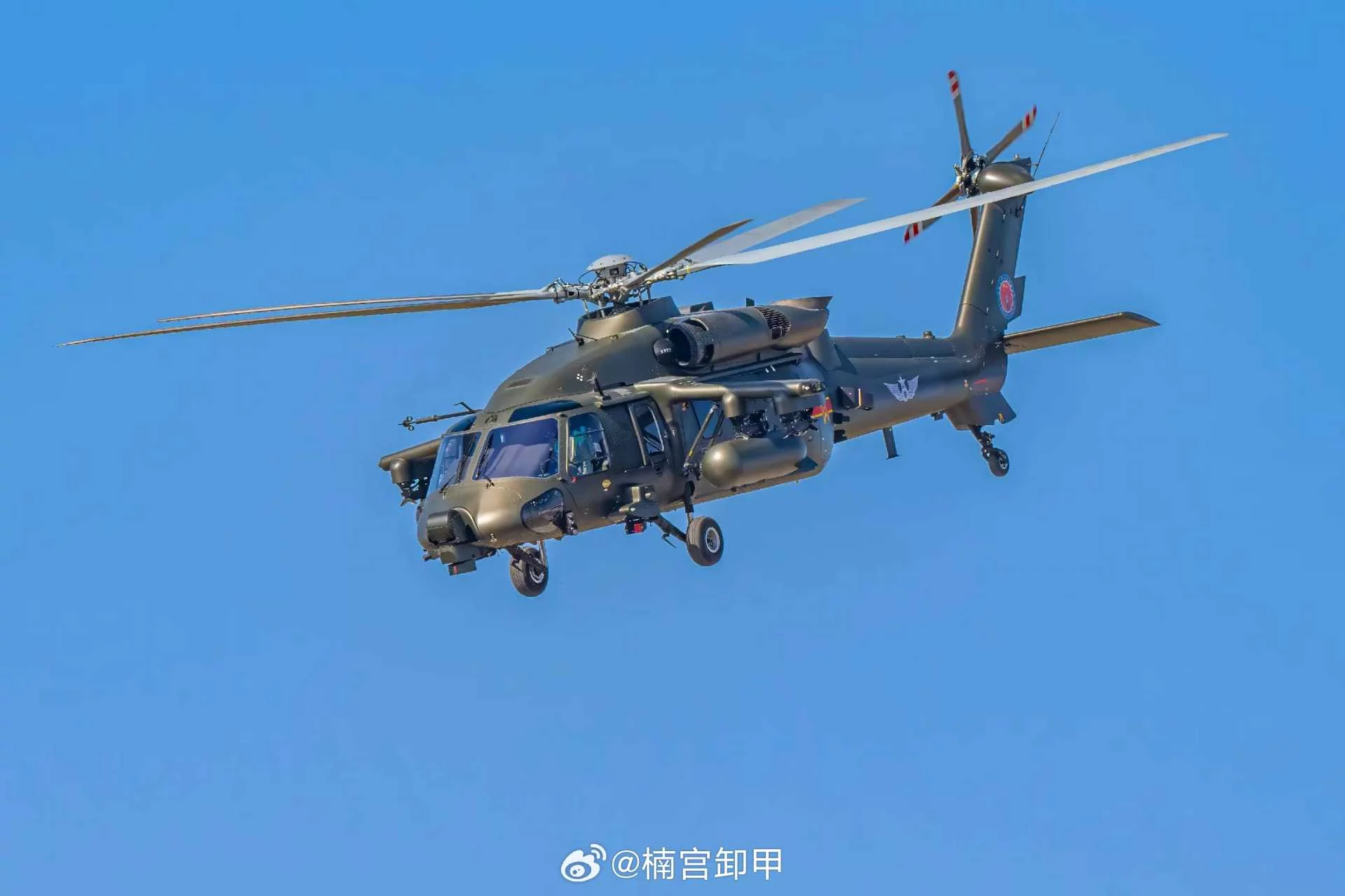
China has officially introduced its new Z-20T assault helicopter, a heavily armed derivative of the Z-20 utility platform, during the 7th China Helicopter Exposition in Tianjin (October 16–19). Developed by the Aviation Industry Corporation of China (AVIC), the Z-20T represents Beijing’s most ambitious attempt yet to match — and potentially surpass — the performance envelope of the U.S.-made UH-60 Black Hawk.
Making its first full public flight demonstrations after a brief appearance in the September Victory Day parade, the Z-20T performed precision maneuvers including hovering turns, steep climbs, and flare releases, underscoring its intended role as a multirole air-assault platform for operations in mountainous, coastal, and urban environments. AVIC describes it as a modular aircraft combining troop lift, direct fire support, and special-operations insertion capabilities.
Derived from the baseline Z-20 tactical utility helicopter—itself modeled after the Sikorsky S-70C-2 Black Hawk once exported to China—the Z-20T features detachable stub wings with four hardpoints for ATGMs, rocket pods, or auxiliary fuel tanks, enabling quick mission reconfiguration. It can carry 12–14 fully equipped troops internally or sling-load up to 4 tonnes externally, with a maximum takeoff weight around 10 tonnes and a top speed of 360 km/h. High-altitude performance allows operations up to 6 km elevation, covering Tibetan plateau regions.
Propulsion comes from twin 1,600 kW WZ-10 turboshaft engines driving a five-bladed composite main rotor. Exhaust diffusers direct heat upward to lower the infrared signature, while a digital fly-by-wire system and active vibration suppression improve handling at low altitude and in adverse weather. The glass cockpit integrates multiple multifunction displays, advanced flight management, and BeiDou satellite navigation for precision flight in degraded visibility.
Sensors include a nose-mounted EO/IR turret, weather and terrain-following radar, and an anti-collision radar, all tied to onboard health and usage monitoring and electronic self-diagnostics. Defensive aids comprise missile and radar warning receivers, flare/chaff dispensers, and directional infrared countermeasures.
The Z-20T’s primary weapons are AKD-9 and AKD-10 anti-tank missiles with ranges of 2–7 km and penetration of up to 1,400 mm, roughly comparable to the AGM-114 Hellfire. Other compatible ordnance includes the longer-range AKD-21, TY-90 air-to-air missiles, and standard 57/90 mm rocket pods. Optional door-mounted heavy machine guns and a chin-mounted cannon can provide suppressive fire during insertions.
The aircraft’s lineage traces back to China’s need for an indigenous Black Hawk-class platform after U.S. arms embargoes in 1989. The original Z-20 first flew in 2013 and entered service in 2018; since then, specialized variants have appeared for anti-submarine warfare (Z-20F), naval transport (Z-20J), and search and rescue (Z-20S).
Within the PLA’s expanding air-assault brigades, the Z-20T will operate alongside Z-10 and Z-21 attack helicopters and deploy from Type 071 and Type 075 amphibious ships. Its modular design and fully domestic supply chain promise rapid reconfiguration and easier maintenance in sustained operations.
While visually reminiscent of the Black Hawk, the Z-20T differs in key engineering aspects — notably its five-bladed rotor, higher engine power, and digital flight controls — giving it potentially superior performance in high-altitude and high-temperature conditions. Analysts widely regard the aircraft as China’s most capable Black Hawk-class competitor to date and a central element in the PLA’s push for rapid-deployment and island-assault capabilities.
