

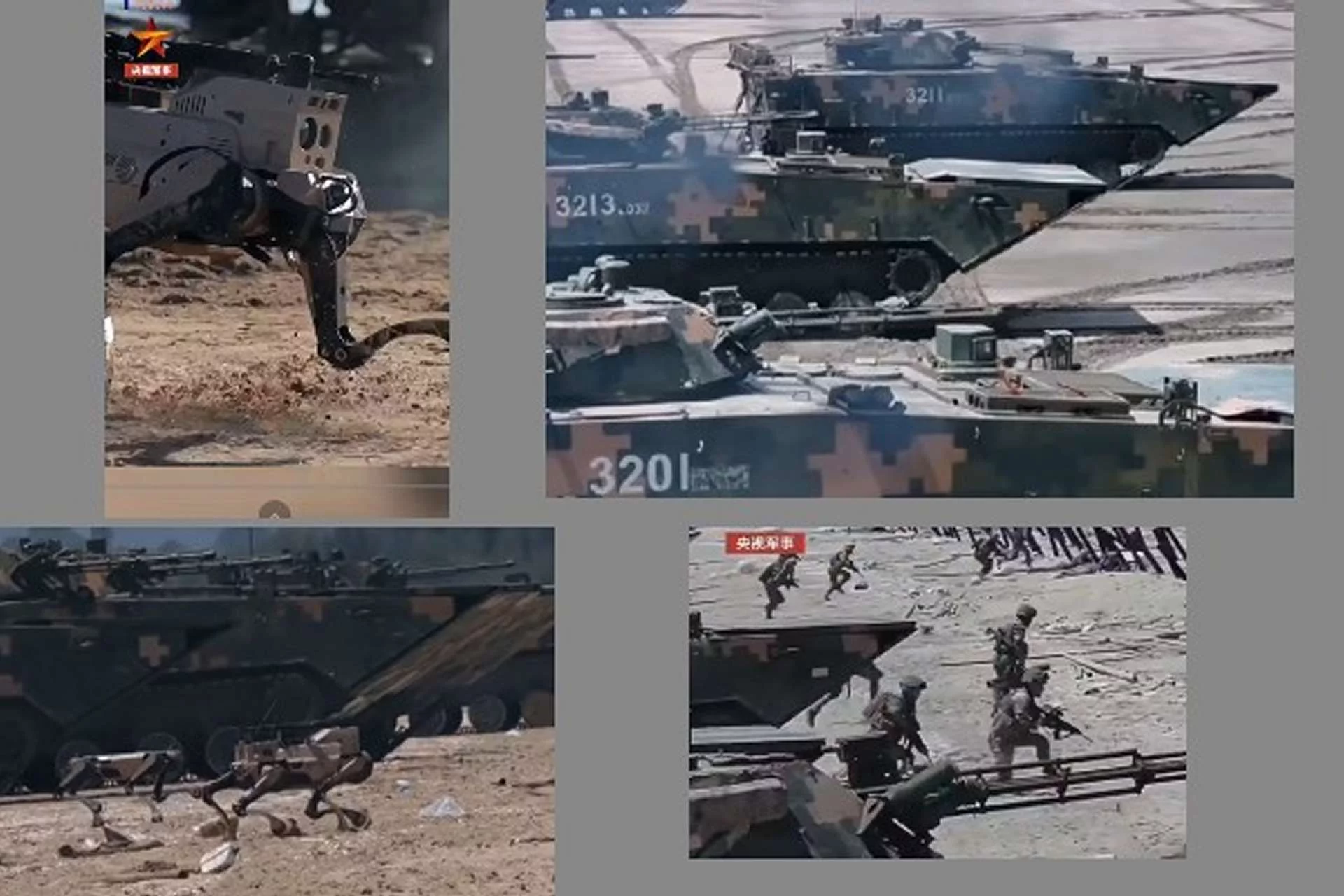
China’s People’s Liberation Army (PLA) recently released new footage showcasing an amphibious landing exercise near Taiwan, integrating four-legged robot dogs with various classes of unmanned aerial vehicles (UAVs). The scenario, amplified by state media, highlights Beijing’s intent to blend attritable ground robots with infantry at the beachhead. Crucially, it also exposes potential control, survivability, and logistics vulnerabilities that opposing forces could exploit.
Drill Details and Strategic Significance
The newly aired footage depicts a large-scale amphibious landing drill conducted on October 28, 2025, where the PLA demonstrated manned-unmanned teaming (MUM-T) by deploying robot dogs alongside aerial drones. This highly publicized vignette arrives amidst heightened PLA activity around the Taiwan Strait and escalating political tension. Its significance lies in demonstrating how Beijing intends to fuse expendable robotics with amphibious assault units, a shift that has direct consequences for Taiwan’s defense planning and allied force design.
| System | Role in the Scenario | Key Function |
| FPV Quadcopters | Striking designated firing points | Suppression of defender positions |
| Reconnaissance Drones | Mapping defenders, cueing follow-on elements | Providing situational awareness and targeting data |
| Explosive-Laden Robot Dogs | Sprinting across trenches and barriers to blast lanes | Breaching beachhead obstacles |
| Ammunition-Shuttling Robot Dogs | Resupplying dispersed infantry squads | Last-meter logistical support |
| Gun-Bearing Robot Dogs | Accompanying paratrooper infiltration teams | Close fire support for deep maneuvers |
The central operational emphasis is on maintaining momentum despite route congestion and distributing lethality across cheap, attritable systems to preserve human assault echelons.
Development and Employment Concept
Chinese laboratories and defense firms have rapidly developed legged platforms since 2023, focusing on payload capacity, autonomy, and low-cost manufacturing. The PLA’s current doctrine deploys these robots in expendable, mission-specific roles, rather than as independent maneuver units:
- Obstacle reduction (Breaching).
- Last-mile resupply.
- Point fire support.
Comparative Advantage and Disadvantage:
- Advantage: Saturation of the breach area with numerous cheap robots, cued by abundant Intelligence, Surveillance, and Reconnaissance (ISR) assets.
- Disadvantage: Legged platforms remain slow, noisy, thermally conspicuous, and fragile under direct fire and fragmentation. The concept trades individual platform survivability for assault tempo.
Strategic Implications
The exercise signals three primary strategic implications:
- Geopolitical: It advertises to regional audiences that Beijing is normalizing MUM-T amphibious task organization as part of routine signaling around Taiwan.
- Geostrategic: It aligns with the focus on control and blockade: robotic breaching at key beaches, paired with drone-enabled precision strikes and deep infiltrations, aims to present Taipei with simultaneous dilemmas across coastal defenses and key infrastructure.
- Military: It foreshadows a contest of adaptation cycles: Taiwan and its partners will deploy denser Counter-UAS, decoys, and mobile reserves; the PLA will respond with thicker ISR layers and EW-resistant links.
The net effect is to push the initial hours of any landing toward higher attrition and faster decision timelines. While robots absorb some losses, they do not eliminate the need for infantry to close and breach under fire.
