

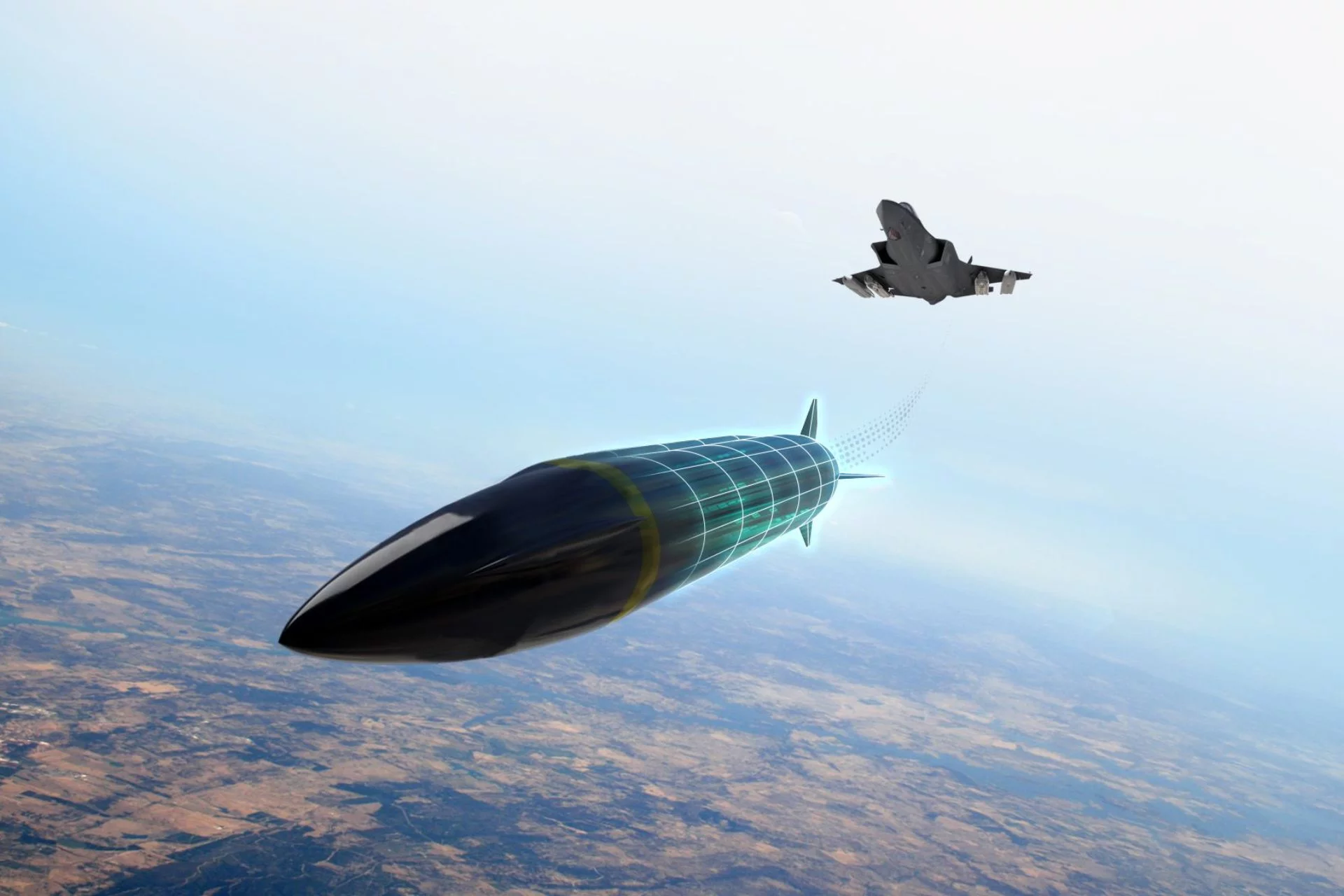
Lockheed Martin’s Mako hypersonic missile is designed to reach speeds of Mach 5 while maintaining compatibility with a broad spectrum of U.S. aerial platforms. Its compact form, modular architecture, and ability to fit inside the internal weapon bays of F-22 and F-35 stealth fighters mark a breakthrough in hypersonic weapon design—long constrained by size and integration limits. This adaptability could reshape U.S. long-range strike capabilities at a time when hypersonic dominance is becoming critical to operational superiority.
Launched in 2017 under the U.S. Air Force’s Stand In Attack Weapon (SiAW) program with approximately $35 million in funding, Mako was conceived to penetrate A2/AD defenses and neutralize high-value targets—particularly in response to China’s growing influence in the Asia-Pacific. Measuring 3.6–4 meters in length, 33 cm in diameter, and weighing around 590 kg, it can carry 60 kg modular warheads with various guidance packages. Its open digital architecture supports rapid upgrades and cost-efficient modernization.
Physical tests confirmed internal carriage on F-22 and F-35A/C, with external compatibility across F-15E, F-16C, F/A-18 Super Hornet, EA-18G Growler, and P-8A Poseidon. Virtual assessments validated internal carriage on B-1B, B-52H, and the future B-21 Raider. With 30-inch standard lugs, the Mako could be integrated across most U.S. platforms, and—when paired with a booster—launched from U.S. Navy vertical launch systems, similar to the AGM-158C LRASM.
This multi-platform compatibility enables innovative tactics: fifth-generation fighters could act as forward scouts for target acquisition, passing data to fourth-generation aircraft equipped with Sniper pods and Mako missiles to execute strikes—maximizing firepower while leveraging each platform’s strengths. Powered by a solid-fuel rocket motor, Mako sustains Mach 5 speeds at altitude with high maneuverability, drastically reducing enemy reaction times. Additive manufacturing of components like the seeker fairing and control surfaces accelerates production, while advanced digital engineering enables virtual testing and rapid iteration.
Strategically, Mako is positioned against China’s YJ-21 hypersonic missile developments, potentially narrowing the capability gap and reinforcing U.S. deterrence. The program also aligns with allied initiatives, as the UK Ministry of Defence evaluates Mako under potential AUKUS cooperation for sovereign hypersonic capability by 2030. Initial production could start in the UK before shifting to the U.S., fostering joint industrial and technological development with British and Australian partners.
Although it has yet to secure full production funding, the U.S. Navy’s inclusion of Mako under the Other Transaction Authority (OTA) could fast-track procurement. If adopted, Mako would combine speed, flexibility, and broad integration potential—positioning it as a key U.S. strike asset across both air and naval operations for decades to come.
