

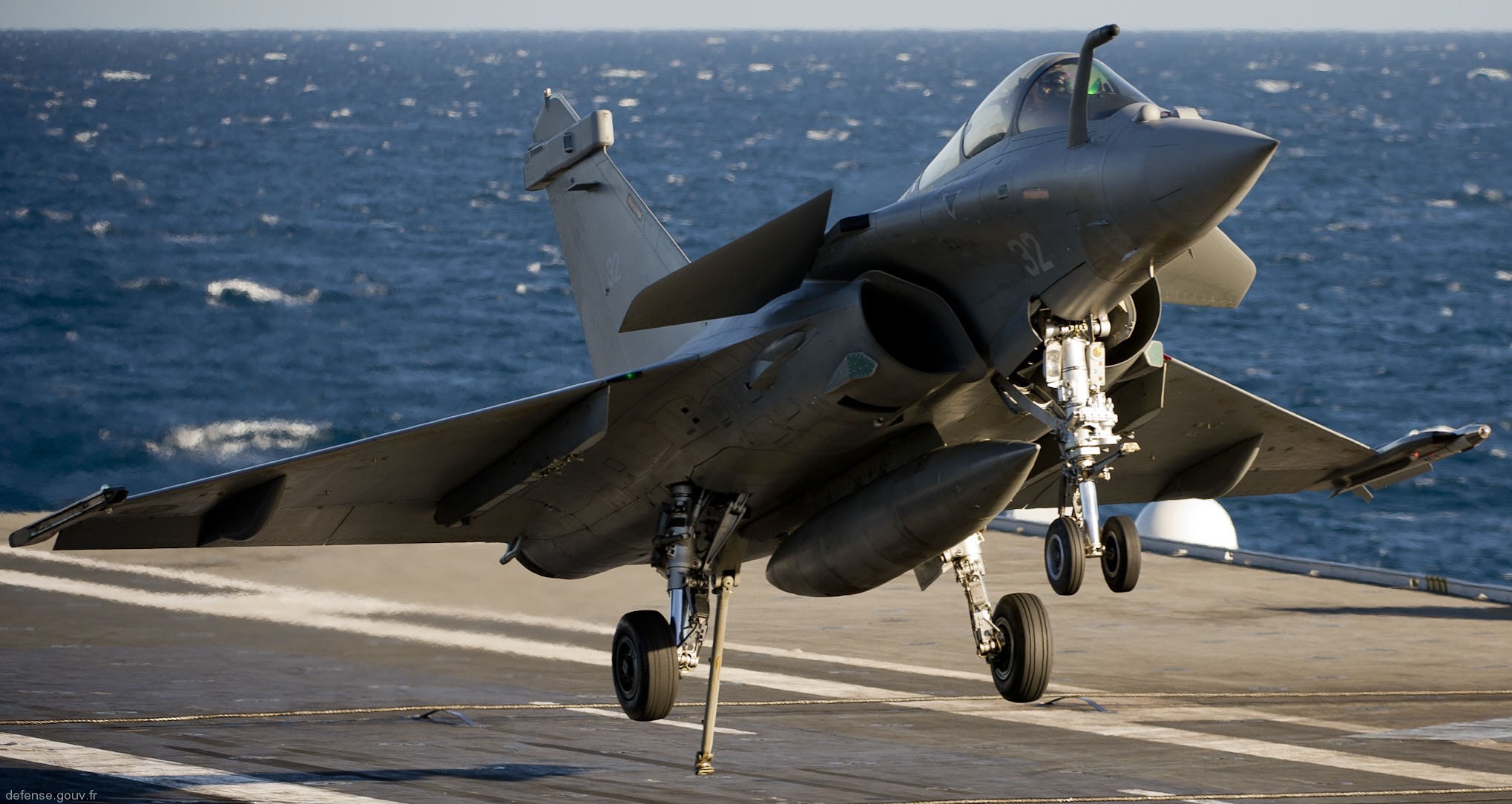
The Dassault Rafale M is a twin-engine, carrier-capable multirole fighter developed by France’s Dassault Aviation. As the naval variant of the Rafale family, the Rafale M is specifically engineered for aircraft carrier operations and serves exclusively with the French Navy, reflecting France’s commitment to advanced naval air power. The aircraft combines air superiority, strike, reconnaissance, and nuclear deterrence capabilities, providing a versatile platform for modern maritime operations.
Development History
The Rafale M originated in the early 1980s to replace France’s aging fleet of F-8 Crusaders and Super Étendards. The French Navy required a high-performance fighter capable of fleet defense, precision strike, reconnaissance, and nuclear missions. The first flight of the Rafale M took place on 12 December 1991, with operational entry in 2001 after extensive trials. Unlike land-based Rafale variants, the M version is reinforced for the intense stresses of catapult launches and arrested carrier landings, with specialized landing gear, an integrated tail hook, and a catapult-compatible nose wheel.
Naval Adaptations & Capabilities
The Rafale M is designed for exceptional performance aboard carriers, requiring only 105 m for landing and 112 m for catapult-assisted takeoff. Its reinforced airframe and landing gear handle high-impact carrier operations, while corrosion-resistant coatings protect critical systems against harsh maritime conditions. A retractable in-flight refueling probe extends mission endurance when paired with carrier-based or aerial tankers.
The cockpit is a single-seat glass design featuring multifunction displays, a wide-angle HUD, and Hands-On Throttle And Stick (HOTAS) controls, allowing the pilot to manage all essential flight and combat systems efficiently. Ergonomics and advanced avionics reduce pilot workload and enhance situational awareness during complex carrier missions.
Design Features
- Delta wing and canard configuration for high agility and aerodynamic efficiency
- Length: 15.27 m | Wingspan: 10.08 m | Height: 5.34 m
- Empty weight: ~11,000 kg
- Airframe uses ~70% composite materials for weight reduction, strength, and radar signature reduction
- Reinforced undercarriage with twin-wheel nose gear
- Integrated tail hook and catapult-compatible nose tow bar
Armament
The Rafale M supports a multirole weapons loadout with thirteen hardpoints:
- Internal Cannon: GIAT 30M791, 30 mm, 125 rounds
- Air-to-Air: MBDA MICA IR/EM, MBDA Meteor beyond-visual-range missile
- Air-to-Ground: AASM Hammer, GBU-12 Paveway II, GBU-24 laser-guided bombs, SCALP-EG cruise missile
- Anti-Ship: AM39 Exocet missile
- Nuclear Strike: ASMP-A missile
- Reconnaissance/Support: Reco NG pods, external fuel tanks for extended range
Engine & Performance
Powered by two Safran M88-2 afterburning turbofans, each delivering 50 kN dry thrust and up to 75 kN with afterburner, the Rafale M achieves:
- Maximum Speed: Mach 1.8 (~1,912 km/h)
- Combat Radius: ~1,850 km
- Ferry Range: >3,700 km with external tanks and in-flight refueling
- Service Ceiling: ~50,000 ft (~15,240 m)
The engines feature FADEC for precise thrust management, rapid throttle response, and optimized fuel efficiency, while corrosion-resistant materials ensure reliability in maritime environments. Twin engines provide redundancy for safe overwater operations.
Avionics & Systems
- Thales RBE2-AA AESA radar for multi-target tracking and high-resolution mapping
- SPECTRA electronic warfare suite (radar, laser, missile warnings, jamming, and decoys)
- Thales Damocles or TALIOS targeting pods for laser designation, IR imaging, and reconnaissance
- INS/GPS navigation
- Link 16 secure datalink for interoperability
- Helmet-mounted display and HOTAS controls for streamlined operations
- Voice command system for reduced pilot workload
Variants
- F1: First operational, air-to-air only, entered 2001
- F2: Full multirole capability with air-to-ground and Exocet integration
- F3: Added nuclear strike (ASMP-A), SCALP missile, reconnaissance, Meteor missile support
- F3R: Mid-life upgrade with full AESA radar, Thales TALIOS pod, improved electronic warfare suite
- F4 (current/upcoming): Advanced AI pilot assistance, improved sensors, connectivity, new weapon systems, UAV operations
