

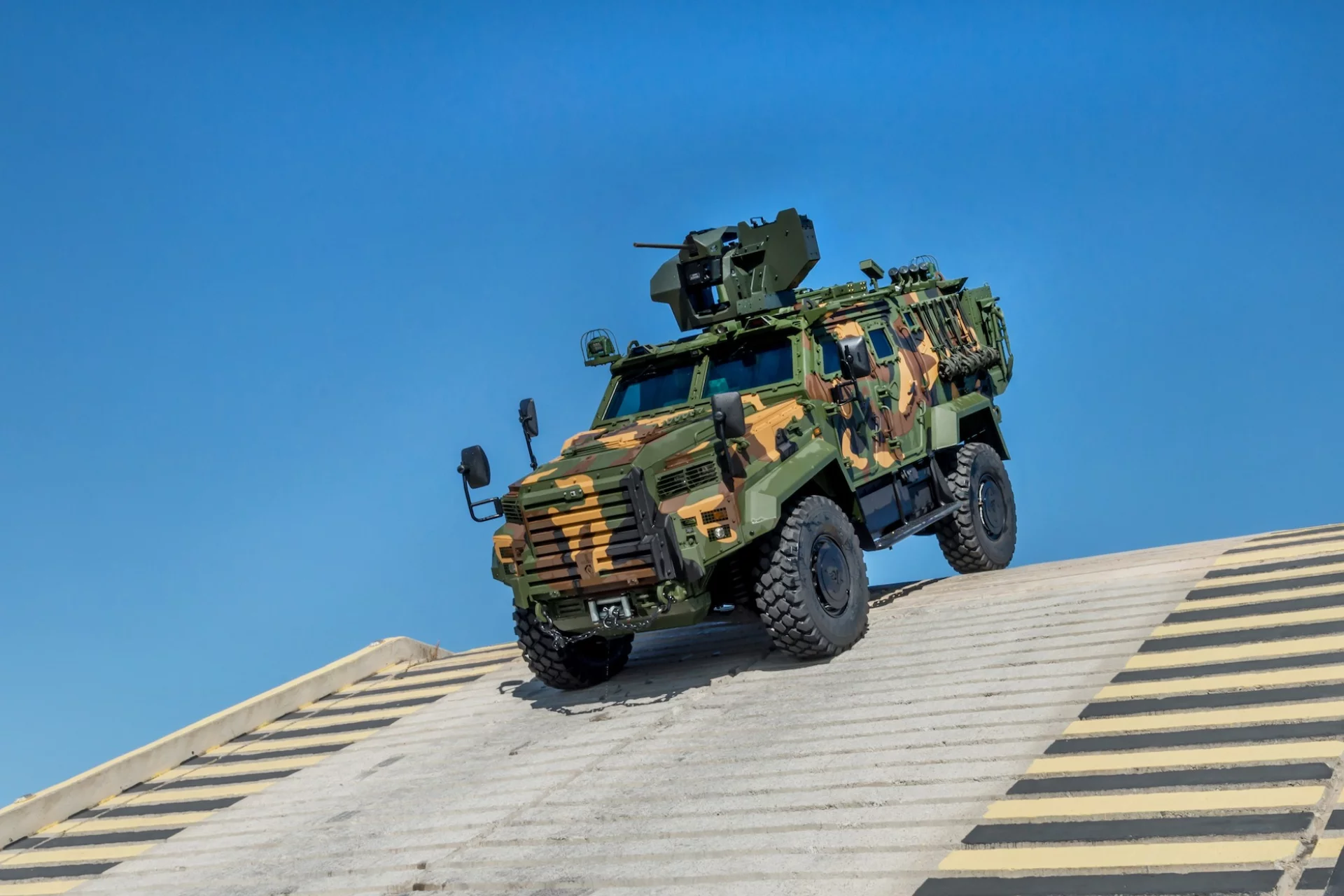
In June 2025, Turkey-based defense manufacturer Nurol Makina and Hungary’s Rába Automotive reached a new milestone by delivering 56 additional Gidran armored vehicles to the Hungarian Armed Forces. This delivery, part of Hungary’s comprehensive defense modernization program, aims to significantly boost the army’s mobility, protection, and rapid response capabilities. It also symbolizes the deepening defense cooperation between Turkey and Hungary amid ongoing efforts to align with NATO standards and meet the growing demand for mobility and survivability on Europe’s eastern flank.
The Gidran, developed by Nurol Makina and based on the combat-proven Ejder Yalçın 4×4 platform, is a multi-purpose tactical armored vehicle. With a 14-ton structure, STANAG 4569 Level 3b ballistic and mine protection, a 375-horsepower Cummins ISL9E3 diesel engine, and a range of up to 700 km, it delivers high performance under modern battlefield conditions. The vehicle is equipped with ASELSAN’s SARP remote-controlled weapon system, compatible with either a 12.7 mm heavy machine gun or a 40 mm grenade launcher. Upon arrival in Hungary, each vehicle is upgraded with national-standard communication systems to achieve full combat readiness.
The presence of the Gidran in the Hungarian military became possible thanks to a localization agreement signed in 2023 between Nurol Makina and Rába. This vehicle, domestically produced to suit Hungary’s geographical terrain, logistics, and military doctrine, represents a concrete step toward reducing foreign dependency in the Hungarian defense industry.
Among European light armored vehicles, the Gidran stands out with its advanced mine protection, off-road capability, and modular adaptability. Compared to counterparts such as France’s Sherpa Light or Germany’s Fennek, the Gidran offers stronger engine power and a better payload-to-weight ratio, ensuring more effective performance in challenging terrain. While the Sherpa focuses on rapid intervention and the Fennek on reconnaissance, the Gidran offers a more balanced, multi-role platform with heavier armor and scalable weapon configurations, making it advantageous in hybrid threat environments.
Strategically, Hungary’s decision to acquire the Gidran is not merely a technical procurement but also a political move to strengthen NATO’s eastern posture. Partnering with Turkey—a fellow NATO ally with a rapidly growing defense industry—helps Hungary diversify its suppliers and boost its own defense autonomy. The Gidran enhances Hungary’s mobility and deterrence along its eastern borders, especially in the face of hybrid threats and conventional risks.
The delivery of 56 Gidran vehicles marks a pivotal moment in the transformation of the Hungarian Defense Forces—not just technically, but strategically. Through this partnership, Nurol Makina secures a stronger position in the European armored vehicle market, while Hungary takes a major step toward building a more resilient and prepared military force in response to evolving regional threats. This cooperation reflects the tangible rise of Turkish defense technology in Eastern Europe.
