

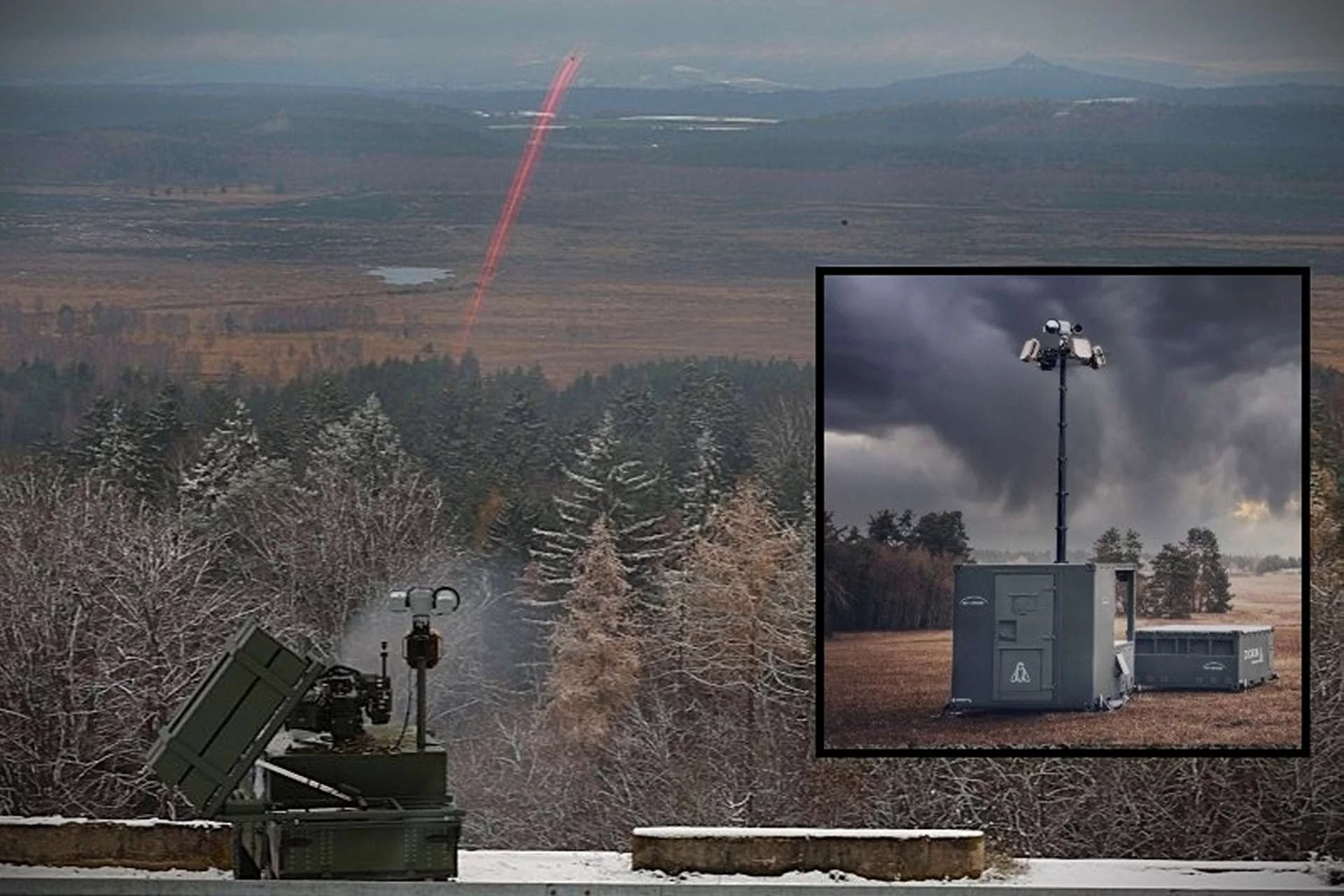
Diehl Defence has completed a series of live trials at the Grafenwoehr training area in Germany, demonstrating the integration of its Kinetic Defence Vehicle (KDV) and CICADA eMissile into the modular Sky Sphere counter-drone architecture. The tests underscored Europe’s push to adapt to cheap UAVs and loitering munitions reshaping warfare from Ukraine to the Middle East.
KDV and CICADA Systems
The trials validated two complementary effectors:
- KDV, a mobile, vehicle-mounted counter-UAS platform with radar, EO/IR sensors and a remote weapon station for short-range engagements.
- CICADA, an electrically powered missile tailored for NATO Class I and smaller Class II UAVs, supporting both lethal fragmentation and non-lethal net capture payloads.
Both were integrated within Sky Sphere to demonstrate a cohesive, close-in defence layer.
From Prototype to Operational Use
The campaign marked the transition from exhibition prototypes to deployable platforms. Earlier showcased at Enforce Tac 2025, the upgraded KDV now features improved sensors, AI-enhanced target recognition and expanded effector options. A containerized Sky Sphere module evaluated detection-to-engagement performance under dynamic conditions, including a longer-range effector for fixed-wing threats.
Layered Defence Role
Diehl’s approach emphasizes mixing effectors at multiple cost and force levels. Against small, inexpensive drones, using high-end SAMs like IRIS-T SLM is inefficient; KDV and CICADA provide scalable and economical alternatives. Sky Sphere’s modularity enables radar, EO sensors, kinetic effectors and future HPEM soft-kill additions to be combined in one architecture for bases, brigades or civilian sites.
Improved Response Cycle
Legacy counter-drone systems often rely solely on jamming or guns, each with limitations. Sky Sphere instead blends AI-assisted detection, automated cueing, and human-in-the-loop engagement, enabling faster response during swarm or saturation attacks while minimizing collateral risk.
Strategic Implications
The demonstrated capabilities position Germany and its industrial partners as providers of flexible C-UAS solutions for NATO and EU states. KDV secures mobile forces and logistics hubs, while containerized Sky Sphere units support fixed-site defence—addressing vulnerabilities seen on the Alliance’s eastern flank and in recent multinational exercises.
Global Relevance
Integrating CICADA and Sky Sphere into broader air-defence networks strengthens the lower tiers of protection, reducing the burden on high-end systems. For partners beyond Europe, such modular solutions offer a practical path to protect ports, bases and critical infrastructure without major upfront investment.
By proving the interoperability of KDV and CICADA within an AI-enabled sensor-to-shooter chain, Diehl Defence has shown that Europe can rapidly convert battlefield lessons into operational capability. Grafenwoehr’s results confirm that scalable and layered short-range counter-drone systems will be essential for NATO members confronting denser and more sophisticated UAV threats in the coming decade.
