

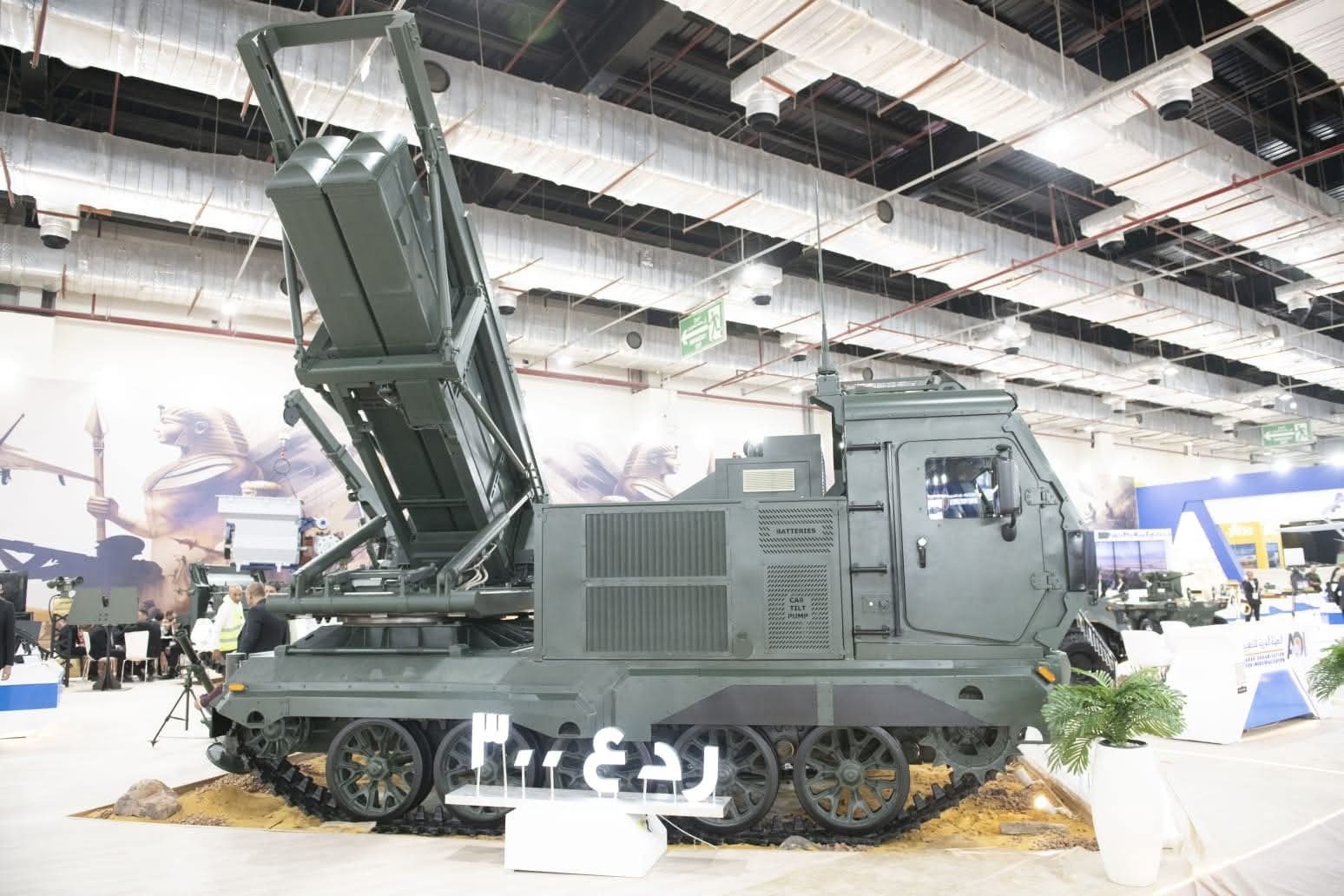
Egypt used the opening day of EDEX 2025 in New Cairo to publicly reveal the Rad’a 300 multi-calibre rocket system, a tracked long-range launcher built for 300 km-class strikes. The unveiling marks a major step in Egypt’s effort to localize deep-fire capabilities and reduce its dependence on foreign rocket artillery.
Presented by the Ministry of Military Production, the Rad’a 300 represents the new core of Egypt’s long-range artillery concept. Photos captured during the show confirm a fully enclosed launcher pod mounted on a tracked chassis derived from the earlier RAAD 200 family. While officials withheld detailed specifications, they indicated the system is intended for both precision strikes and area saturation missions within a 300 km envelope.
The launcher retains the basic mechanical layout of RAAD 200—five road wheels per side and an armored cabin—but replaces the former open-tube rack with a sealed factory-loaded pod. The tracked platform is capable of around 40 km/h across desert and rough terrain, placing it in the same operational bracket as ATACMS-equipped HIMARS or Brazil’s Astros II AV-TM 300 cruise missile launcher.
The podded launch architecture showcased at EDEX confirms Egypt’s shift toward modular, sealed rocket packs similar to the Chinese AR1A and the U.S. M270 series. This approach simplifies reload procedures, limits crew exposure, and allows multiple pod types to be swapped: everything from 122 mm saturation rockets to larger 300 mm guided rounds or quasi-ballistic missiles. Egyptian officials acknowledged the system’s multi-calibre design but did not specify the rocket types.
Rad’a 300 can be viewed as the culmination of Egypt’s experience with both the RAAD 200 and foreign long-range systems including Ukraine’s Vilkha-M, Brazil’s Astros II, and China’s A300 rockets. The result is a domestically controlled platform capable of delivering deep strike effects over long distances.
With a 300 km reach, the system allows Egyptian artillery to threaten air bases, logistics hubs, naval installations, and command centers along the Eastern Mediterranean and Red Sea without leaving national territory. It can fire large salvos for area neutralization or deliver precision attacks using guided rockets, mirroring the roles demonstrated by HIMARS and Vilkha-M in recent conflicts. The tracked chassis ensures mobility across soft desert terrain, aligning with the maneuver profile of Egypt’s mechanized formations.
Rad’a 300 is tailored for rapid “shoot-and-scoot” operations: batteries occupy surveyed firing points, receive targeting data via a digital fire control network, launch their pods in minutes, and relocate before enemy sensors can respond. As Egypt expands its drone fleet—including several new loitering munitions displayed at EDEX—UAV-assisted targeting and post-strike assessment will likely shape the system’s doctrine.
For export markets, the Rad’a 300 offers two key advantages:
• a sovereign long-range option for states unable to access U.S. or European rocket artillery;
• and an open pod architecture enabling licensed production or collaborative development of rockets, similar to partnerships seen with the Astros II ecosystem.
Mid-sized militaries could use Rad’a 300 as the backbone of a national fire brigade, supporting anti-invasion missions, coastal denial campaigns, or punitive strikes on hostile missile sites. When paired with 122 mm MLRS and 155 mm howitzers, it extends a layered fires structure out to 300 km rather than replacing existing systems.
Compared to HIMARS, AR1A, Astros II, or Vilkha-M, Egypt’s system may initially lack a mature missile portfolio, but it provides Cairo with sovereign control of a strategic weapon class and a scalable domestic launcher platform. For a country that has spent decades importing its heavy artillery, this shift marks a significant boost in industrial autonomy.
