

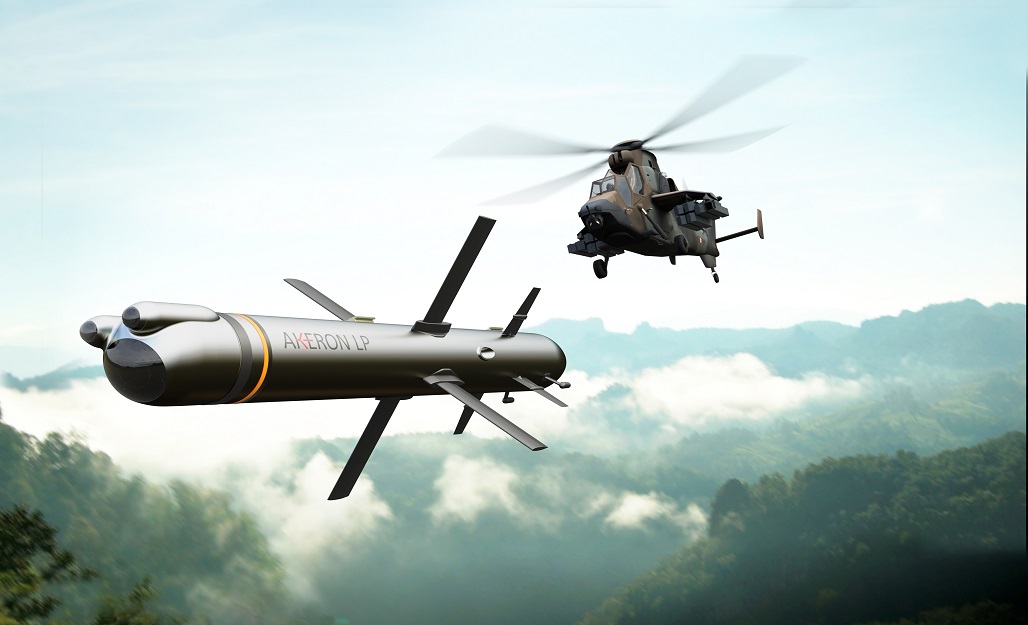
Milrem Robotics announced the successful integration and testing of MBDA’s long-range guided Akeron LP missile system on the Estonian-made Type-X Robotic Combat Vehicle under the Modular Architecture Solution for EU States (MARSEUS) project, supported by the European Defence Fund (EDF). At the demonstration, the RFHunter Direction Finder developed by Cyprus-based SignalGeneriX was also mounted on MBDA’s BLOS (Beyond Line of Sight) capable Akeron turret and put into operational use.
Under the MARSEUS framework, the Type-X platform proved its ability to engage targets beyond visual line of sight. According to statements by Milrem and SignalGeneriX founder Tasos Kounoudes, the system provides electromagnetic situational awareness by passively detecting hostile electromagnetic signals. This important milestone was achieved in cooperation with the Defense Ministries of France, Sweden, Belgium, and Cyprus, as part of a wider effort to integrate European-controlled BLOS missile systems with unmanned and manned platforms under EU design authority.
The MARSEUS program is a 36-month EDF-funded project that began in December 2022 and is planned to conclude in November 2025. Coordinated by MBDA France, it involves 15 companies and institutions from Belgium, France, Sweden, and Cyprus (including John Cockerill Defense, Arquus, FN Herstal, Novadem, Bull SAS, Exensor, BAE Systems Hägglunds, SAAB Dynamics, Xenics NV, the Royal Military Academy of Belgium, SignalGeneriX, Additess, and Delair). The total budget is approximately €27.3 million, of which €25 million is provided by the European Defence Fund. MARSEUS builds on the 2019 EDIDP LynkEUs project, continuing to develop collaborative BLOS strike capabilities across platforms.
The program aims to develop modular systems offering a common architecture usable on both unmanned and manned vehicles, scalable and adaptable to various operational environments. France, Belgium, and Cyprus signed the initial letter of intent in 2019, with Sweden joining through a memorandum of understanding in 2023.
Within the MARSEUS framework, robotic systems like the Type-X and manned vehicles such as the Arquus Sherpa are involved, with MBDA’s Akeron missiles serving as the main weapon systems. Tests have been carried out with live firing on IMPACT turret systems coordinated by unmanned aerial vehicles such as Novadem’s NX70. The project will continue until 2025 and include phases with human-in-the-loop and autonomous engagement modes. Development of loitering munitions and joint training modules is underway, along with the establishment of a unified European doctrine for BLOS systems. This architecture contributes to Europe’s strategic autonomy by reducing dependency and supply chain risks.
EU BLOS is a PESCO project launched in November 2018 focused on developing medium-range land battlefield missile systems fully controlled by EU member states. It enables firing with third-party designation from UAVs, reconnaissance assets, or fixed sensors. Key components include secure data links, autonomous/semi-autonomous guidance, and AI-supported targeting algorithms. The distinction between human-in-the-loop and human-on-the-loop systems is maintained. The LynkEUs project provided the technical foundation and demonstrated missile effectiveness through tests in Cyprus. MARSEUS standardizes this infrastructure to serve EU armed forces.
Milrem Robotics’ Type-X Robotic Combat Vehicle is a 12.5-ton tracked, hybrid-electric unmanned ground vehicle capable of carrying 5 tons of payload. It measures 6.2 m long, 2.9 m wide, and 2.5 m high. It can reach speeds of 80 km/h on paved roads and 50 km/h off-road. It can climb 60% slopes, surmount vertical obstacles up to 1 meter high, and ford water up to 1.5 meters deep. It has zero turning radius. It offers STANAG 4569 Level 4 protection against kinetic threats and Level 1 against mines. It can be operated remotely or semi-autonomously and can be equipped with loitering munitions, remote weapon stations, and anti-tank missile turrets. It is optimized for flanking maneuvers and high-risk missions, allowing manned units to maintain standoff distances. It functions as a sensor-shooter node integrated with networked command and targeting systems.
MBDA France’s Akeron LP (Longue Portée) missile is a fifth-generation, long-range, multi-role guided munition developed for helicopters, MALE UAVs, naval and ground combat platforms. It weighs 30–40 kg and is 1.8 meters long. Its tandem warhead can penetrate over 1,000 mm of armor and 2 meters of concrete. It uses a multimode seeker combining semi-active laser, TV imaging, and uncooled infrared sensors. It supports fire-and-forget, lock-on-before-launch, and lock-on-after-launch modes, with in-flight retargeting and mission abort. The missile maintains communication via a bidirectional RF datalink, allowing target updates throughout flight. Its range exceeds 8 km from ground vehicles and 20 km from aerial platforms. Trajectory profiles can be selected as flat, lofted, or top-attack. It integrates with standard 14-inch lug and MIL-STD-1760 interfaces. 2025 tests showed RFHunter sensors providing targeting data in contested environments.
The combination of Type-X, Akeron LP, and RFHunter creates a new unmanned ground capability offering autonomous beyond line-of-sight precision strikes, electromagnetic situational awareness, and platform survivability. RFHunter, showcased at DEFEA 2025 in Athens and developed by SignalGeneriX, is a passive electronic warfare system that detects, locates, and classifies enemy communication signals. Integrated into the BLOS turret, it protects the platform against electronic threats without emitting detectable signals. It enables operation in GPS-denied or electromagnetically contested environments. It supports third-party designation and autonomous hostile emitter detection. Its passive mode reduces detection risk, advantageous in missions requiring electronic signature control.
This integrated platform serves European defense goals by reducing dependency on external suppliers, enhancing interoperability among member states, and enabling sovereign BLOS capabilities with full operational control. It supports a wide range of tactical roles including reconnaissance, overwatch, flanking support, and precision fires in urban and open terrain environments.
