

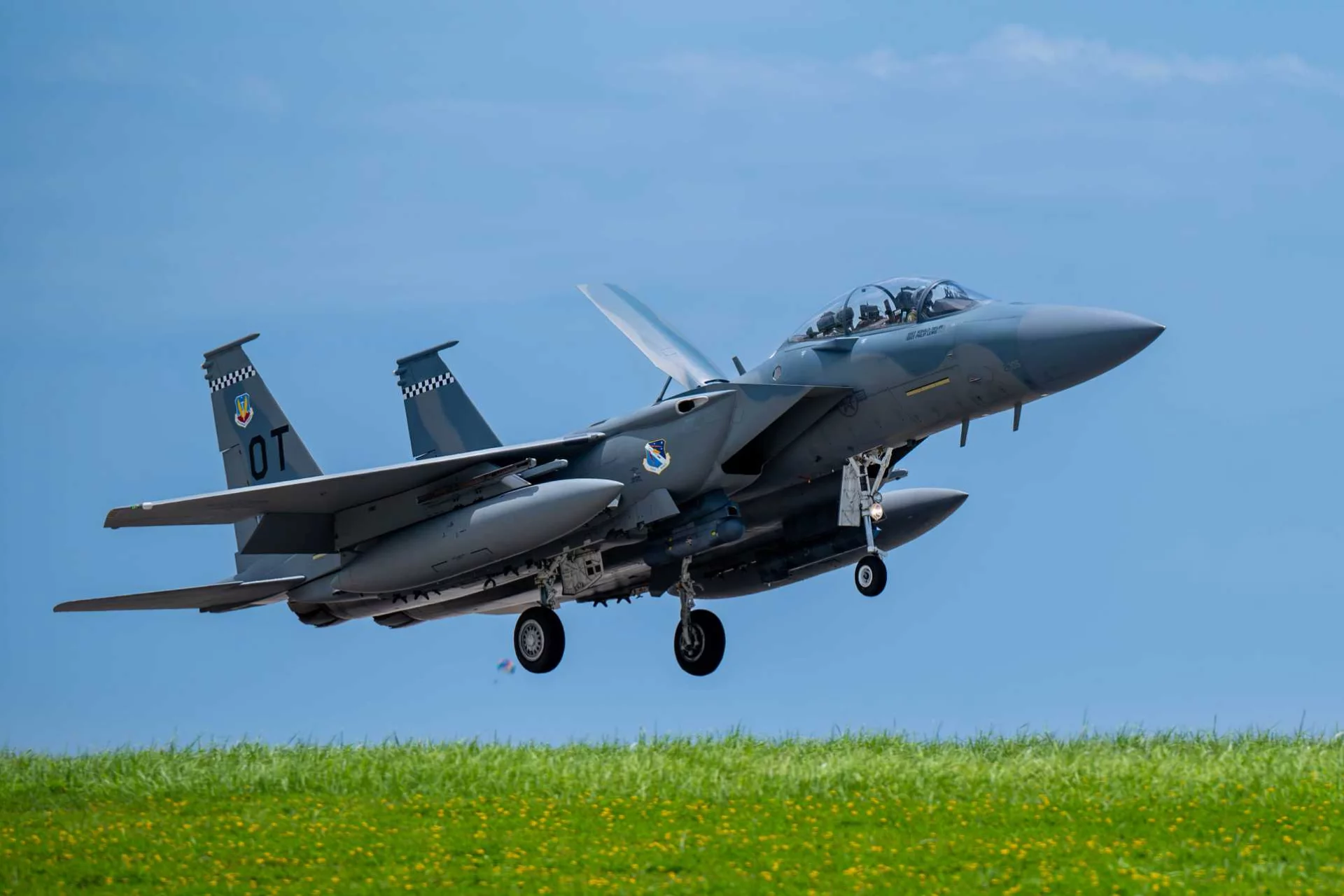
The Boeing F-15EX Eagle II has transcended its role as a mere upgrade to the iconic F-15 family, evolving into a pivotal asset for the U.S. Air Force (USAF). Rather than being valued only for speed and firepower, the F-15EX is now envisioned as an airborne command-and-control hub, aligning with the USAF’s vision for Joint All-Domain Command and Control (JADC2) and manned-unmanned teaming.
Equipped with a two-seat layout, an advanced digital cockpit, and a flexible open mission architecture, the Eagle II can rapidly integrate new systems, including hypersonic weapons. Its powerful F110-GE-129 engines and a 20,000-hour service-life airframe offer superior payload capacity—up to 29,500 pounds—while reducing sustainment costs.
What truly sets the F-15EX apart is its role as a “network node.” Beyond air-to-air and strike capabilities, the aircraft can coordinate unmanned aerial vehicles (UAVs), manage data flows across domains, and act as a force multiplier by accelerating decision-making. This distributed command capability is designed to counter peer threats like China and Russia, who are investing in electronic warfare and long-range strike capabilities.
Manned-unmanned teaming remains a defining feature. The F-15EX can deploy loyal wingman drones into contested areas, directing them to conduct reconnaissance, electronic attack, or strike missions while staying at a safer distance. Unlike stealth aircraft, which operate under emissions control to avoid detection, the F-15EX operates as a highly connected and heavily armed presence—keeping allied operations synchronized.
For international partners such as Israel, Japan, and Saudi Arabia, the Eagle II offers a cost-efficient path to network-centric operations while remaining compatible with existing F-15 fleets. Its modular design allows rapid upgrades, ensuring operational relevance well into the coming decades.
Ultimately, the F-15EX represents a shift in airpower philosophy: survivability is no longer just about stealth but about information dominance and operational integration. The Eagle II is poised to become a digital-era battle manager, orchestrating both manned and unmanned forces in future high-intensity conflicts.
