

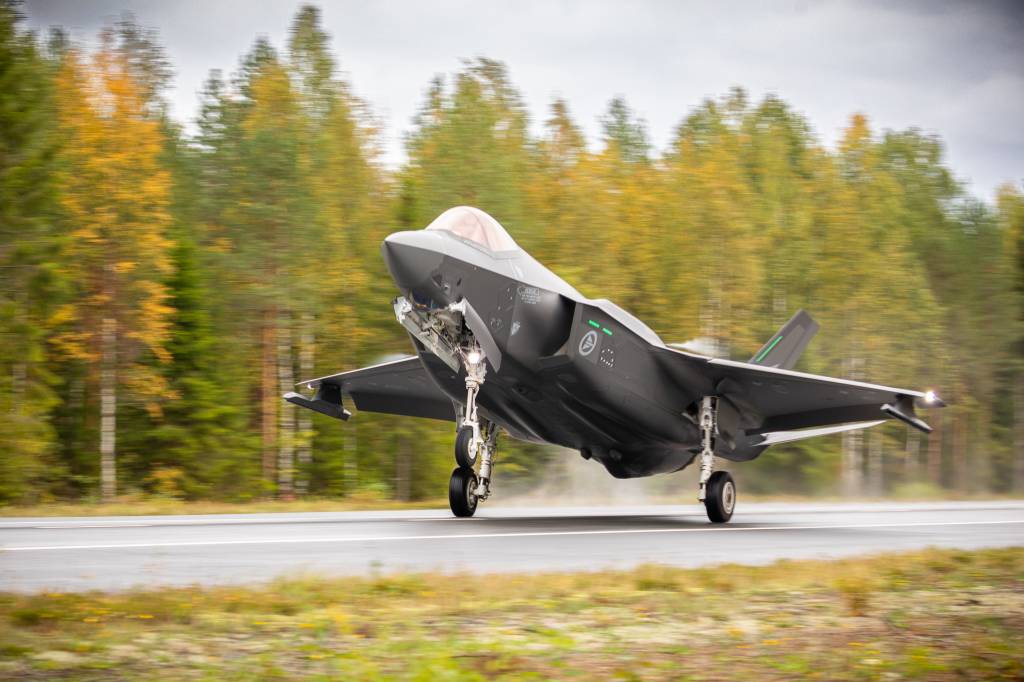
The U.S. F-35 Lightning II fighter jet can detect enemy destroyers before visual contact thanks to the AN/APG-81 AESA radar developed by Northrop Grumman. This cutting-edge sensor transforms the aircraft into a long-range intelligence and targeting platform, reshaping modern air combat.
Multi-Domain Combat Power
The F-35’s edge isn’t only about stealth or speed. Its real strength lies in seeing threats before anyone else. The AN/APG-81 radar turns the jet into a multi-role platform capable of monitoring both air and ground threats simultaneously.
Target Detection and Tracking
Located in the nose, the radar provides precise tracking of both air and ground targets. Its passive mode can detect enemy electronic emissions without revealing the F-35’s position, maintaining situational awareness in contested environments.
Advanced Sensor Technology
Equipped with thousands of solid-state modules, the APG-81 electronically steers beams, removing mechanical limitations. Pilots gain a highly detailed, long-range picture of the battlespace. Integrated with the F-35’s mission systems and Distributed Aperture System, it presents a single, prioritized tactical picture.
Electronic Warfare and Suppression
The radar also offers built-in electronic attack capabilities, jamming or degrading enemy air defenses. This allows the F-35 to operate in anti-access/area denial zones while keeping electronic warfare as an integral part of its mission package.
Proven Battlefield Performance
In exercises like Red Flag, the F-35 has consistently detected and engaged threats before being seen. Weapon cueing and data sharing reduce kill-chain timelines from minutes to seconds, giving the jet the first-look, first-shot, first-kill advantage.
Comparison with Competitors
Other modern fighters with AESA radars, such as the F-16 Viper or F/A-18E/F Super Hornet, cannot match the APG-81’s integration and sensor fusion. Russian Su-57 and Chinese J-20 radars claim long-range detection but lack the same level of battlefield fusion and integrated electronic warfare.
Future Upgrades and Continued Superiority
The upcoming Block 4 software upgrade will bring machine learning-based target recognition, higher-resolution SAR imaging, and enhanced electronic attack modes. These improvements ensure the F-35 maintains its superiority in any airspace well into the 2030s.
