

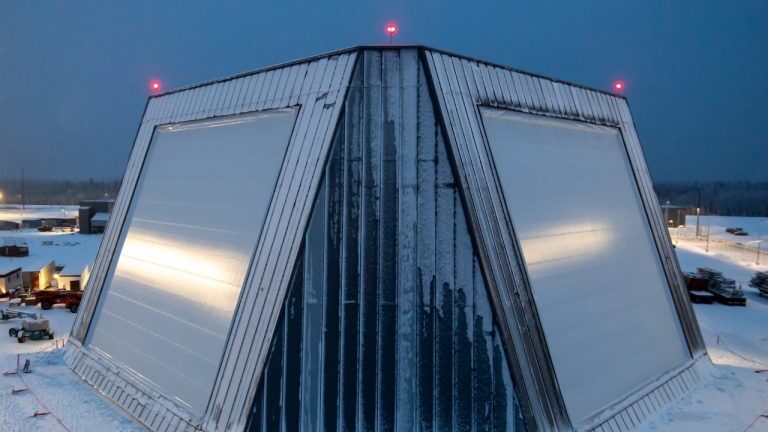
The U.S. Missile Defense Agency (MDA) has achieved a critical milestone in its efforts to strengthen national defense: the Long-Range Discrimination Radar (LRDR) has, for the first time, successfully tracked a target mimicking an intercontinental ballistic missile (ICBM) during a live test.
The radar, built by Lockheed Martin and stationed at Clear Space Force Station in Alaska, forms a key pillar of the “Golden Dome” missile shield — a vision originally championed by former President Donald Trump. Although LRDR has been operational since late 2021, this test represents the first real-time demonstration of its intended capabilities.
During Monday’s exercise, codenamed Flight Test Other-26 (FTX-26), an air-launched target traveled over 2,000 kilometers off Alaska’s southern coast. LRDR, alongside the Upgraded Early Warning Radar (UEWR), tracked the object and relayed crucial data to the Ground-Based Midcourse Defense (GMD) system. The successful test paves the way for the radar’s official acceptance into operational service by the U.S. Space Force — pending final performance review.
Originally slated for 2022, the test faced delays due to pandemic-related disruptions and technical issues. But for U.S. Northern Command, which has long awaited LRDR’s full deployment, the radar’s ability to differentiate real threats from decoys — especially amid evolving ICBM and hypersonic missile technologies — is considered vital.
Beyond missile tracking, LRDR is also expected to contribute to space situational awareness, supporting future space-based defense systems envisioned under the broader Golden Dome strategy.
