

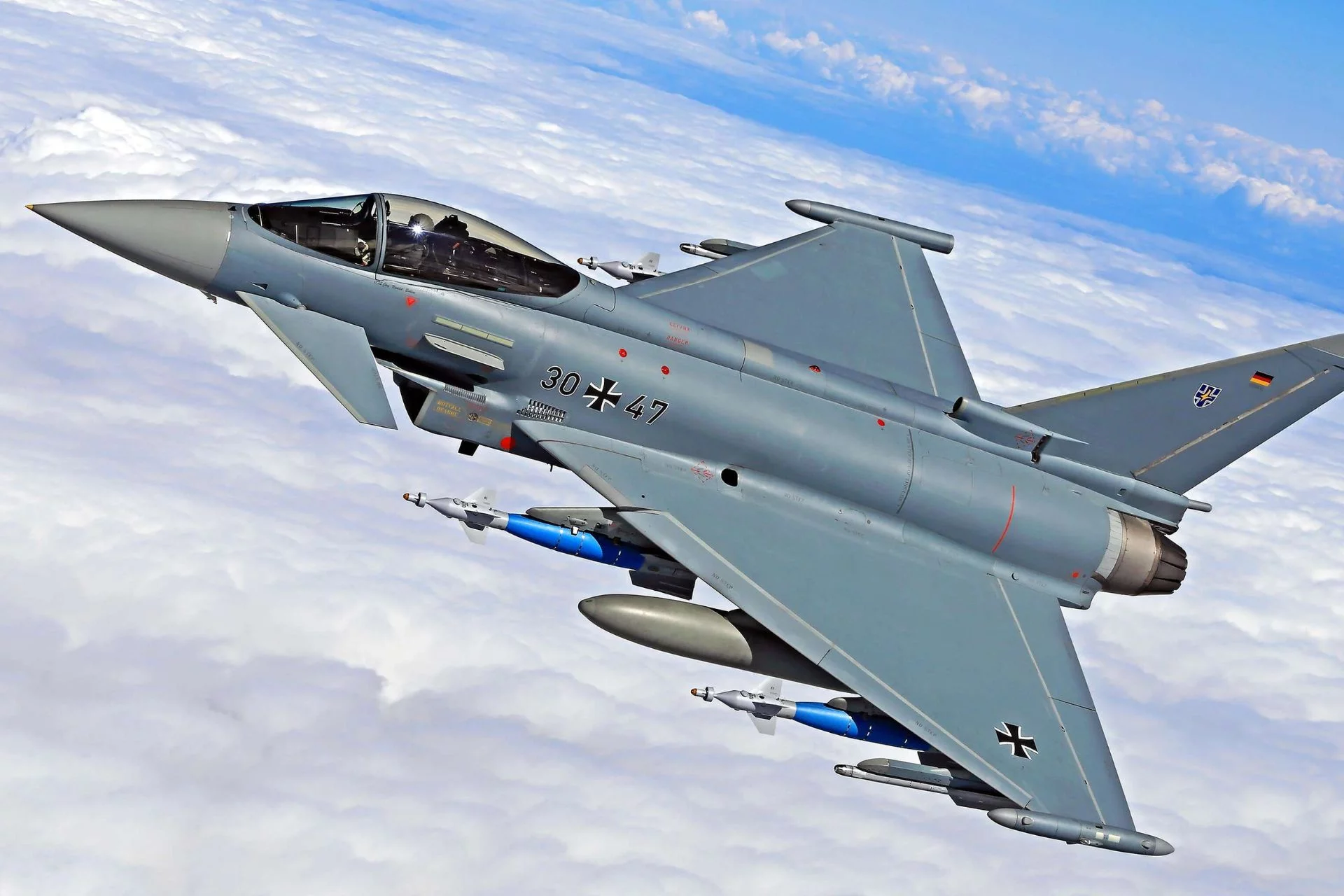
Warsaw | August 4, 2025 — In a clear signal of solidarity with NATO allies and in anticipation of Russia’s upcoming Zapad-2025 military drills, Germany has deployed five Eurofighter Typhoon jets to Minsk Mazowiecki Air Base, located just east of Warsaw. This marks the first time German Air Force fighter jets have been stationed on Polish soil, a move seen as a key component in reinforcing the alliance’s deterrence posture in Eastern Europe.
The deployment comes as Russia and Belarus prepare to launch a large-scale joint military exercise expected to involve 13,000 troops. The German aircraft, along with approximately 150 Bundeswehr personnel, will begin operational duties on August 5, forming part of an expanded NATO airspace policing operation.
A German Air Force spokesperson described the move as a “strong message of alliance unity,” underscoring NATO’s commitment to defending its eastern borders amid escalating tensions.
The Eurofighter Typhoons deployed to Poland are among the most capable multi-role fighters in NATO’s arsenal. Jointly developed by Germany, the UK, Italy, and Spain, the aircraft offers superior performance in both air-to-air and air-to-ground missions. With cutting-edge avionics, evolving radar systems (transitioning to AESA), and the ability to carry weapons such as Meteor air-to-air missiles, Brimstone anti-armor missiles, and GBU-24 precision bombs, the Typhoon is designed to operate effectively in high-intensity conflict environments.
Despite earlier announcements that Zapad-2025 would be relocated inland to avoid provoking NATO, recent remarks from Belarusian Deputy Defense Minister Pavel Muraveika suggest that this decision may be reversed due to the shifting geopolitical landscape.
Belarus, while not directly involved in combat operations in Ukraine, has played a strategic role for Russia. In early 2022, Moscow used Belarusian territory to launch assaults on northern Ukraine, particularly toward Kyiv. Fears of a renewed Russian build-up in Belarus persist, especially after Ukrainian President Volodymyr Zelensky warned earlier this year of a potential deployment of up to 150,000 Russian troops within Belarusian borders.
NATO’s new Secretary General, Mark Rutte, recently stated that Europe must prepare for the possibility of large-scale conflict within this decade. Germany’s latest deployment is seen as part of this broader preparation — a measured yet firm step to assure allies and deter adversaries.
As Zapad-2025 draws near, the presence of German fighters in Poland highlights a tactical shift in Europe’s defense posture, reflecting NATO’s broader commitment to forward defense and rapid response capability in an increasingly volatile security environment.
