

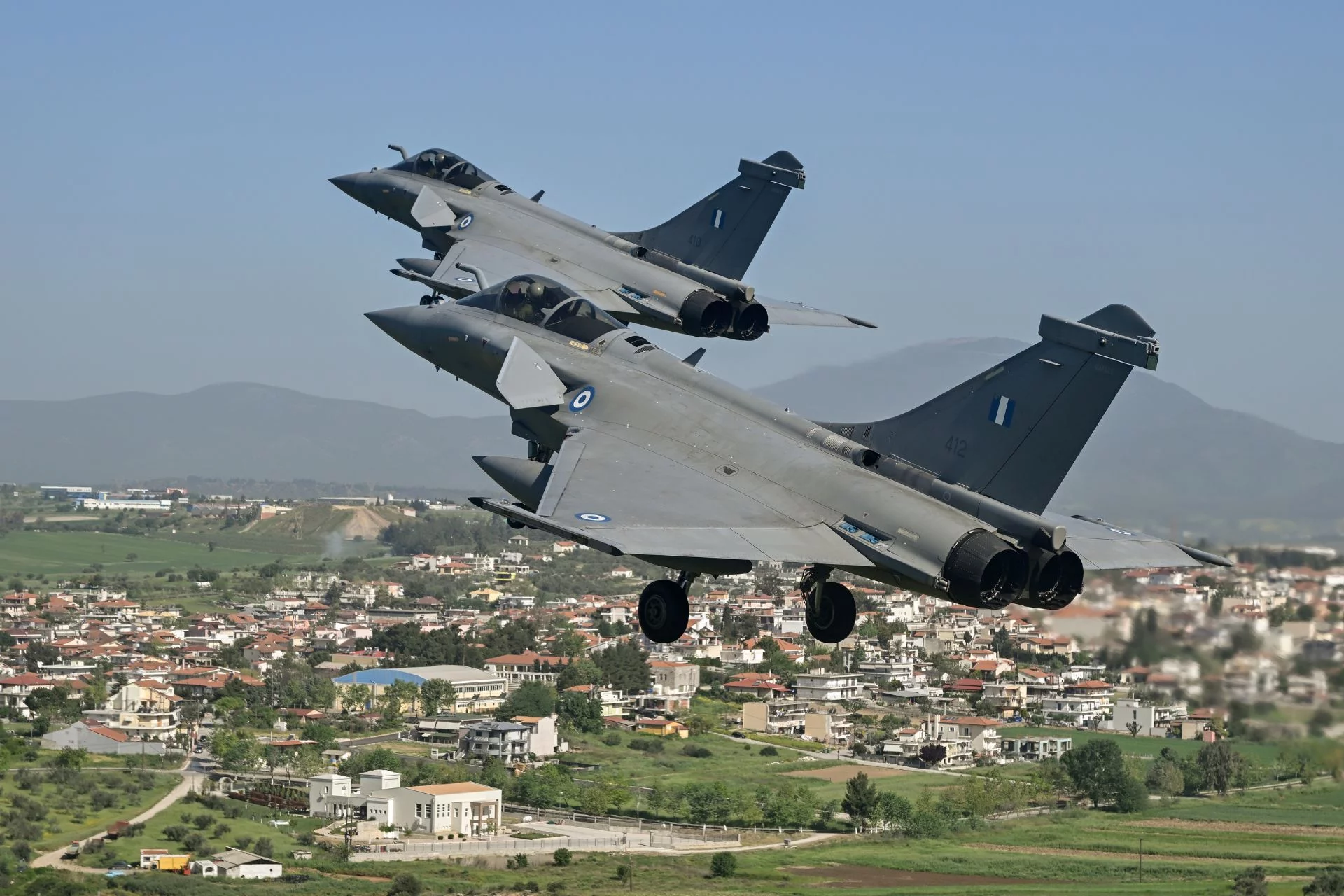
Greece is assessing the potential acquisition of additional Dassault Rafale F4 fighters as Türkiye moves closer to finalizing its Eurofighter Typhoon deal, reportedly including Meteor long-range missiles. The move reflects Athens’ strategic goal to field roughly 200 advanced fighters through the 2030s, replacing older Mirage 2000-5s while integrating F-35As into its inventory.
According to reports from Ekathimerini, defense planners in Athens aim to sustain a decisive edge over Türkiye by deepening their partnership with France. The Rafale F4 upgrade provides significant enhancements in connectivity, electronic warfare resilience, and weapons integration — key elements for dominance in the Aegean airspace.
Enhanced Connectivity and Network Resilience
At the heart of the F4 configuration lies robust, multi-layered communication. Beyond the NATO-standard Link 16 network, Rafale F4s feature a dedicated intra-flight data link that maintains coordination in dense jamming environments. This dual-link design ensures continuous information flow and rapid data sharing — crucial for situational awareness during contested operations.
The upgraded active electronically scanned array (AESA) radar delivers advanced tracking, even for mobile ground targets, while the new infrared search and track (IRST) system improves stealth target detection. Together with the Scorpion helmet-mounted display (HMD) and the enhanced SPECTRA self-protection suite, the F4 ensures survivability and precision in both air-to-air and air-to-ground missions.
New-Generation Weapons and Combat Advantage
The F4 standard introduces the MICA NG (New Generation) missile, available with both infrared and radar-guided seekers. With an extended range of around 40% over earlier MICA versions and a 360-degree firing envelope, the MICA NG paired with the AESA radar broadens engagement zones and limits enemy maneuvering options. This enables Greek pilots to engage earlier, maintaining initiative during beyond-visual-range (BVR) encounters.
Strengthening Joint Operations and NATO Interoperability
By aligning its future fleet around Rafale F4, F-16V, and F-35A, Greece enhances interoperability with NATO allies. Standardized systems improve cryptographic security, logistics, and maintenance efficiency. The integration of Scorpion HMDs also harmonizes target acquisition across platforms, while upgraded mission computers enable faster data fusion and improved battle management.
Strategic Context in the Eastern Mediterranean
The Rafale F4 evaluation underscores Athens’ intent to preserve air superiority as Türkiye pursues modernization with Eurofighter Typhoons and advanced missiles. While both NATO members expand their fleets, France’s continued defense cooperation with Greece bolsters Hellenic deterrence.
Ultimately, the stability of the Eastern Mediterranean will depend on whether both countries can balance modernization with de-escalation, maintaining interoperability to prevent regional tensions from escalating into conflict.
