

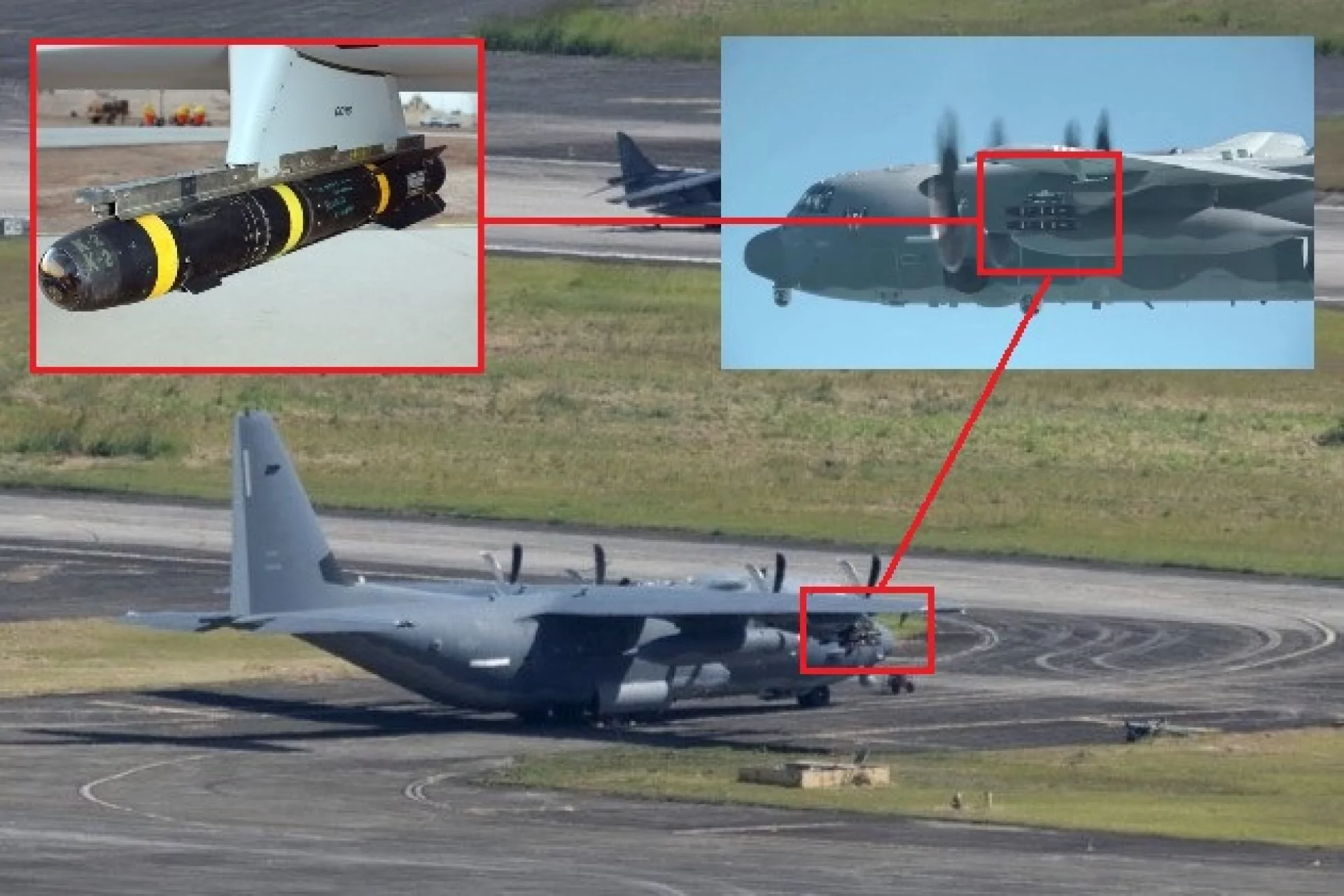
New imagery from Roosevelt Roads in Puerto Rico is shedding light on a growing U.S. military presence in the southern Caribbean. A Reuters photograph taken on December 1, 2025, shows a U.S. Marine Corps AV-8B Harrier II operating alongside an AC-130J Ghostrider—confirming that both Marine strike aircraft and a special-operations gunship are now flying from the same rapidly reactivated base just minutes from Venezuelan airspace.
The image follows earlier sightings from October, when an AC-130J was documented carrying AGM-114 Hellfire missiles under its wings—an uncommon loadout for the Caribbean region. Together, the two sets of visuals indicate that Washington has established a sustained, heavily armed air posture on U.S. territory, but within immediate reach of Venezuela’s coastline and maritime corridors.
The AC-130J is the most advanced gunship variant in U.S. service, featuring the Precision Strike Package, which integrates high-resolution electro-optical sensors, IR cameras, secure data links, and mission consoles with side-firing weapons. In addition to its 30 mm cannon and 105 mm howitzer, the aircraft is certified to fire GBU-39/GBU-69 glide munitions, Griffin missiles, and—most notably—AGM-114 Hellfires. This gives the Ghostrider a low-collateral, line-of-sight strike option against moving vessels, radar sites, coastal positions, or small maritime threats.
The decision to revive Roosevelt Roads significantly amplifies the strategic message. Closed in 2004, the former naval base has undergone rapid modernization throughout 2025, with resurfaced taxiways, new construction activity and a rising tempo of visiting combat aircraft. Recent satellite and press images show fighters, transports, tankers, and now a gunship operating out of the facility—suggesting Washington is reestablishing a layered logistical and airpower hub in the northeastern Caribbean.
Operationally, the December photograph highlights an integrated joint posture. The Harrier II seen taxiing near the AC-130J belongs to a Marine air detachment associated with amphibious operations from USS Iwo Jima, using Roosevelt Roads as a land base between sorties. Fast-moving Harriers (and in other sequences, F-35Bs) offer rapid strike options, while the Ghostrider provides persistent surveillance and precision engagement—together forming a potent crisis-response team should tensions around Venezuela escalate.
This pattern extends beyond Puerto Rico. Other recent reports have shown AC-130J activity in Central America, including missions from El Salvador documented in mid-November. The units form part of a broader U.S. network combining counter-narcotics operations with contingency preparations related to Venezuela.
The presence of a Hellfire-equipped AC-130J in Puerto Rico—now documented in both October and December imagery—represents more than an unusual weapons configuration. It demonstrates that the United States is forward-positioning special operations airpower and Marine aviation in a way that allows rapid surveillance, deterrence, and, if required, limited precision strikes without deploying new forces on short notice.
