

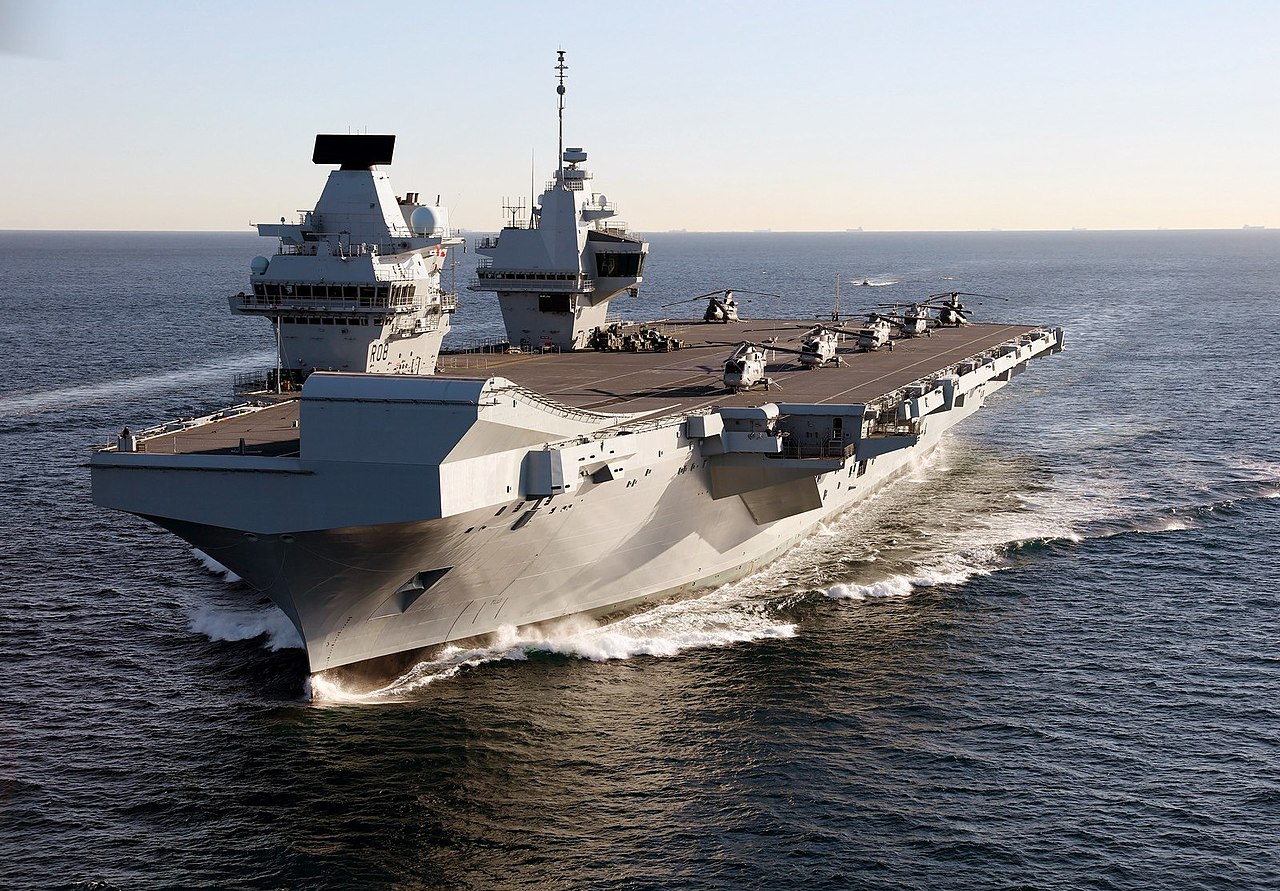
The HMS Queen Elizabeth (R08) is the pride of the Royal Navy and one of the most advanced aircraft carriers ever built in Europe. Formally christened by Queen Elizabeth II on July 4, 2014, the vessel represents the largest warship in the history of the British fleet. Following years of construction and sea trials, the carrier was commissioned in 2017 and entered full operational service in 2020. Together with her sister ship, the HMS Prince of Wales (R09), she forms the core of the UK’s modern carrier strike capability.
Design and Capabilities
At 284 meters in length and 72,300 tonnes displacement, HMS Queen Elizabeth is an engineering marvel built to project British air and naval power across the globe. With a beam of nearly 73 meters and a draught of 36 feet, the carrier provides a massive flight deck capable of handling fixed-wing fighters, helicopters, and support aircraft. The ship operates with a crew of approximately 1,450 sailors, while its air wing can support 40 or more aircraft, making it one of the most formidable platforms in NATO.
Propulsion and Endurance
Unlike the U.S. Navy’s nuclear-powered carriers, the Queen Elizabeth class uses a conventional propulsion system. Power is generated by two Rolls-Royce Marine Trent MT30 gas turbines (48,000 horsepower each) supported by four Wartsila diesel generators. This configuration provides a top speed of 27 knots and a range of nearly 10,000 nautical miles, enabling long deployments without frequent refueling.
Air Wing and Aircraft Carried
The true strength of HMS Queen Elizabeth lies in its embarked air group. The carrier is designed around the Lockheed Martin F-35B Lightning II, the fifth-generation stealth fighter capable of short takeoff and vertical landing (STOVL). In addition to strike fighters, the vessel can deploy:
- Boeing CH-47 Chinook transport helicopters
- Boeing AH-64 Apache attack helicopters
- AgustaWestland Merlin HM.2/HC4 multi-role helicopters
- Wildcat HMA.2/AH.1 medium-lift/utility helicopters
This mix of advanced aircraft gives the Royal Navy unmatched flexibility for missions ranging from maritime strike to anti-submarine warfare and humanitarian assistance.
Defensive Systems
For close-in defense, HMS Queen Elizabeth is equipped with 20mm Phalanx Close-In Weapon Systems (CIWS) and 30mm cannons to counter aerial and surface threats. While the ship relies primarily on its escort vessels and aircraft for layered defense, these onboard systems provide a last line of protection against missiles and fast-attack craft.
Strategic Importance
As the flagship of the Royal Navy, HMS Queen Elizabeth enhances Britain’s role as a global maritime power. It supports carrier strike operations, power projection, and rapid crisis response. The ship is a key contributor to NATO’s collective security, providing deterrence in the Atlantic, Mediterranean, and Indo-Pacific regions.
The HMS Queen Elizabeth aircraft carrier is more than just a warship—it is a statement of national power and technological achievement. With its state-of-the-art design, advanced propulsion system, and formidable air wing, it stands at the heart of the UK’s defense strategy. Alongside the HMS Prince of Wales, it ensures that the Royal Navy remains a world-class force well into the 21st century.
