

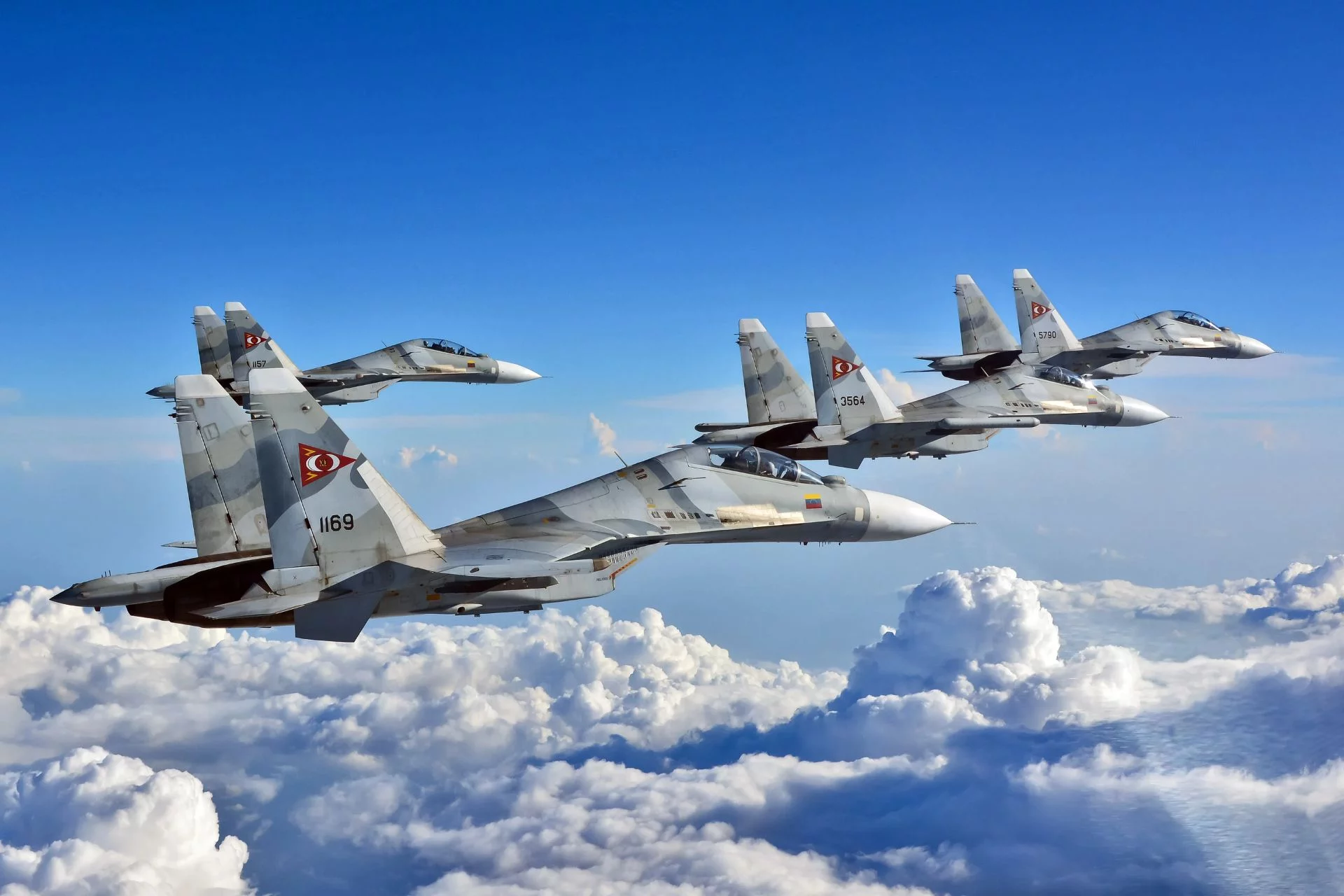
As U.S. naval and air patrols intensify across the Caribbean, Venezuela’s layered air defense network is drawing renewed scrutiny. Analysts warn that its combination of long-, medium-, and short-range systems could complicate any American attempt to operate close to Venezuelan territory.
The Venezuelan Air Force operates around twenty Su-30MKV multirole fighters, forming the backbone of its combat aviation. Armed with R-77, R-27, and R-73 air-to-air missiles, these jets can also employ Kh-31A and Kh-31P missiles against naval or radar targets, giving Caracas a credible limited counter-strike capability. A handful of aging F-16A/Bs remain in service for secondary tasks such as patrol and escort missions.
On the ground, the country’s integrated air defense architecture, coordinated under CODAI, combines several tiers. The long-range S-300VM forms the outer shield, capable of targeting aircraft and cruise missiles. Beneath it, Buk-M2E and S-125 Pechora-2M systems provide medium coverage, while Igla-S and RBS-70 short-range missiles and numerous ZU-23-2 guns secure low altitudes. Acting together, these systems can force attackers to fly higher, fire from farther away, and devote more sorties to suppression missions.
In August 2025, President Nicolás Maduro announced the mobilization of 4.5 million militia members in response to perceived U.S. threats. The force, to be equipped with AK-103 rifles and man-portable air defense systems such as Igla-S, adds density to Venezuela’s defenses around airfields, ports, and urban zones. While not a high-tech deterrent, this mass mobilization complicates low-altitude operations and increases risks for reconnaissance, close air support, and helicopter missions.
Venezuela continues to rely heavily on Russia, China, and Iran for logistics, parts, and training support. Despite economic pressure and limited readiness, these partnerships sustain a patchwork but persistent defense capability.
Meanwhile, the U.S. Southern Command has expanded its presence in the Caribbean with guided-missile destroyers, P-8A Poseidon patrol aircraft, and the Iwo Jima Amphibious Ready Group, reinforcing counter-narcotics operations and signaling deterrence.
Ultimately, Venezuela’s air defenses cannot seal the skies against a modern U.S. strike force. But they can slow operations, force more complex planning, and raise the cost of action — a factor that may influence decision-making before any strike ever begins.
