

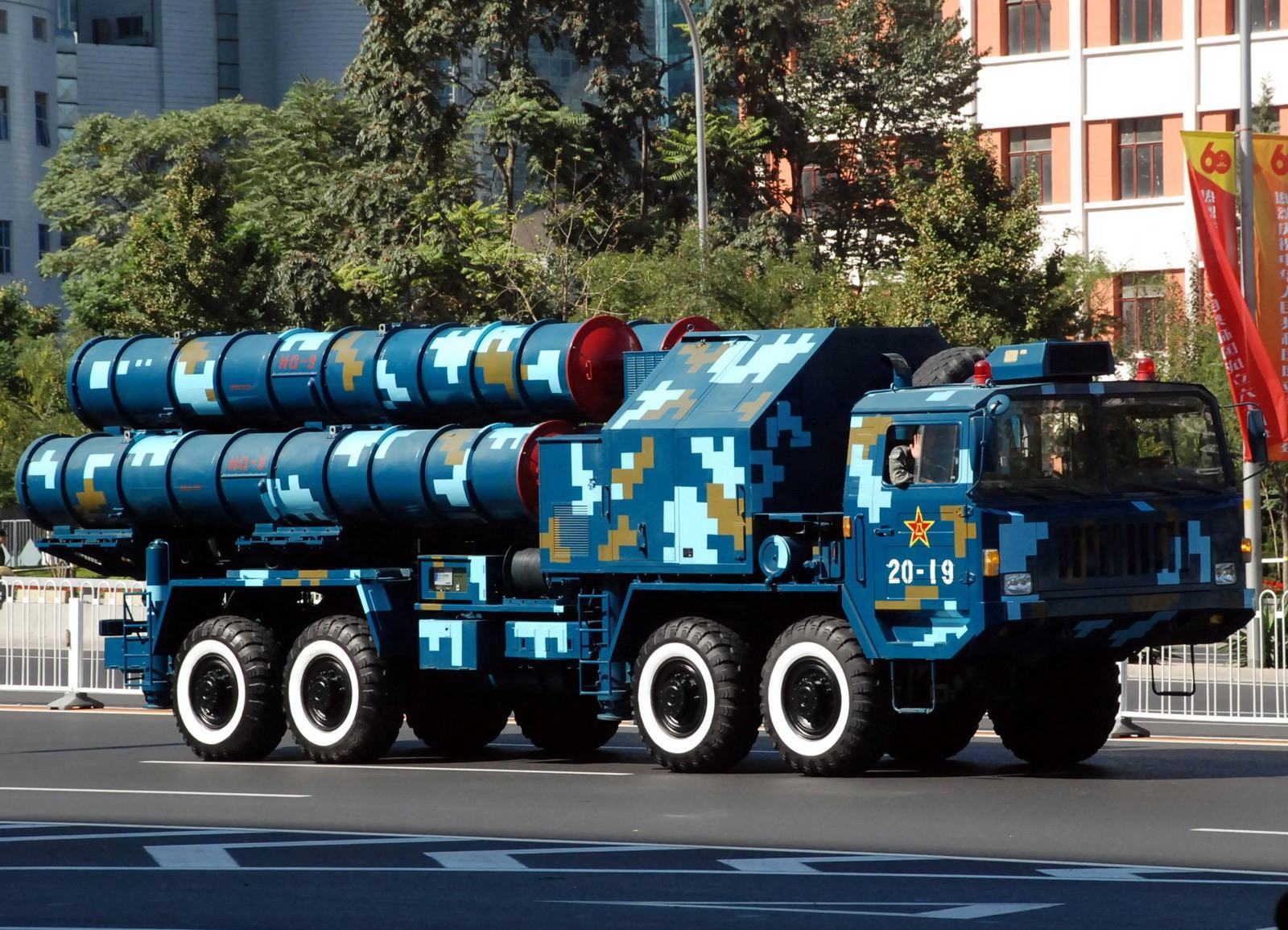
The HQ-9 is a sophisticated medium-to-long range surface-to-air missile (SAM) system developed by China’s CPMIEC (China Precision Machinery Import & Export Corporation). Engineered to counter diverse aerial threats, it is capable of engaging enemy aircraft, cruise missiles, air-to-surface missiles, and tactical ballistic missiles. The system made its public debut during the 60th anniversary celebrations of the People’s Republic of China.
Development of the HQ-9 began in the early 1980s, drawing inspiration from the U.S. Patriot missile system, which China reportedly acquired through indirect channels. Much like the Patriot, the HQ-9 utilizes a Track-Via-Missile (TVM) guidance mechanism and was originally designed to be launched from box-shaped containers mounted on a vehicle. The missile system’s export variant, the FD-2000, has attracted interest from countries such as Turkey.
Variants of the HQ-9 include:
- FD-2000: The export model featuring anti-stealth capabilities.
- FT-2000: Equipped with passive homing throughout its flight and designed to operate with CETC International’s ground-based DWL-002 passive surveillance system.
- HHQ-9: The naval adaptation of the HQ-9 system.
- HQ-9A: An upgraded version first tested in 1999 and operational since 2001.
- HQ-9B: Enhanced with extended range and a dual seeker system.
- HQ-9C: Currently in development, featuring active radar homing.
Technical Overview
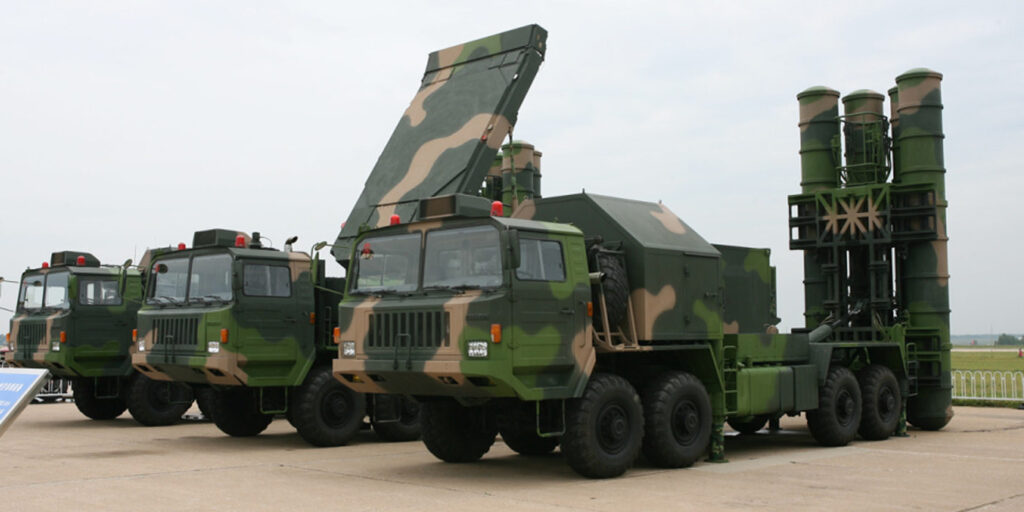
The HQ-9 missile system employs a launcher vehicle carrying four missile canisters. When deployed, the containers rotate vertically at the rear of the transporter erector launcher (TEL) truck, which stabilizes itself with deployable supports.
The missile itself is a two-stage design measuring 6.8 meters in length and weighing nearly 2 tons. Its first stage has a diameter of 700 mm, while the second stage measures 560 mm. It carries a 180 kg warhead and reaches speeds up to Mach 4.2, with an effective range extending up to 200 kilometers and an altitude ceiling of 30 kilometers. The proximity fuse activates within 35 meters of the target, engaging fully when the missile is approximately 5 km away. A notable design distinction from the Russian S-300V system is the exposed thrust vector control (TVC) on the HQ-9, visible from the side.
The missile’s guidance integrates inertial navigation with mid-course updates via uplink and concludes with active radar homing for terminal targeting.
Mobility and Support Systems
The missile launchers are mounted on the Taian TAS-5380 8×8 truck, a platform based on the Russian MAZ-543 chassis and powered by an air-cooled diesel engine.
An HQ-9 battery includes six TEL trucks supported by an HT-233 3D C-band phased array radar and managed by a TWS-312 command post. The HT-233 radar, derived from the Russian 30N6E Flap Lid/Tomb Stone series, covers a detection range of 120 km and tracks up to 100 targets simultaneously, engaging more than 50 at once across a full 360° azimuth and 0-65° elevation.
Multiple auxiliary radar systems, including anti-ballistic and anti-stealth radars like the Type 305B, Type 120, Type 305A, YLC-20, and DWL002, augment the system’s detection capabilities.
In Chinese military organization, a full HQ-9 battery encompasses command and control vehicles, multiple radar units, numerous missile launch vehicles carrying a total of 192 missiles, as well as logistical and support vehicles.
Summary of Specifications
- Missile type: Medium-to-long range surface-to-air missile
- Missiles per launcher: 4 in sealed containers
- Users: China, Algeria, Morocco, Turkmenistan, Uzbekistan
- Range: 500 meters minimum, up to 200 kilometers maximum (effective up to 30 km altitude against ballistic missiles)
- Guidance: Track-Via-Missile (semi-active radar homing)
- Warhead: 180 kg
- Radar systems: HT-233 engagement radar, H-200 mobile radar, Type 120 low-altitude radar, Type 305A/305B 3D acquisition radars
- System reaction time: Approximately 10 seconds
