

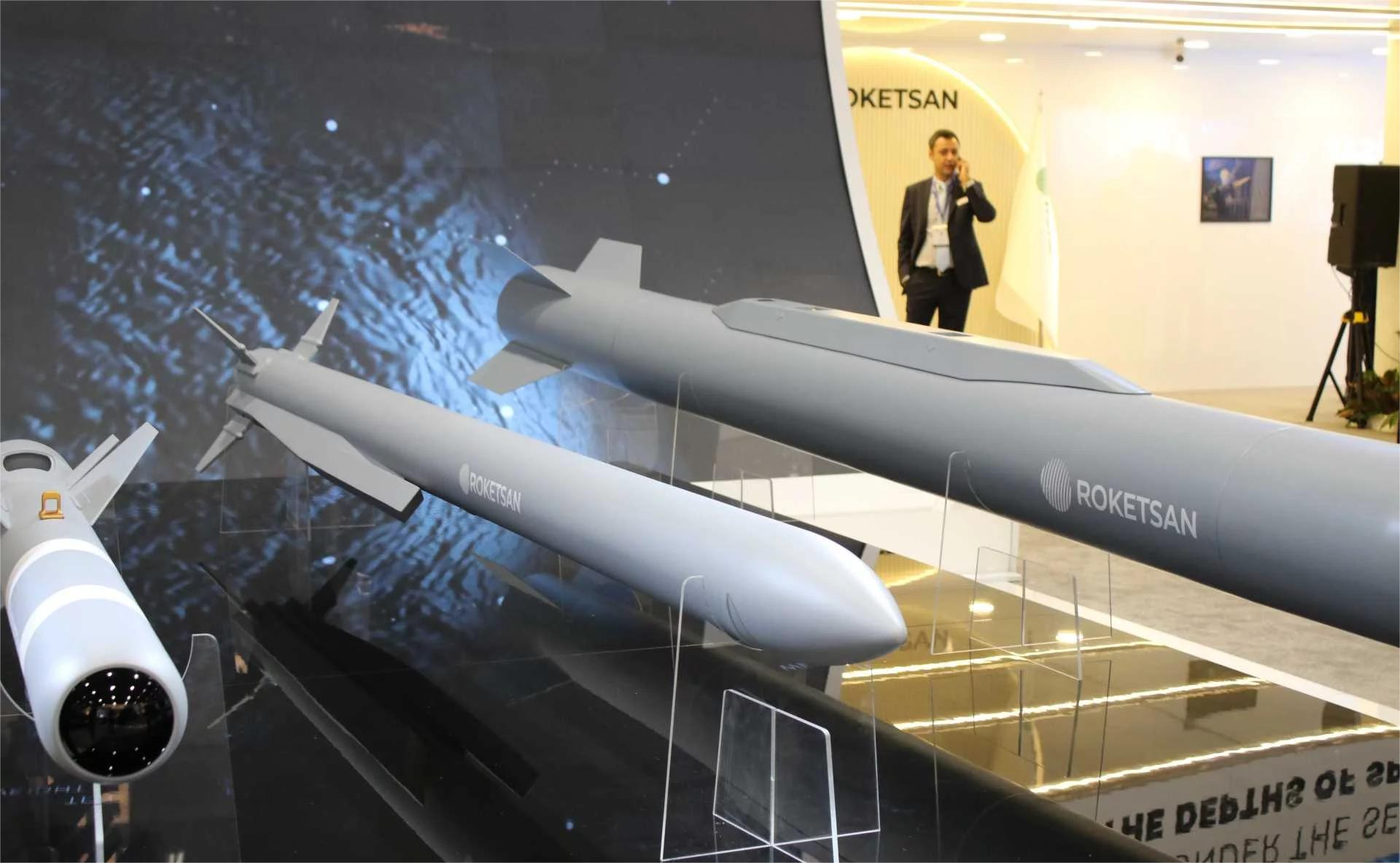
At the IDEF 2025 defense exhibition in Istanbul, Roketsan officially introduced Gökbora, Türkiye’s first air-to-air missile powered by a solid-fuel ramjet engine and compatible with internal weapon bays. Developed for the fifth-generation KAAN stealth fighter and the unmanned combat aircraft Bayraktar Kızılelma, Gökbora represents a major leap in Türkiye’s air dominance capabilities.
With a range exceeding 100 nautical miles (approximately 185 km), Gökbora is conceptually likened to the Meteor missile developed by France and the UK. However, Turkish defense sources claim Gökbora surpasses Meteor in range and offers a broader no-escape zone, giving it an operational edge in long-range engagements. Unlike TÜBİTAK-SAGE’s Gökhan, which must be externally mounted, Gökbora is engineered for internal carriage — minimizing radar cross-section and supporting stealth operations.
The missile measures 3.75 meters in length and 180 mm in diameter. Its propulsion relies on a solid-fuel ramjet, allowing it to maintain thrust during high-speed, high-altitude flight. Navigation and guidance are handled via inertial systems and mid-course updates through datalink, transitioning to active targeting via an AESA radar seeker during the terminal phase. Gökbora is equipped with a high-explosive fragmentation warhead, optimized to engage a wide array of targets: fighters, AEW&C aircraft, tankers, UAVs, cargo planes, and cruise missiles.
The missile’s ability to fit inside internal weapon bays enables stealth aircraft to retain low observability while carrying it — a key factor differentiating Gökbora from earlier domestic missiles. Defense officials describe this feature as critical for the next generation of air warfare.
The solid-fuel ramjet engine used in Gökbora belongs to a class of airbreathing propulsion systems that compress incoming air via the vehicle’s forward motion, mix it with fuel, and combust it to produce thrust. These engines lack moving parts, offering a simplified and compact architecture ideal for internal integration. Unlike turbojets, they don’t require complex mechanical assemblies or pumps, improving reliability and reducing maintenance demands.
The history of ramjet development spans over a century, with early theoretical work dating back to 1913. Experimental systems were pursued by the Soviet Union, Germany, the U.S., and others through the 20th century. Now, Türkiye joins a select group of nations capable of fielding indigenous ramjet-powered missiles adapted for stealth platforms.
Roketsan’s unveiling of Gökbora is more than a technological milestone — it’s a strategic statement. By integrating long-range engagement, stealth compatibility, and robust domestic engineering, Gökbora solidifies Türkiye’s position as an emerging force in advanced missile systems. The missile is poised to become a core element in future Turkish and allied air-to-air combat doctrines.
