

In the wake of a deadly aerial confrontation with Pakistan earlier this year, India has launched an aggressive procurement campaign to bolster its air defense and counterterrorism capabilities, signaling a hardening of its strategic posture in the region.
From May 7 to 10, India and Pakistan engaged in a series of cross-border air skirmishes following India’s Operation Sindoor, a retaliatory strike targeting alleged terrorist camps in Pakistani territory. The operation came after 26 civilians were killed in Jammu and Kashmir on April 22, an attack India has blamed on groups supported by Islamabad.
In response to the escalating tensions—and in particular, Pakistan’s deployment of armed drones and air strikes—India’s Ministry of Defence has signed 13 emergency contracts worth ₹19.82 billion (approximately $231 million) aimed at rapidly closing gaps in aerial threat response and ground troop protection.
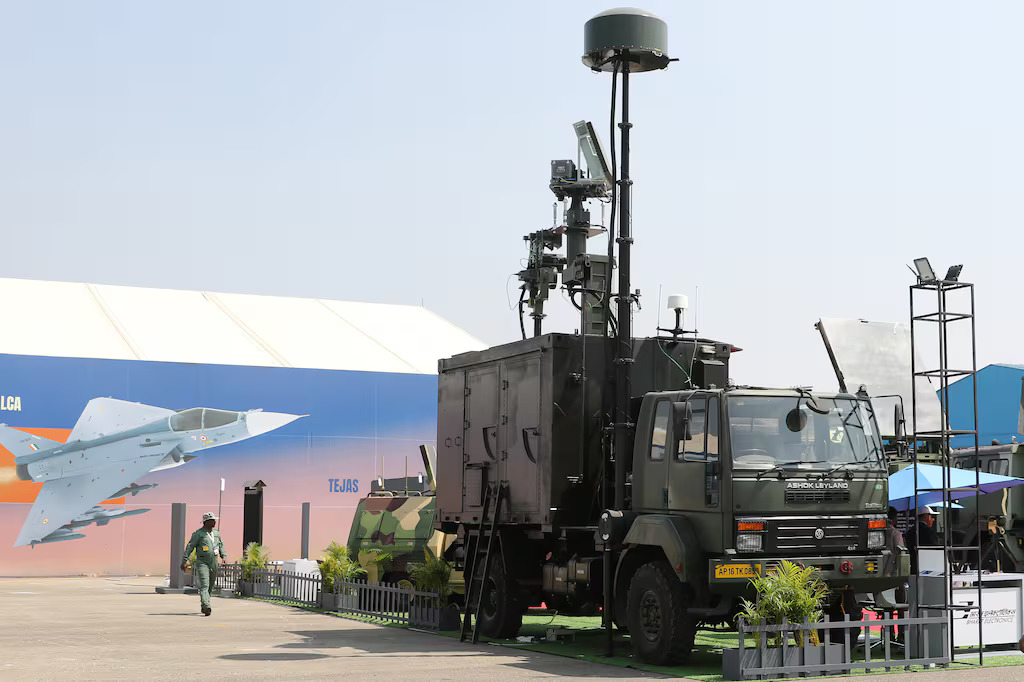
At the center of the new procurements are Integrated Drone Detection and Interdiction Systems (IDDIS), Low-Level Lightweight Radars (LLLRs), and very-short-range air-defense (VSHORAD) missiles and launchers. These systems played a critical role during the May conflict, with several Pakistani drones reportedly intercepted by IDDIS units.
Both IDDIS and LLLRs are manufactured by Bharat Electronics Limited, part of India’s push to rely exclusively on domestic defense firms. The LLLR, in particular, is a portable, 3D AESA radar system capable of tracking drones with minimal radar visibility, making it vital in defending sensitive border regions.
The defense package also includes drones and loitering munitions, such as the ideaForge Hybrid Mini UAV for real-time surveillance and 450 Nagastra-1R loitering munitions from Solar Industries, designed to hunt and strike mobile targets with precision.
“Executed under emergency procurement mandates, these acquisitions are designed to boost battlefield mobility, protection, and real-time threat detection,” the Ministry of Defence said in a statement.
Beyond aerial systems, India’s military personnel will also be equipped with bullet-proof vests, ballistic helmets, night-vision rifle sights, and Tata 4×4 Quick-Reaction Fighting Vehicles, enhancing survivability during counterinsurgency operations along volatile borders.
Since January, India has reported over 80 terror-related incidents and responded with more than 530 counterterror operations, many of which have involved drone surveillance or interdiction near the Pakistan border. Authorities say several drones carrying small arms have been captured crossing from Pakistan, underscoring the growing role of unmanned threats in hybrid warfare.
Prime Minister Narendra Modi declared the recent defense push a key part of India’s evolving anti-terror doctrine: “Operation Sindoor is now a cornerstone of our national defense strategy. We will no longer distinguish between terrorist actors and those who harbor them.”
Defense analysts warn that this policy marks a significant escalation in India’s rules of engagement, raising the likelihood of future confrontations between the two nuclear-armed neighbors.
With technology-driven warfare now a dominant reality, India’s latest moves suggest a shift from reactive defense to proactive deterrence, backed by domestic innovation and rapid military modernization.
