

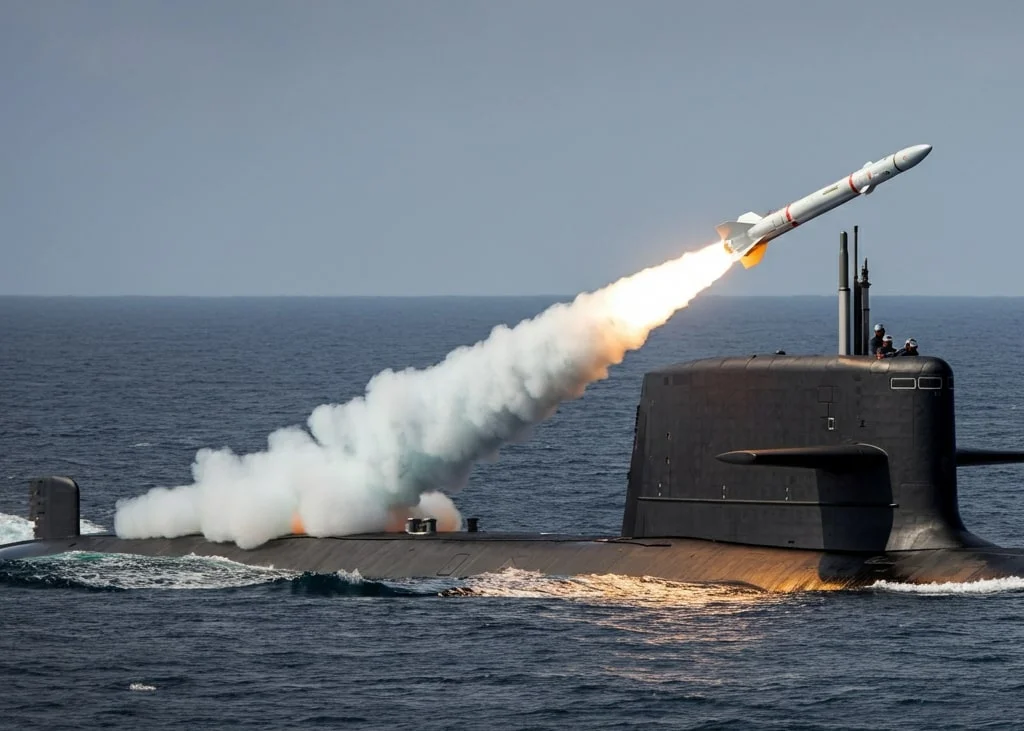
India is preparing to test one of its most ambitious and technologically advanced weapon systems to date — the K-6 hypersonic submarine-launched ballistic missile (SLBM) — marking a historic step in the nation’s strategic defence posture. Developed by the Defence Research and Development Organisation (DRDO) at the Advanced Naval Systems Laboratory in Hyderabad, the K-6 is designed to become the crown jewel of India’s nuclear triad, offering unmatched speed, range, and strike precision.
Hypersonic Speed Meets Strategic Reach
Unlike any missile in India’s current arsenal, the K-6 will boast hypersonic speeds of Mach 7.5 — over 9,200 km/h — allowing it to drastically reduce the time adversaries have to detect or intercept. With an intercontinental range of approximately 8,000 kilometres, the K-6 will extend India’s second-strike capability far beyond regional boundaries, potentially covering targets across Asia, Europe, and parts of Africa.
The K-6 will surpass its predecessors in the K-series, such as the K-4 (3,500 km) and the K-5 (up to 6,000 km), establishing India’s sea-based deterrence as a truly global force.
Equipped with MIRV for Multi-Target Engagement
What makes the K-6 even more formidable is its integration of Multiple Independently Targetable Re-entry Vehicle (MIRV) technology. This allows a single K-6 missile to carry 4–6 nuclear warheads, each capable of striking different targets independently. This capability not only multiplies the destructive potential of a single launch but also overwhelms missile defence systems by saturating them with simultaneous threats.
Next-Gen Deployment on S-5 Class Submarines
India plans to deploy the K-6 on its upcoming S-5 class nuclear submarines, currently in the final stages of design. These submarines — almost double the size of the Arihant-class at around 13,000 tons submerged displacement — are being built to house 12 to 16 K-6 missiles. Production of these vessels is expected to begin by 2027, with synchronized deployment alongside the K-6 expected in the early 2030s.
Advanced Engineering and Indigenous Technology
At over 12 meters long and 2 meters in diameter, the K-6 will be constructed using advanced composite materials and a three-stage solid-fuel propulsion system — ensuring high speed, stealth, and durability. Its advanced guidance systems offer an impressive circular error probable (CEP) of just 90–100 meters, confirming its precision strike capability.
The project is a flagship of India’s Atmanirbhar Bharat (Self-Reliant India) defence initiative, reducing dependence on foreign imports and showcasing the DRDO’s ability to design and manufacture world-class missile systems.
More Than BrahMos: A Strategic Leap
While comparisons are inevitable with India’s BrahMos cruise missile, the K-6 exists in a different league. BrahMos, with a speed of Mach 3 and a range of 800 km, serves as a tactical system. In contrast, the K-6 is a strategic deterrent, capable of global reach, hypersonic speed, and nuclear payload delivery — and launched from hidden submarines, making it nearly impossible to preemptively strike.
Strengthening India’s Nuclear Triad
The K-6 missile will be pivotal in completing India’s nuclear triad, providing the assured second-strike capability vital for its no-first-use policy. Submarine-based systems like the K-6 are essential for survivability in a nuclear exchange, as they remain concealed in vast oceanic spaces.
With the K-6, India joins an elite group of nations — including the U.S., Russia, and China — that possess hypersonic submarine-launched nuclear capability, fundamentally shifting the balance of power in the Indo-Pacific region.
Looking Ahead: First Tests by Late 2020s
Initiated in 2017, the K-6 development program is on track for its first test flights in the late 2020s, with full operational status targeted for the early 2030s. India’s experience from successful K-4 launches — such as the November 2024 test from INS Arighaat — lays a strong foundation for the K-6’s upcoming evaluations.
India’s Strategic Future Is Underwater — and Hypersonic
The K-6 missile represents a landmark in India’s journey toward full-spectrum nuclear deterrence. By merging hypersonic velocity, intercontinental range, MIRV precision, and submarine stealth, India is not just enhancing its defence — it is redefining its position on the global strategic map.
As the missile nears testing and deployment alongside next-gen submarines, the K-6 will become not just a weapon, but a symbol of India’s emergence as a technologically sophisticated, strategically autonomous power in the 21st century.
