

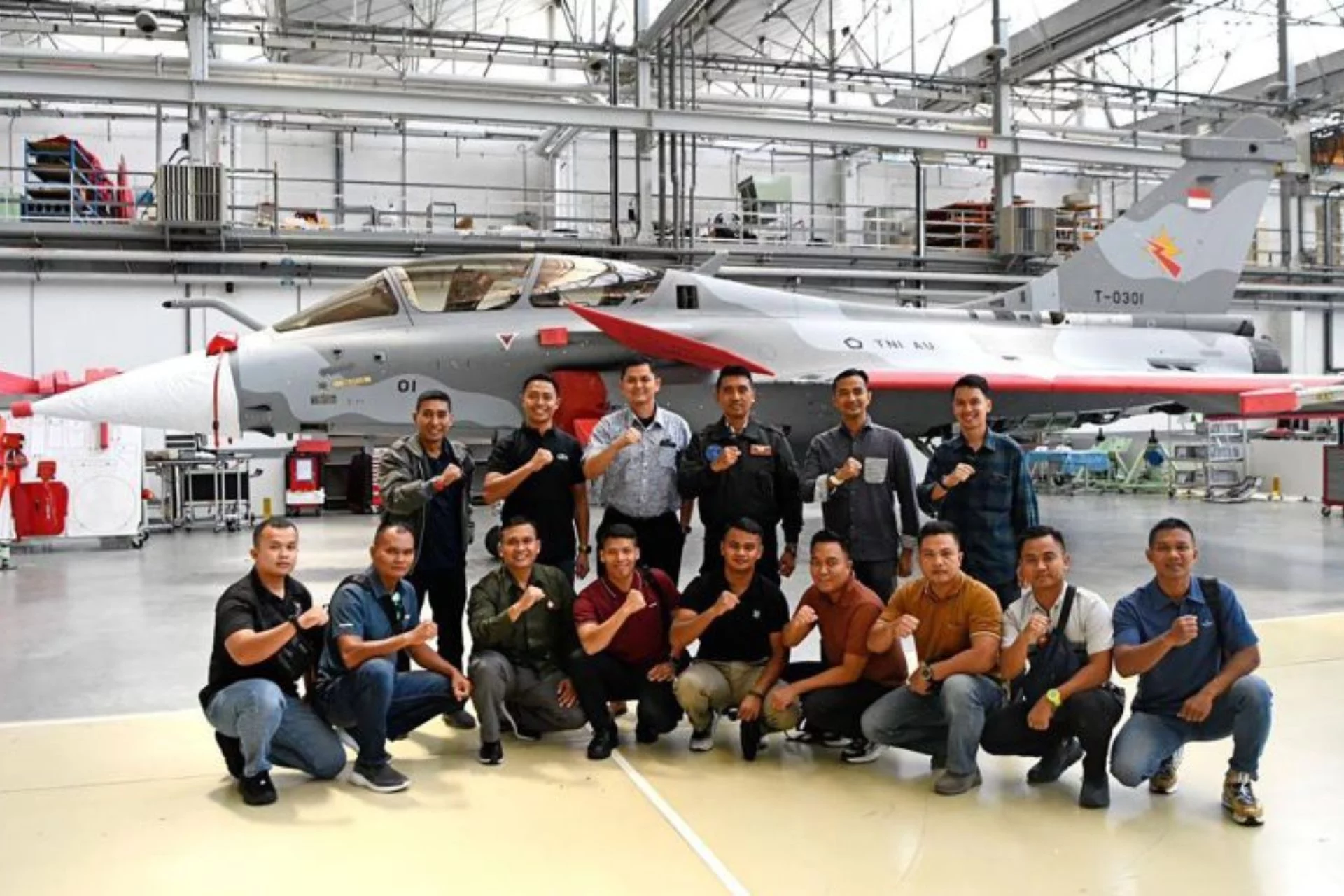
The Indonesian Air Force has unveiled the first Rafale fighter jet in its national colors, signaling the start of a new era for the country’s combat aviation. The aircraft, serial number T-0301, features a two-tone gray camouflage and bears the insignia of the 6th Air Wing on its tail, home to the 12th Air Squadron—the first Indonesian unit set to operate the French-built jet. Aircrews are currently undergoing training as part of the aircraft’s induction process.
Indonesia signed the procurement contract with Dassault Aviation on 10 February 2022 for 26 single-seat Rafale C and 16 two-seat Rafale B variants. During French President Emmanuel Macron’s visit to Indonesia in May 2025, discussions included the potential for additional orders. The Rafale will gradually replace the Air Force’s aging F-16s and Sukhoi Su-27/Su-30s, complementing future acquisitions of the South Korean KF-21 Boramae and the Turkish Kaan, as part of a broader modernization strategy.
Designed as a multirole platform, the Rafale combines a delta wing with close-coupled canards, providing high agility and balanced performance in both air combat and ground-attack roles. It is equipped with advanced systems including the RBE2 AESA radar, SPECTRA electronic warfare suite, and MDPU modular avionics, enabling sophisticated data fusion and robust defensive measures. Powered by two M88-2 turbofan engines, the fighter can reach speeds up to 1,800 km/h, operate at ranges up to 3,700 km, and carry more than nine tons of weapons and fuel across 14 hardpoints. Its arsenal includes MICA and Meteor air-to-air missiles, SCALP cruise missiles, Exocet anti-ship missiles, precision-guided AASM and laser bombs, and a 30 mm Nexter cannon.
Currently, four Indonesian pilots and twelve technicians are in France for initial training. From 20 August to December, pilots will train at Saint-Dizier Air Base, undertaking both live and simulator missions, while technicians receive classroom and hangar-based instruction in organizational-level maintenance alongside French Air and Space Force personnel. The jet showcased in the image is a two-seat Rafale B—one of 16 ordered—allowing Indonesia to begin training flights on its own aircraft from the outset.
The arrival of the Rafale represents a strategic transformation in Indonesia’s air defense posture. Combined with the forthcoming Kaan and KF-21 fighters, the new fleet will provide advanced air superiority, deterrence, and precision strike capabilities across Indonesia’s vast archipelago and beyond. With long-range sensors, multi-target engagement, and interoperability with regional and global partners, the Rafale will strengthen Indonesia’s ability to patrol its airspace, secure contested zones, and conduct deep-strike missions.
Operational lessons from other Rafale operators—such as India’s combat experience against Pakistan—show that even advanced fighters require strong intelligence, seamless joint operations, and adaptive engagement strategies. For Indonesia, integrating the Rafale will mean upgrading detection networks, enhancing command-and-control systems, training for high-intensity operations, and developing long-range tactics. In a region where air capabilities are advancing rapidly and external powers are increasingly active, the Rafale’s success will depend on being embedded within a responsive and well-coordinated operational framework.
