

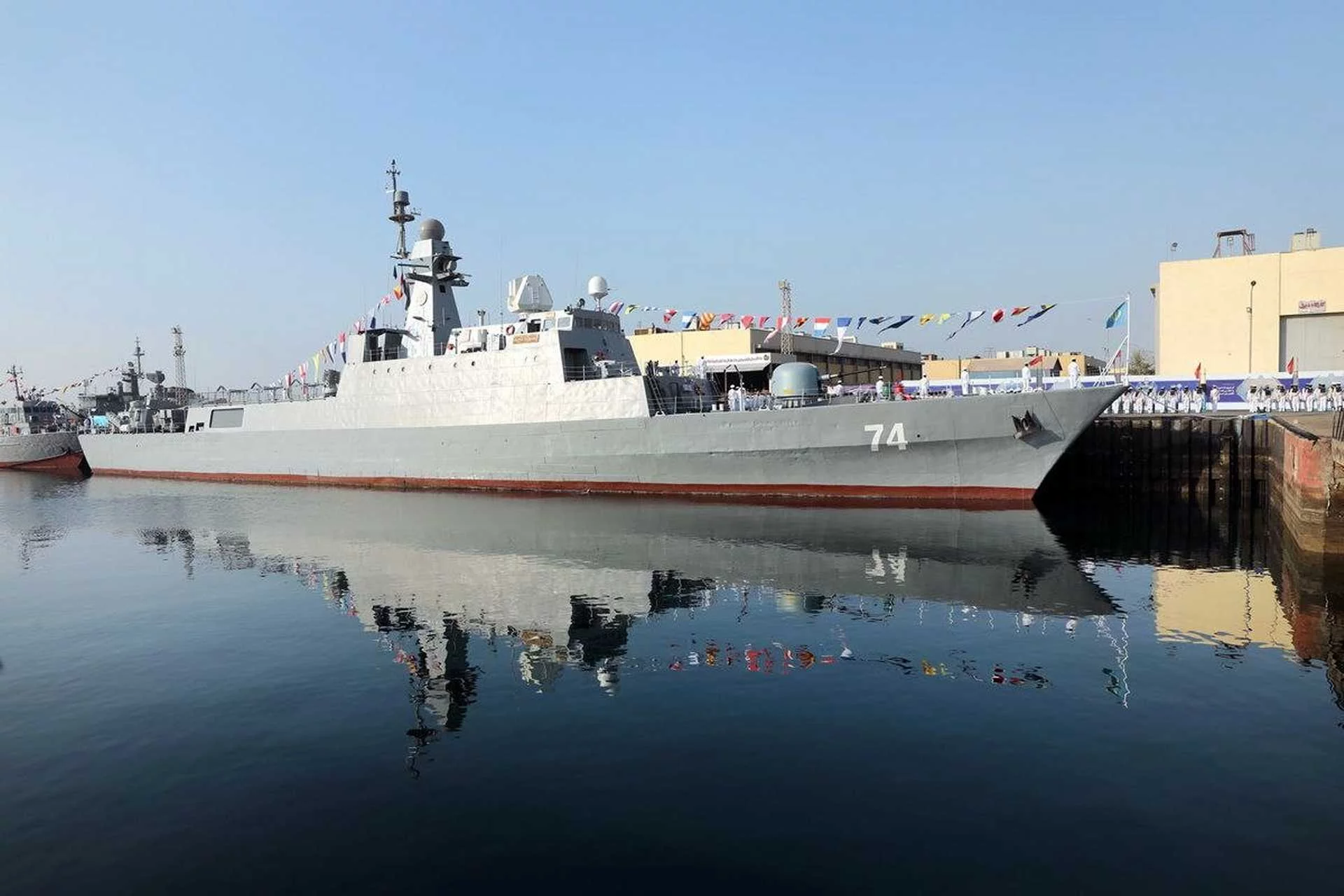
Iran has returned the Moudge-class frigate Sahand to operational status following extensive repairs after its 2024 capsizing, recommissioning the ship alongside the forward base vessel Kurdistan during a Navy Day ceremony in Bandar Abbas. The move is being framed as a reaffirmation of Iran’s ambitions to sustain long-range naval operations despite recent setbacks.
According to domestic reports, Sahand— which capsized and partially sank at the Bandar Abbas shipyard in July 2024 during maintenance—has completed a lengthy recovery and overhaul phase and has now rejoined the fleet. The recommissioning event also saw the formal induction of the Makran-class forward base ship Kurdistan, described by Iranian officials as a platform that will extend the navy’s endurance and access to international waters.
Navy Day Ceremony in Bandar Abbas Showcases New Platforms
The ceremony took place in Bandar Abbas in the presence of senior military leaders including Major General Amir Hatami, Rear Admiral Habibollah Sayyari, and Rear Admiral Shahram Irani, as well as provincial governors, religious figures, members of parliament, and families of naval personnel. As part of Navy Day commemorations, three families of sailors killed on duty were honored.
Beyond Sahand and Kurdistan, the navy also unveiled:
- A missile-armed fast attack craft,
- Multipurpose unmanned aerial vehicles,
- Uncrewed underwater systems,
- New electronic warfare, missile and intelligence systems deployed from shore and at sea.
Naval leaders linked these additions to broader objectives: improving combat readiness, updating weapons projects to match evolving threats, deepening innovation in ship design, and expanding Iran’s presence in strategic waterways. They reiterated that security in the Strait of Hormuz and adjacent sea lanes should, in their view, be provided by regional states rather than outside powers, tying naval expansion to sea-based economic development.
Kurdistan: Sea Basing and Long-Range Support
Although secondary in media focus, the forward base ship Kurdistan is central to how Sahand and other combatants may be used in future. Converted from a decades-old crude oil tanker, Kurdistan features:
- A large flight deck for helicopters and UAV operations,
- Facilities for search and rescue, medical support, and at-sea logistics,
- The ability to deliver fuel, food and supplies to deployed units,
- Support for both naval and non-naval forces and a “port-city” role along Iran’s Makran coast.
Iranian descriptions claim that Kurdistan can sustain up to three destroyers on a three-year, round-the-world deployment without needing to refuel in port. In line with a naming convention designed to tie the fleet to national identity, floating bases are named after provinces (e.g., Kurdistan, future Khuzestan units), destroyers after mountain peaks, missile boats after Shahnameh heroes, and support vessels after ports.
Sahand: Specifications and Combat Systems
Sahand, classified as a destroyer by Iran and generally as a frigate by foreign analysts, is the third Moudge-class ship built at the Bandar Abbas NEDAJA facilities. Launched in September 2012 and commissioned in December 2018 under pennant number 74, the vessel is roughly 94–95 meters long, with an 11-meter beam and displacement reported in the 1,200–1,500-ton range (around 1,300 tons in many accounts).
Key characteristics include:
- Four diesel engines and four generators, enabling speeds of about 30 knots,
- Endurance of up to 150 days at sea when supported by an auxiliary ship,
- A crew complement of around 140 personnel,
- A stern helicopter deck and hangar for Bell 212/214 or similar aircraft.
The ship is equipped with the Asr 3D long-range PESA radar, electronic warfare suites and chaff launchers for decoy deployment, while stealth measures include radar-absorbing materials, minimized protrusions and an exhaust funnel integrated into the superstructure.
Weapons Fit and Air Defense Upgrades
Prior to its latest announced upgrades, Sahand’s armament package comprised:
- A 76 mm Fajr-27 main gun on the foredeck,
- A 40 mm Fath-40 or a 30 mm Kamand close-in weapon system,
- Two 20 mm Oerlikon guns and 12.7 mm heavy machine guns,
- Eight Qader or Noor anti-ship cruise missiles,
- Four Mehrab surface-to-air missiles (navalized Sayyad-2),
- Two triple 324 mm torpedo launchers for anti-submarine warfare.
The Kamand CIWS is credited with a firing rate of 4,000–7,000 rounds per minute and engagement ranges of roughly 2–4 km.
In May 2025, the Iranian Navy announced plans to upgrade Sahand with Sayyad-3 and Navvab air defense systems, increasing the missile load from eight to twelve and fielding three different classes of SAMs onboard:
- Sayyad-3: A third-generation solid-fuel SAM with a reported range of around 120 km and engagement altitude up to roughly 27–30 km, associated with ground-based systems such as Khordad-15, Talaash-3 and Bavar-373.
- Navvab: The navalized variant of the Zoubin short-range system, incorporating radar, command unit and vertical launch cells on a single platform, with the Zoubin radar said to detect targets to about 30 km, track up to 100 and engage multiple threats within a 15–20 km (planned 25 km) envelope.
Navvab has already been integrated on Shahid Soleimani and Zolfaghar-class vessels and on high-speed boats, and is intended to form part of a wider layered network that also involves systems such as Majid, Mersad and Third Khordad. Future plans include vertical-launch installations of this family on Moudge-class ships like Sahand and Teftan.
Operational Record, Accident and Recovery
Before the 2024 accident, Sahand had been used by Iran as a symbol of extended naval reach. In 2019, the frigate deployed to the Gulf of Aden with the supply ship Kharg to escort commercial shipping and address piracy and wider maritime security risks. In 2021, Sahand and the forward base ship Makran undertook a 133-day deployment of roughly 144,000 km, reaching the Atlantic and Saint Petersburg to participate in Russian Navy Day events—described domestically as the first Iranian naval presence in the Atlantic without foreign port calls.
The July 2024 capsizing occurred while Sahand was in dry-dock-like conditions for repairs. Water reportedly leaked into internal tanks, the ship lost balance in shallow water and rolled over. Efforts to stabilize the hull were hampered when a securing rope failed, causing the vessel to sink further, with at least one officer killed and several personnel injured according to local reporting. Salvage operations using heavy lifting gear and technical teams from the Iran Shipbuilding and Offshore Industries Complex lasted about two weeks, with the hull finally fully raised around 22 July 2024 and towed for overhaul.
Recommissioning in a Broader Naval Context
Over the past 15 years, Iran has pursued a policy of building its own surface combatants—including the first indigenous destroyer in 2010 and subsequent Moudge-class vessels such as Jamaran, Damavand and Sahand—largely in response to sanctions that restrict arms imports. The same period has seen multiple high-profile naval losses, from the friendly-fire sinking of Konarak in 2020 to the Kharg fire in 2021 and the grounding of Damavand in the Caspian.
Within this mixed record, bringing Sahand back to sea with upgraded air defense systems and pairing it with the Kurdistan forward base ship is being presented as proof that Iran intends to preserve and extend its blue-water ambitions: escorting shipping, conducting joint drills with partners such as Russia, China and Pakistan, and sustaining a more persistent naval presence in regional seas and beyond.
