

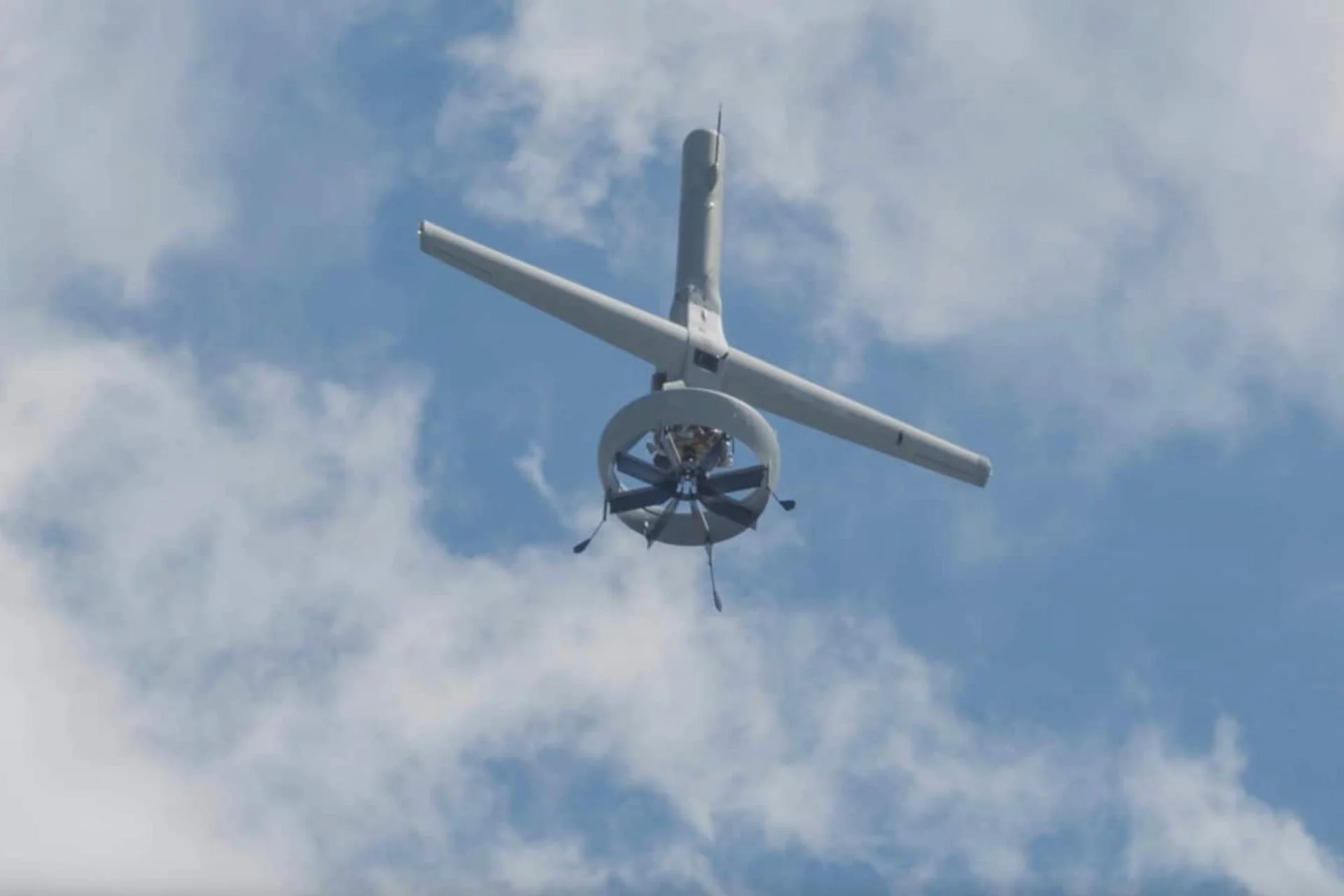
Japan has officially confirmed its plans to deploy advanced unmanned aerial vehicles (UAVs) aboard its naval fleet, as detailed in the 2025 Defense White Paper published on July 16. Facing an increasingly volatile regional environment, Tokyo is reinforcing its maritime surveillance capabilities by integrating shipborne drones. Six compact UAVs are expected to be introduced by the end of fiscal year 2025. While the white paper did not name a specific platform, Shield AI previously confirmed that its V-BAT drone was selected for deployment on Japanese warships.
The V-BAT is a vertical takeoff and landing drone designed for high-endurance ISR (Intelligence, Surveillance, Reconnaissance) missions in denied environments. It features a ducted fan for safer deck operations and offers over 13 hours of flight time. Its modular design supports quick deployment and a payload capacity of up to 18 kg. Equipped with a SAR radar, ViDAR optical system, laser designator, and SATCOM, the V-BAT can operate effectively even when GPS or communications are jammed.
Beyond the Navy, Japan’s self-defense forces operate a variety of UAVs. The RQ-4B Global Hawk serves for high-altitude surveillance, the MQ-9B SeaGuardian is used for maritime patrol, and Insitu’s ScanEagle supports mid-range ISR missions. Additionally, Mitsubishi Heavy Industries is developing a medium-class cargo UAV capable of carrying 200 kg, recently showcased during a disaster response drill.
Japan is also looking ahead to next-generation aerial warfare. As part of the GCAP (Global Combat Air Programme) with the UK and Italy, Japan is co-developing a loyal wingman UCAV to operate alongside sixth-generation fighters by 2035. These semi-autonomous platforms will rely heavily on artificial intelligence for strike and electronic warfare roles.
These strategic steps reflect Japan’s commitment to building an integrated and autonomous defense ecosystem. From reconnaissance drones to armed platforms and logistics UAVs, Japan’s growing UAV inventory is tailored to meet the multifaceted challenges of the Indo-Pacific. The integration of the V-BAT not only extends Japan’s maritime situational awareness but also strengthens interoperability with allied forces amid rising tensions with China, Russia, and North Korea.
