

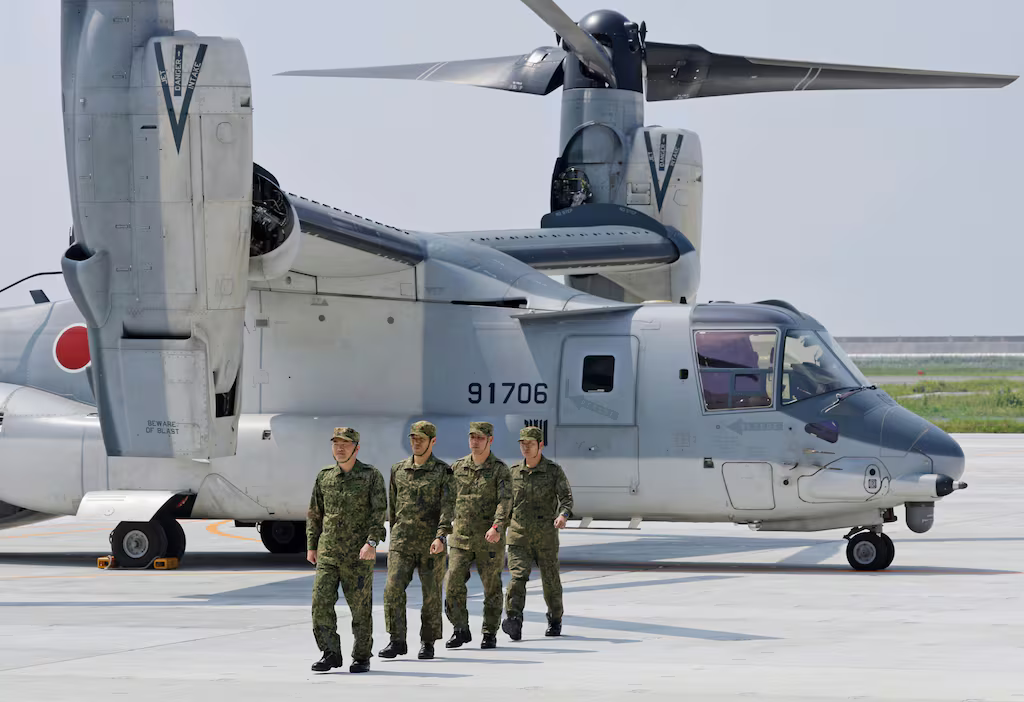
Japan has begun stationing its fleet of V-22 Osprey tiltrotor aircraft at a newly established permanent base in the country’s southwest, marking a significant step in Tokyo’s expanding defense strategy. The deployment to Camp Saga, announced by the Ground Self-Defense Force, comes as regional tensions continue to escalate—particularly with China’s growing maritime assertiveness.
The first aircraft has already arrived, and the full fleet of 17 is expected to be in place by mid-August. The Ospreys will be closely integrated with Japan’s amphibious rapid deployment brigade based in nearby Sasebo, enhancing the nation’s ability to defend its remote southwestern islands.
Defense Minister Gen Nakatani emphasized the urgency of strengthening Japan’s island defenses, citing an increasingly hostile security environment. “We must act swiftly to bolster our readiness,” he said.
However, the Osprey’s presence remains divisive. Public opposition persists, particularly in Japan’s southern regions, due to the aircraft’s safety record. Outside Camp Saga, demonstrators voiced their discontent, holding signs and chanting slogans against the deployment. “There’s always a fear that it could crash again,” said protester Osamu Rikihisa.
That fear is not unfounded. A U.S. Air Force Osprey crash in November 2023 off the southern coast of Japan claimed eight lives. A year later, a Japanese Osprey suffered a mishap during joint drills, with investigators blaming human error.
Still, Prime Minister Shigeru Ishiba defended the deployment during a campaign stop in Saga, arguing that the Ospreys offer superior range and versatility compared to conventional helicopters—making them a vital asset for both defense and disaster response.
