

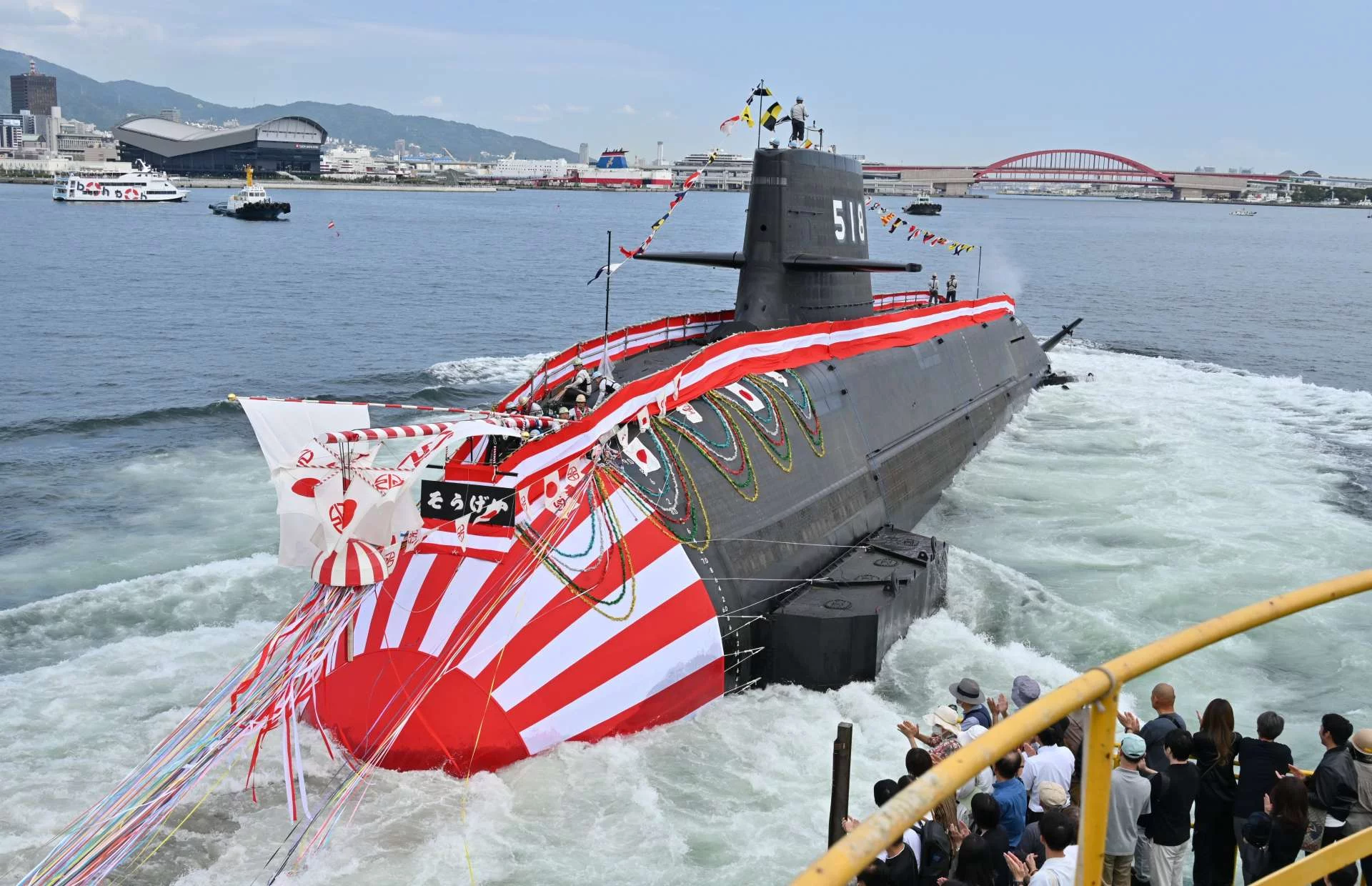
Japan has launched its sixth Taigei-class attack submarine, JS Sogei (SS-518), at Kawasaki Heavy Industries’ Kobe facility. Powered by lithium-ion batteries, the new submarine enhances Tokyo’s undersea capabilities and reflects the ongoing modernization of the Japan Maritime Self-Defense Force.
Technical Specifications and Armament
The 3,000-ton, 84-meter JS Sogei carries a crew of approximately 70 and is equipped with six 533 mm tubes for heavyweight torpedoes and tube-launched anti-ship missiles. Its lithium-ion batteries provide extended endurance, sprint capability, and low acoustic signatures. Advanced diesel engines and the ZQQ-8 sonar suite increase speed, stealth, and operational range.
Production Cadence and Modernization
The Taigei-class has followed an accelerated production schedule, with nearly one submarine launched annually since 2020. From the fourth boat onward, Kawasaki’s high-output 12V25/31 diesels and upgraded snorkel systems reduce battery recharge times and limit exposure at periscope depth.
Operational Capability and Strategic Advantages
JS Sogei is armed with Type 18 heavyweight torpedoes and UGM-84L Harpoon missiles. Its combination of lithium-ion batteries and powerful diesels allows fast, covert maneuvers and ambush operations. In peacetime, the submarine can perform ISR, trailing, and barrier patrols; in crisis scenarios, it can execute anti-submarine and anti-surface ambushes, deploy mines, and, with future tube-launched long-range missiles, strike land targets covertly.
Regional Comparison and Strategy
Compared to China’s AIP-equipped Yuan-class and South Korea’s KSS-III, the Taigei-class emphasizes rapid, stealthy repositioning and effective strike options from its tubes. Each new Taigei enhances JMSDF’s ability to police the straits, deter coercion near the Senkaku Islands, and integrate with U.S. and Australian undersea networks. The launch of JS Sogei demonstrates Japan’s intent to develop a strategically tailored undersea force along the first island chain.
