

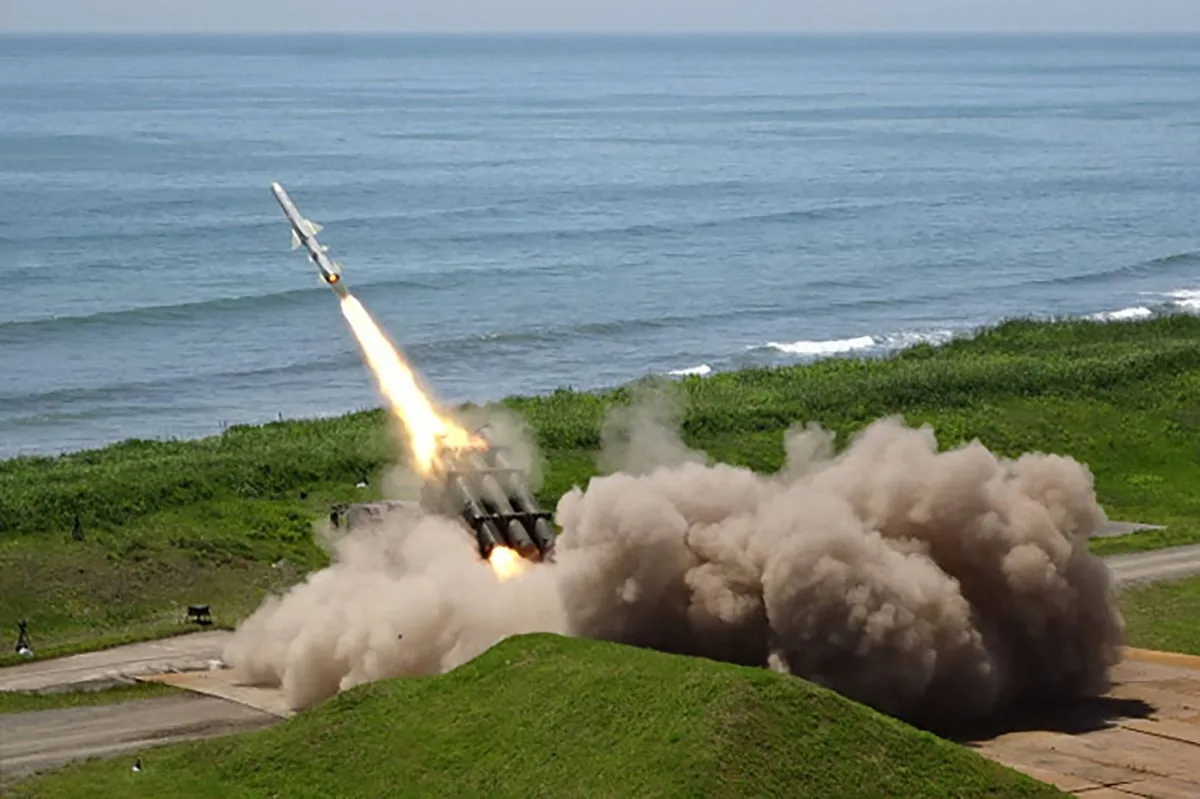
Japan’s Defense Ministry has launched a research effort to explore a new generation of anti-ship weapons that would cooperate in flight using onboard artificial intelligence, ministry documents show. The program — backed by an initial budget request of about ¥200 million for fiscal 2026 — will study secure communications, resistance to jamming, and safety controls as part of a multi-year evaluation that could lead to practical use around fiscal 2029 if tests prove satisfactory.
The concept under study moves beyond single-weapon guidance: missiles, decoys and electronic-attack pods would form a networked “salvo” that exchanges sensor updates, assigns roles and adapts trajectories when targets maneuver or defenders employ countermeasures. Each weapon would keep its own terminal seeker for final identification and attack, while a cooperative layer helps preserve mission continuity if individual nodes are jammed, lost, or degraded.
Program planners frame the work as a way to extend engagement range, complicate an opponent’s decision-making and increase the likelihood that at least part of an incoming wave penetrates layered defenses. Cooperative behavior could let the group synchronize time-on-target from multiple bearings, stagger approach profiles to overwhelm interceptors, and use coordinated decoys and jammers to impose uncertainty on defenders.
Technical and legal caution is central to the effort. The ministry says human officers will remain responsible for mission intent and the authority to approve engagement parameters throughout testing and any later deployment decision. The assessment will examine encryption, authentication and survivable datalinks to guard against spoofing or hostile takeover, and will define fallback modes so a salvo can revert to preplanned profiles if communications fail.
Researchers will also evaluate different networking architectures: simpler leader-follower schemes that centralize decision authority versus fully distributed meshes that let each missile act as an autonomous node. Each model trades off robustness, processing demand and complexity. At the algorithmic level, onboard AI would fuse radar, infrared and radio-frequency cues to maintain tracks in cluttered seas and help discriminate real targets from decoys in the terminal phase — while operational constraints and fail-safes would limit any autonomous use of lethal effects.
The ministry’s timetable anticipates a three-year evaluation of higher-performance AI to determine cost-effectiveness and technical risk before committing to production. Observers note that linked or semi-cooperative behaviors are not unprecedented — earlier missiles and some modern systems include datalinks and coordinated attack logic — but Japan’s program appears aimed at expanding that capability set with greater onboard autonomy and integrated electronic attack, subject to strict human oversight and safety safeguards.
