

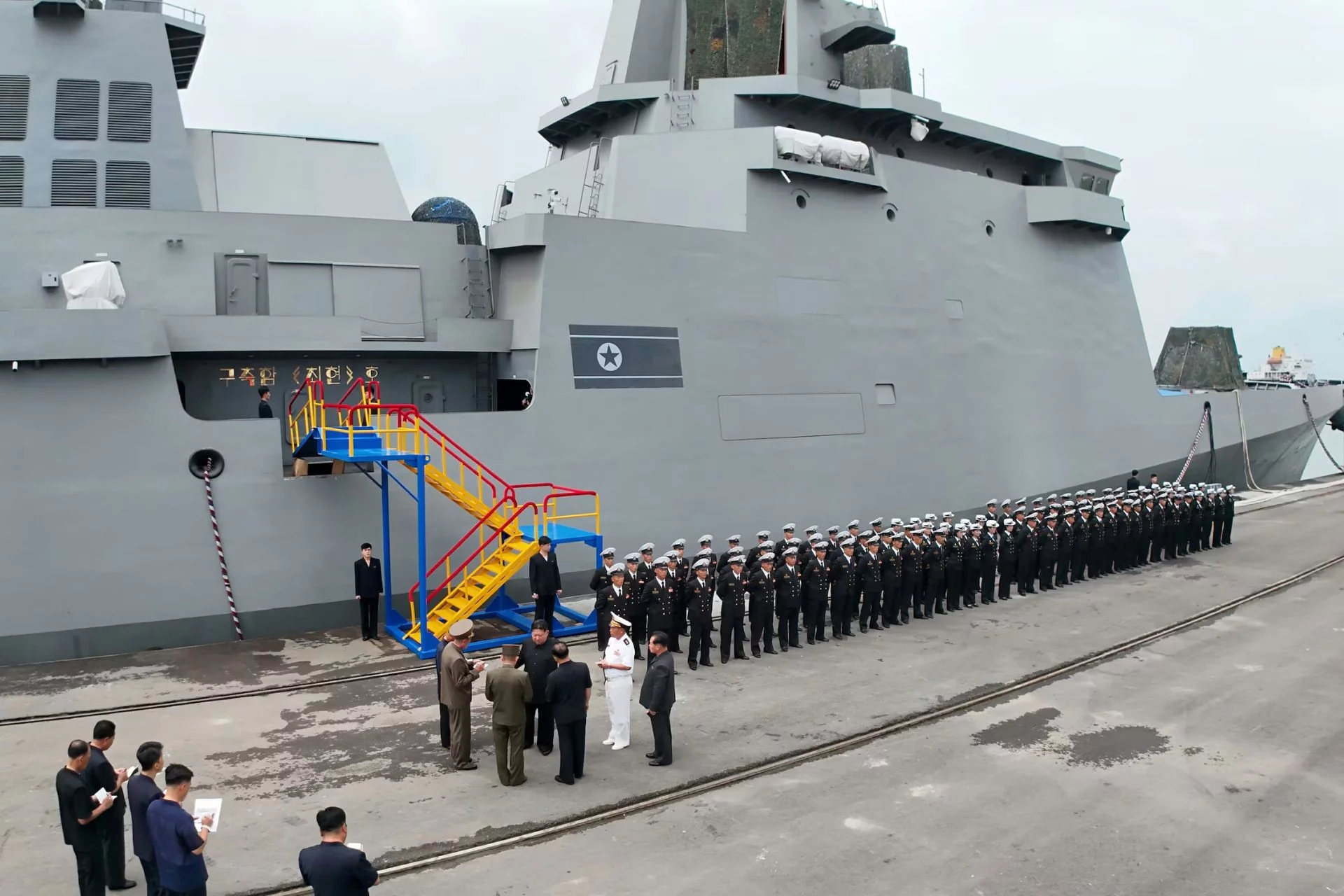
North Korean leader Kim Jong Un inspected the Choe Hyon, a 5,000-ton destroyer under development, on August 19, 2025. The warship—intended to be fitted with cruise missiles and tactical ballistic missiles capable of carrying nuclear warheads—served as the backdrop for Kim’s renewed call to accelerate the country’s nuclear expansion. He argued that an “urgent response” was required to counter what he described as mounting threats from the United States and South Korea.
Welcomed aboard by Vice Admiral Pak Kwang Sop, Kim reviewed crew conditions, received a technical briefing on the ship’s integrated combat systems, and assessed ongoing trials. State media reported that the destroyer’s full evaluation is expected in October, while a third vessel of the class is under construction at Nampo shipyard. The program aims to deliver at least two large surface combatants annually, marking an unprecedented expansion of North Korea’s naval capabilities.
The Choe Hyon class, North Korea’s largest warship design to date, represents a leap in both size and firepower. With a displacement of around 5,000 tons, a length of roughly 145 meters, and a beam of 16 meters, it is equipped with phased array radars, fire-control systems, sonar, and electronic countermeasures. Armament includes a 127–130 mm naval gun, Pantsir-ME and AK-630 CIWS, 74 vertical launch system cells, anti-ship missiles, Bulsae-4 SAMs, and 533 mm torpedo tubes. The flight deck supports helicopter or UAV operations, extending surveillance and anti-submarine capabilities.
Strategically, these ships are envisioned as platforms for nuclear-capable missiles, extending Pyongyang’s deterrence at sea. Although lacking the survivability of nuclear submarines, the destroyers add a new dimension to North Korea’s arsenal by complicating adversaries’ operational planning and signaling long-range strike potential.
The announcement coincides with Ulchi Freedom Shield 25, ongoing joint US–South Korea military drills that include field maneuvers, air operations, cyber and space simulations, and the participation of US F-35 fighters and the carrier USS George Washington. While Washington and Seoul describe the exercises as defensive, Pyongyang denounces them as hostile, using the drills to justify its accelerated militarization.
Kim’s rhetoric underscores a deliberate escalation: a vision of a “high-tech, nuclearized navy” able to directly threaten US and South Korean forces. Despite South Korean President Lee Jae Myung’s recent offer of dialogue, Pyongyang rejected talks, with Kim Yo Jong reiterating that the North has “no will” to improve relations.
By arming its navy with nuclear-capable destroyers, North Korea signals a decisive shift in regional power dynamics. The strategy raises concerns of a deepening security imbalance in Northeast Asia and heightens the risk of confrontation amid closer US–South Korea–Japan military cooperation.
