

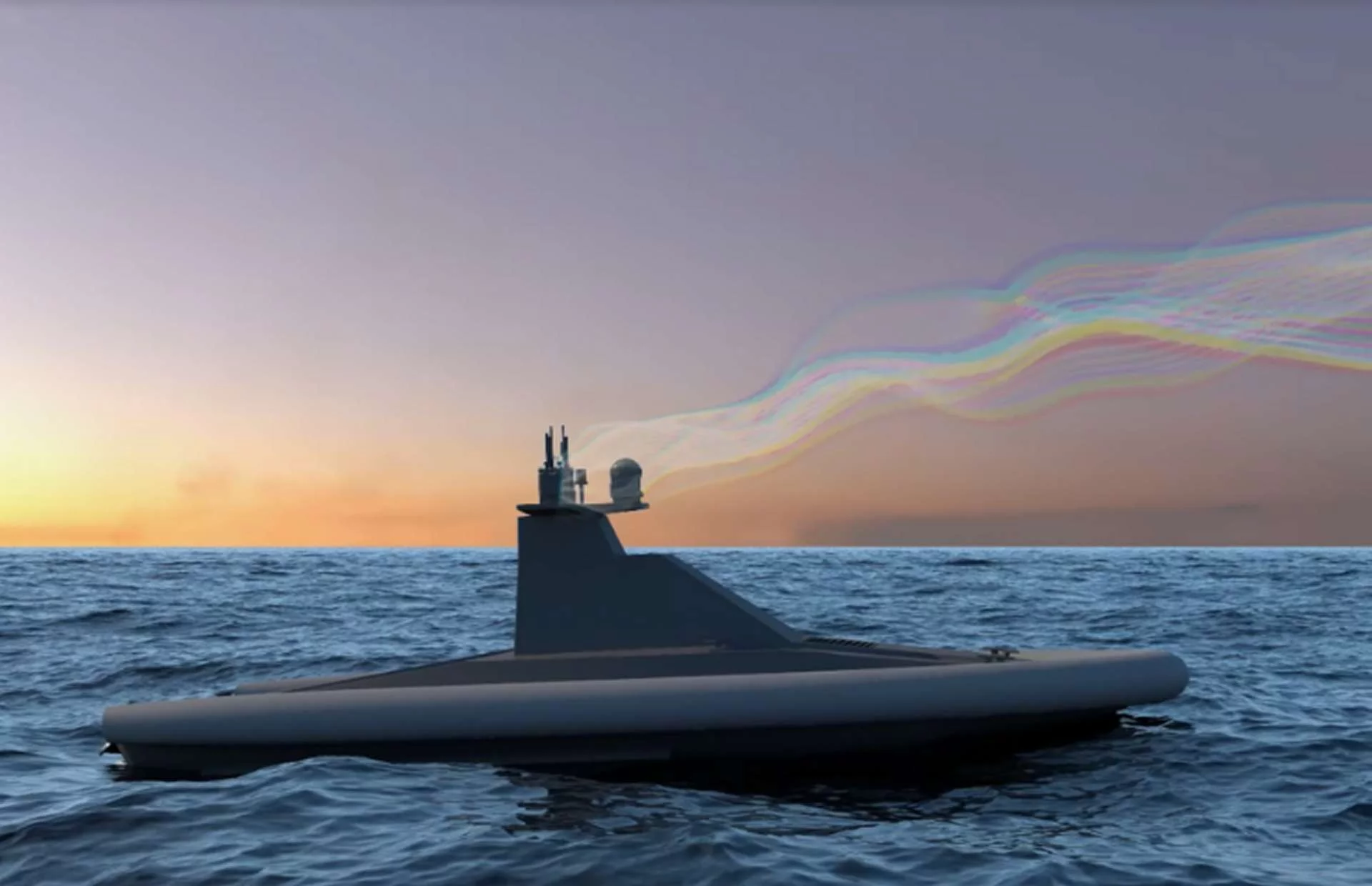
Leonardo DRS has successfully completed open-water trials of its Maritime Mission Equipment Package (MEP) on August 12, 2025, demonstrating an advanced counter-unmanned aerial system designed for integration on small unmanned surface vessels (USVs).
Built on a modular open-systems architecture adapted from the company’s land-based short-range air defense and counter-drone solutions, MEP is engineered to tackle aerial threats launched from surface, subsurface, or land-based platforms. The system autonomously executes the full kill chain—detection, identification, tracking, classification, and engagement coordination—while maintaining real-time maritime situational awareness.
At its core, the BlackLab passive RF detection system identifies and geolocates hostile drones by intercepting control and telemetry signals across multiple frequency bands, without emitting detectable signatures. This capability is particularly valuable in contested electromagnetic environments. Complementing this is the STAG EO/IR gimbal, equipped with high-resolution day cameras and cooled thermal imaging sensors for precision tracking, even in adverse weather or against low-signature drone profiles.
All sensor inputs are processed through Leonardo’s AI-powered sensor fusion core, which rapidly distinguishes between commercial UAVs, military-grade threats, and friendly aerial assets. The architecture supports both soft-kill options—such as directional RF jamming, GPS spoofing, and advanced 4G/5G electronic warfare modules—and hard-kill systems including compact missile launchers and kinetic interceptors.
The MEP is suitable not only for naval fleets but also for coast guards, offshore security operators, and agencies safeguarding strategic waterways. Potential adopters include the U.S. Navy, Royal Navy, Japan Maritime Self-Defense Force, NATO members, and emerging maritime powers in the Asia-Pacific and Middle East.
By enabling distributed and autonomous patrol operations, MEP-equipped USVs extend fleet defensive coverage, detect threats earlier, and reduce risks to human crews. This aligns with modern distributed maritime operations doctrine, ensuring that hostile drones face multiple autonomous defensive layers before they can pose a danger to manned assets.
