

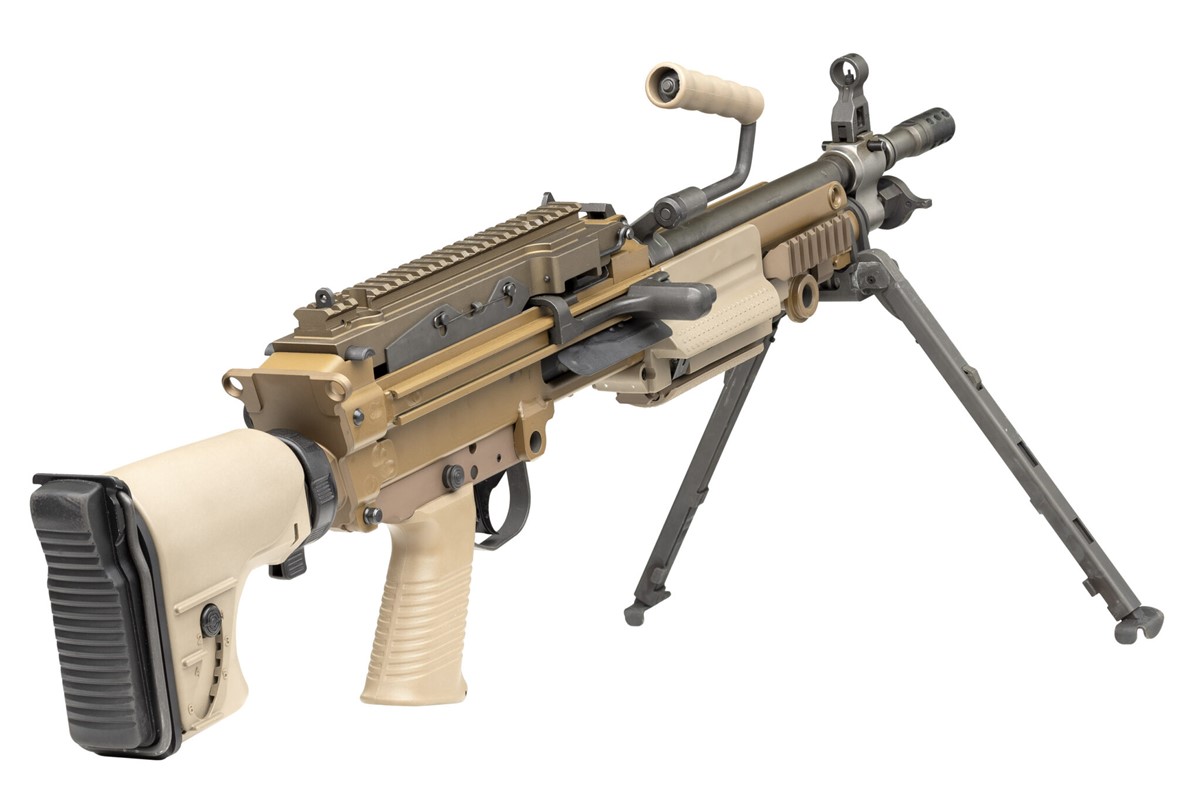
A light machine gun (LMG) is a lightweight automatic firearm designed to provide infantry support, typically operated by a single soldier with or without assistance. These weapons usually fire the same caliber ammunition as standard rifles used within the same squad, and are often referred to as squad automatic weapons (SAWs).
Characteristics
Early LMGs fired full-power rifle cartridges, but modern LMGs tend to use lighter, intermediate cartridges—often the same rounds used by service assault rifles. This change has allowed for reduced weight and better portability. Some LMGs, such as the Russian RPK, are modified versions of standard rifles, adapted with heavier barrels, larger magazines, reinforced internal mechanisms, and bipods to handle sustained fire.
The classification of an LMG also depends on usage and configuration. Many general-purpose machine guns (GPMGs) can serve as either LMGs or medium machine guns (MMGs). When deployed on a tripod for prolonged suppressive fire, they function as MMGs. When used from a bipod in short bursts, particularly from a prone position, they are considered LMGs.
LMGs are typically employed to deliver suppressive fire, either from the hip or while advancing, enabling tactical maneuvers. This mobile fire technique is the foundation of “walking fire” tactics. Modern LMGs are now light enough to be deployed at the fire team level, with platoons often using multiple units.
Ammunition Feeding Systems
Historically, many LMGs like the Bren gun or Browning Automatic Rifle (BAR) were magazine-fed. Others, such as the Hotchkiss M1922, utilized belt or box feeding mechanisms. Modern LMGs, firing smaller calibers, are commonly belt-fed from attached pouches or supplied via high-capacity drum magazines. Some models, like the FN Minimi, also accept standard rifle magazines as a backup when belts are exhausted.
Historical Development
In 1903, French military theorists recognized that heavy machine guns were ineffective during infantry assaults. They proposed the idea that the machine gun “must learn to walk.” This led to theoretical development of portable automatic weapons capable of providing suppressive fire during advances. Although early prototypes were not adopted in time for World War I, the outbreak of war pushed France to mass-produce them quickly to enhance infantry firepower.
By the end of World War II, it had become standard for each squad or fire team to have an LMG. Modern infantry tactics evolved around the deployment of LMGs to deliver suppressive fire and dominate small-unit engagements.
Selected Examples of Light Machine Guns
Below is a table showcasing historically and operationally significant LMGs. Some are dedicated designs; others are adaptations of existing weapons:
| Model | Country of Origin | Year Designed | Caliber(s) | Weight | Feed System | Rate of Fire (rpm) | Notes |
|---|---|---|---|---|---|---|---|
| Madsen | Denmark | 1896 | Various | 9.07 kg | Box Magazine | 450 | One of the earliest LMGs |
| Chauchat CSRG | France | 1907 | 8mm Lebel, .30-06 | 9.07 kg | Magazine | 240–360 | Widely used in WWI |
| BAR M1918 | USA | 1917 | .30-06, 7.92mm, 6.5mm | 8.8 kg | Magazine | 650 | Squad-level support weapon |
| RPK | USSR | 1960 | 7.62×39mm | 4.8 kg | Drum/Magazine | 600 | LMG variant of AK-47 |
| FN Minimi (M249) | Belgium | 1974 | 5.56mm NATO, 7.62mm NATO | 6.85 kg | Belt/Magazine | 1,150 | Still in service globally |
| Heckler & Koch MG4 | Germany | 1990s | 5.56mm NATO | 8.55 kg | Belt-fed | 885 | German Army standard LMG |
| Ultimax 100 | Singapore | 1977 | 5.56mm NATO | 4.75 kg | Drum/Magazine | 600 | Known for excellent control |
| IWI Negev | Israel | 1985 | 5.56mm NATO | 7.4 kg | Belt/Magazine | 1,150 | Versatile and rugged design |
| M27 IAR | Germany/USA | 2008 | 5.56mm NATO | 3.6 kg | Drum/Magazine | 640 | Used by US Marines |
