

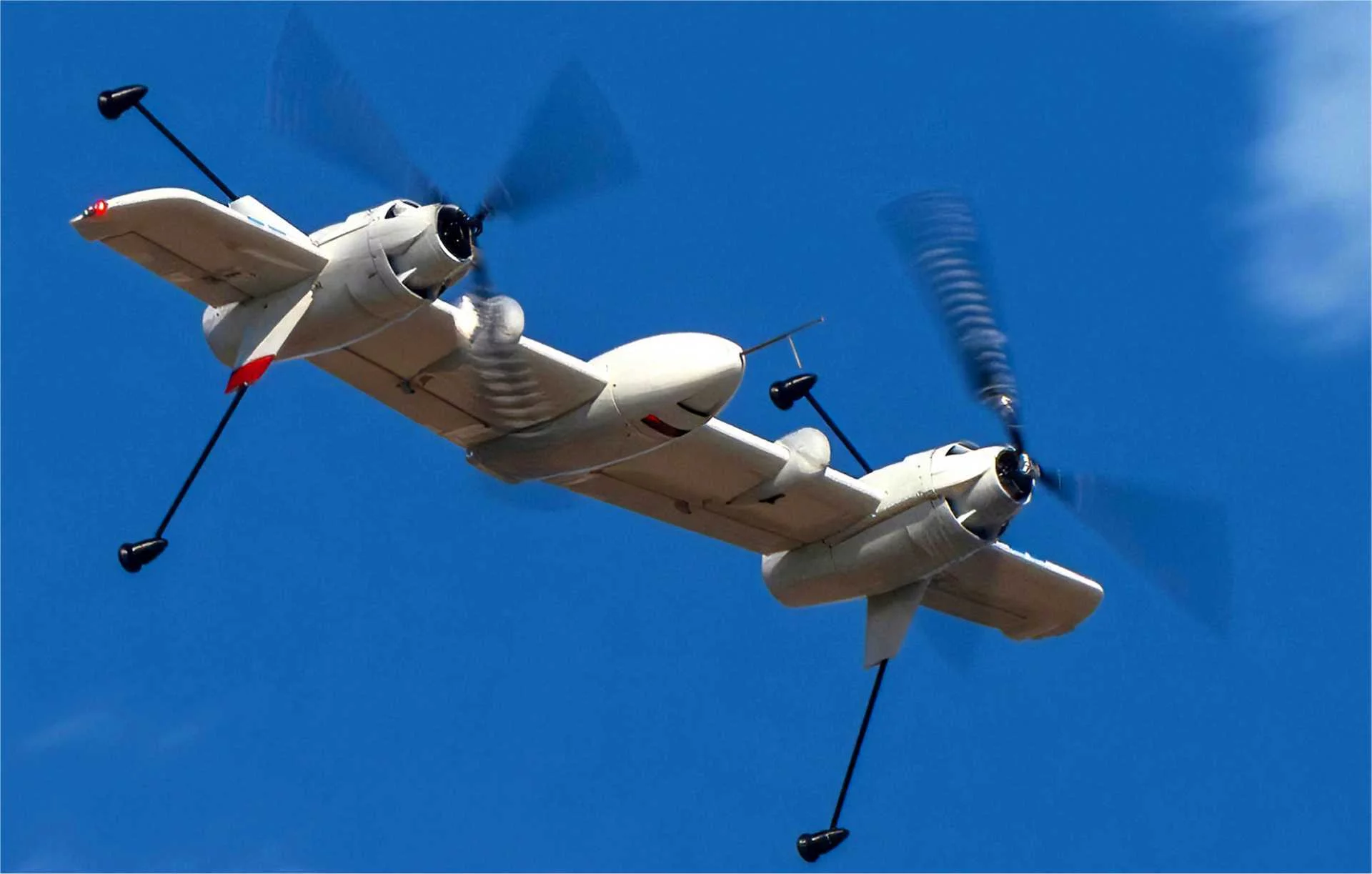
Sikorsky, a Lockheed Martin company, revealed its new Nomad™ family of rotor-blown wing VTOL unmanned aerial systems on October 6, 2025. The scalable, runway-independent designs are intended to fulfill reconnaissance, light-strike and contested logistics roles in multi-domain operations, marking a significant push to expand autonomous capabilities for future U.S. military missions.
Nomad’s rotor-blown wing architecture pairs twin proprotors with a fixed wing, enabling vertical lift for takeoff and landing and efficient wing-borne cruise in forward flight. That dual-mode performance delivers greater range and endurance than conventional rotary-wing UAS without requiring runways or dedicated launch infrastructure.
During hover and transition, rotor downwash is channeled over the wing to enhance lift and control, while forward flight shifts lift to the wing for superior fuel economy and loiter time. Sikorsky’s autonomous flight controls handle the aerodynamic transition and continuously optimize flight profiles across mission phases.
Flight testing began in early 2025 with the Nomad 50 demonstrator — a 10.3-foot wingspan prototype that validated vertical lift, transition mechanics and stable cruise. Sikorsky is now scaling up to the Nomad 100, an 18-foot wingspan Group-3 variant intended for tactical ISR and light payload delivery; it incorporates a hybrid-electric propulsion system for quieter operations and reduced thermal signature in contested environments.
Larger Group-4 and Group-5 variants are planned to adopt conventional propulsion for longer range and heavier payloads, with modular internal and external bays to house electro-optical sensors, EW suites, precision munitions and networked ISR nodes. Software-defined mission systems and standardized payload interfaces will allow rapid reconfiguration for roles ranging from maritime patrol to forward arming and resupply, and manned-unmanned teaming.
All Nomad variants rely on Sikorsky’s MATRIX™ autonomy framework — an open-architecture flight control system enabling obstacle avoidance, multi-vehicle coordination, real-time mission replanning and GPS-denied operations. MATRIX integration supports persistent ISR, loitering-munition employment, airborne logistics and resilient operations in degraded electromagnetic environments.
Operationally, Nomad is designed to operate from confined, unprepared sites — ship decks, rooftops, or forest clearings — and to perform nap-of-the-earth profiles, extended reconnaissance, precision-strike support and expeditionary resupply. The platform’s low acoustic and thermal signatures, combined with runway independence, make it attractive for deep reconnaissance and distributed force sustainment.
Sikorsky confirmed the Nomad 100 will be shown at AUSA 2025 as a baseline tactical configuration. Future evolutions will prioritize longer endurance, increased payload capacity and tighter integration with long-range fires and JADC2 networks. By blending rotorcraft agility, fixed-wing endurance and advanced autonomy, Nomad aims to supply forces with a flexible, runway-independent UAS optimized for contested 21st-century battlefields.
