

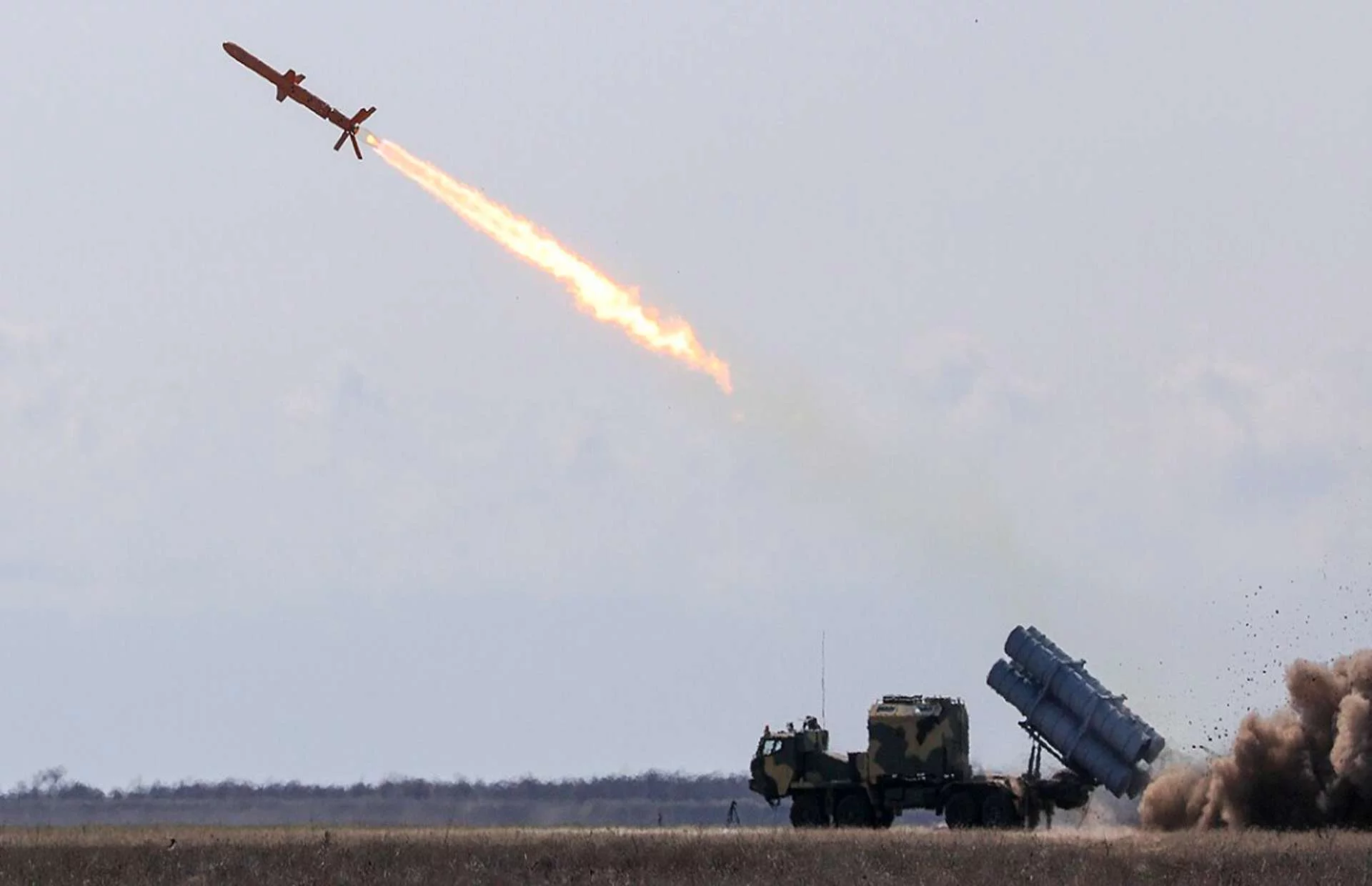
Ukraine has revealed the Neptune-D (designated RK-360L), a domestically developed cruise missile with roughly a 1,000 km range and a heavier warhead. The upgrade represents a major expansion of Kyiv’s ability to conduct deep strikes and underscores growing indigenous weapons-design capability under wartime conditions.
Design Changes and Propulsion
Significantly reworked from the original sea-target R-360, Neptune-D features an elongated airframe—around six metres—and a widened fuselage (about 500 mm) to increase internal fuel and payload volume. The missile carries an estimated 260-kg high-explosive warhead and relies on a compact turbojet for sustained subsonic cruise. A solid-fuel booster can be used to support launches in cold weather or from short-runway/road-mobile platforms. Canisterized launch tubes mounted on heavy trucks, along with dispersed command, control, and reload vehicles, are intended to complicate enemy detection and preemption.
Guidance and Dual-Role Capability
Neptune-D is built as a dual-role missile. For land attacks it follows pre-programmed low-altitude routes using inertial navigation augmented by satellite updates to hug terrain and evade radar line-of-sight; for maritime strikes it retains anti-ship targeting capabilities against moving vessels. Mid-course navigation likely incorporates anti-jamming measures, while terminal sensors are adapted to engage both radar-significant hulls and distinct inland structures. Official accuracy metrics (e.g., CEP) have not been published, but the combination of a large warhead and long time-of-flight suggests optimization for disabling infrastructure and fixed nodes rather than only precision bunker-busting.
Operational and Strategic Effects
A 1,000 km envelope places rail hubs, transformer farms, air-defense command nodes, and defense-industrial sites deep inside Russia within reach of launchers positioned well behind the front. Salvos can be routed along staggered ingress corridors to exploit seams in radar coverage and reduce reaction time for systems such as S-300 and S-400. The larger warhead increases the likelihood of functional kills on generators, turbine halls, machine tools, and fixed C2 nodes, lowering the missile-per-target ratio compared with lighter standoff munitions. Coastal batteries may pivot between Black Sea denial missions and deep-strike roles as circumstances demand.
Broader Implications
By fielding a domestically produced long-range cruise missile, Ukraine complicates Moscow’s assumptions about interior sanctuaries and forces a redistribution of scarce long-range air defenses inland. For NATO capitals, Neptune-D highlights Ukraine’s growing self-sufficiency and the operational need to harmonize targeting, deconfliction, and battle-damage assessment when Western and indigenous standoff weapons are used in parallel. The emergence of Neptune-D widens the deep-strike contest—eroding Russia’s interior lines, increasing pressure on war-sustaining infrastructure, and reshaping discussions about long-range munitions production and escalation management.
