

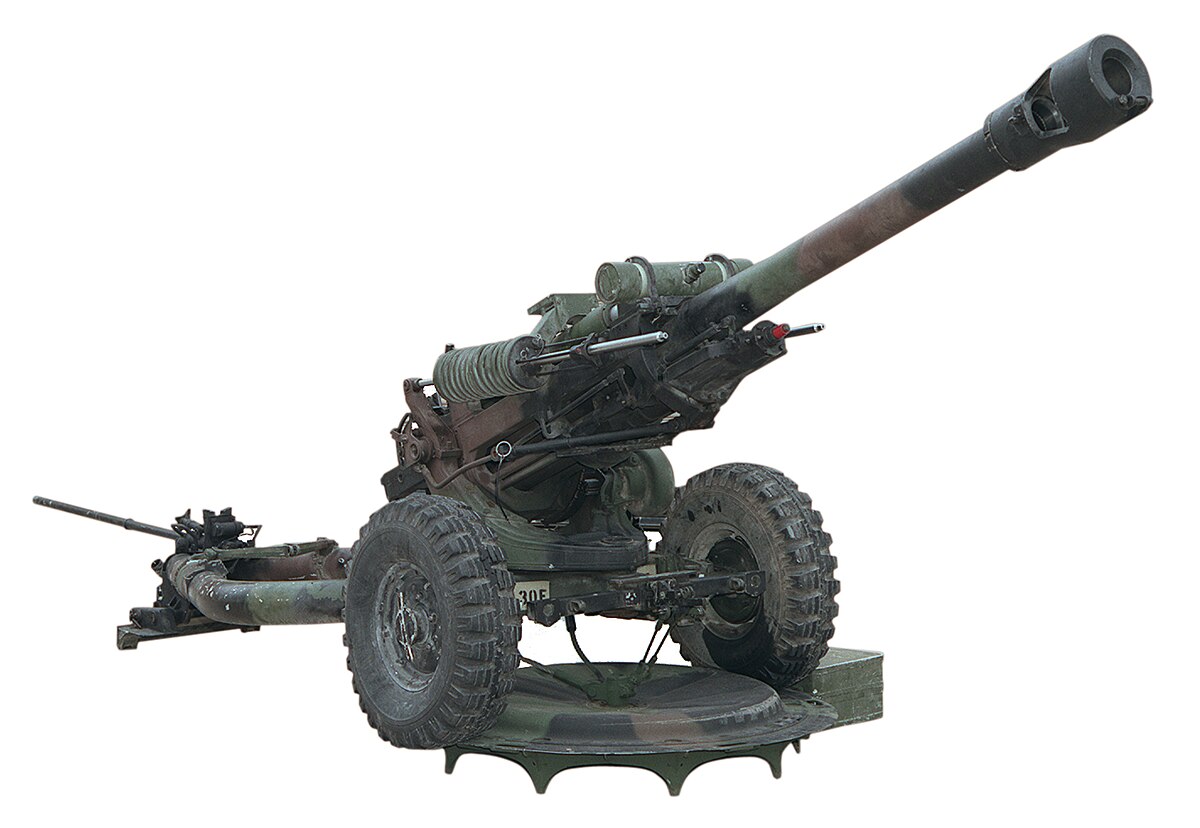
The M119A1 howitzer is a highly mobile, lightweight artillery piece in service with the United States Army, specifically designed for airborne and rapid-deployment units. Its compact size and light frame allow it to be airlifted by helicopters like the CH-47 Chinook or UH-60 Blackhawk, or dropped via parachute into remote or contested environments. Remarkably, this howitzer operates without the need for a recoil pit, making it ideal for quick positioning in diverse terrains.
Origins and Evolution
The M119 traces its design back to the British Royal Ordnance’s L118/L119 Light Gun series, introduced in the 1970s. The L118 model, which entered British service in 1975, fired separate-loading 105mm ammunition and gained combat credibility during the Falklands War, where it reportedly delivered up to 400 rounds per day in some units.
The L119 was later developed to meet NATO standards, using fixed 105mm rounds. This version served as the basis for the American M119, which began production in 1987 under a licensing agreement. The M119 officially replaced the older M102 howitzer and saw its combat debut with the 7th Infantry Division in 1989.
Subsequent upgrades led to the M119A1, which introduced improved performance in extreme cold climates (as low as -45°C), simplified maintenance protocols, and support for a digital fire control system. These enhancements positioned the M119 as a reliable and efficient tool for modern artillery units.
Deployment and Operational Use
The M119 series is a staple of U.S. Army light infantry divisions, including the 10th Mountain Division, 25th Infantry Division, and elite airborne units such as the 82nd and 101st Airborne Divisions. It’s also widely used by National Guard artillery battalions, providing vital indirect fire support in both conventional and asymmetric warfare settings.
Its lightweight frame allows for rapid transport and deployment, enabling artillery crews to quickly respond to shifting frontlines or sudden fire missions. Whether slung beneath a helicopter or dropped into a forward outpost, the M119 delivers accurate, high-volume fire in austere environments.
Ammunition Types and Capabilities
The M119A1 can fire a variety of NATO-standard 105mm munitions, including:
- M1 HE (High Explosive) – Standard fragmentation round
- M314 Illumination – Used to light up the battlefield during night operations
- M60/M60A2 White Phosphorus – For smoke screening and incendiary effects
- M913 HERA (High-Explosive Rocket-Assisted) – Extended range up to 19.5 km
- M760 HE – Effective range up to 14.5 km
These diverse munitions enable the M119 to engage enemy personnel, light vehicles, structures, and fortified positions with precision.
Variants of the M119
- M119 – Direct adaptation of the original British L119 design
- M119A1 – Improved cold-weather performance, ease of maintenance
- M119A2 – Enhanced optics, including the M90A3 sight unit and M137A2 panoramic telescope for superior targeting accuracy
The M119A1 howitzer embodies a balance between portability and firepower, making it a crucial asset for light and airborne artillery units. Its flexibility in transport, diverse ammunition options, and steady modernization ensure it remains a relevant and reliable tool on the modern battlefield. With continued upgrades and proven field performance, the M119 will likely remain in active service for many years to come.
