

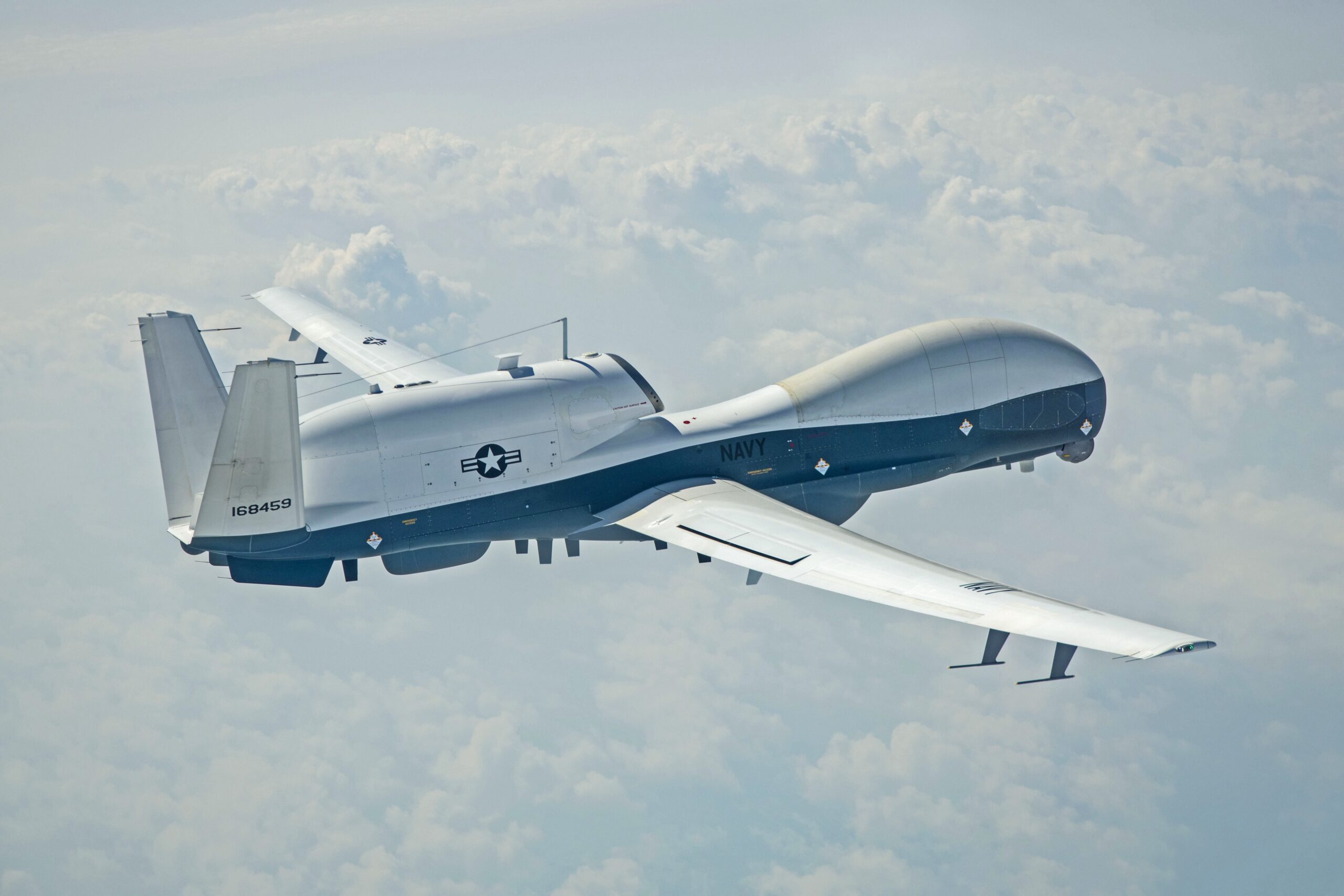
The MQ-4C Triton, developed by Northrop Grumman for the U.S. Navy, is a Broad Area Maritime Surveillance (BAMS) Unmanned Aircraft System (UAS) designed to deliver continuous maritime Intelligence, Surveillance, and Reconnaissance (ISR) support to the Maritime Patrol and Reconnaissance Force (MPRF). As a versatile platform, the Triton supports a range of missions, including strike operations, signals intelligence, and communications relay.
Operational Role
Once fully operational, the MQ-4C Triton provides persistent ISR coverage over extensive maritime areas, capable of maintaining up to five simultaneous mission orbits globally. Its roles include maritime monitoring, enemy order-of-battle data collection, battle damage assessment, port surveillance, communications relay, and support for maritime interdiction, surface warfare, battlespace management, and targeting for maritime and littoral strikes.
Variants
- RQ-4 Global Hawk: Triton is a naval adaptation of the RQ-4B, tailored to U.S. Navy specifications.
- RQ-4A: First production version for the U.S. Air Force (16 units built).
- RQ-4B: Upgraded variant featuring extended wingspan, increased payload, and longer fuselage.
- RQ-4E: German “Euro Hawk” based on the RQ-4B with EADS electronics.
- EQ-4B: Equipped with the Battlefield Airborne Communications Node (BACN).
- KQ-X: Proposed autonomous aerial refueling variant.
Design & Construction
- Fuselage: Standard aluminum, semi-monocoque construction.
- Wings: Lightweight, high-strength composite materials.
Payload & Sensors
- Maximum Internal Payload: 3,200 lbs (1,452 kg)
- Maximum External Payload: 2,400 lbs (1,089 kg)
Key Sensor Systems
- MFAS AESA Radar: 2D electronically steered array; maritime and air-to-ground modes; long-range detection and classification.
- MTS-B Multi-Spectral Targeting System: Electro-optical/infrared, auto-target tracking, multiple fields-of-view, full motion video.
- AN/ZLQ-1 Electronic Support Measures: Digital emitter identification.
- Automatic Identification System (AIS): Tracks maritime vessel movements via VHF broadcasts.
Notable Features
- Continuous maritime ISR within 2,000 nm mission radius; operational 24/7 with 80% ETOS.
- Land-based and afloat command and control for sensors and aircraft.
- Dual redundant flight controls; anti-ice, bird strike, and lightning protection.
- 51,000-hour airframe lifespan; due regard radar for safe separation.
- Open-architecture mission control and net-ready interoperability.
Powerplant
- Allison Rolls-Royce AE3007H turbofan, producing 7,050 lb (31.4 kN) of thrust.
Specifications
- Type: High-Altitude, Long-Endurance (HALE) Surveillance UAS
- Crew: None (autonomous)
- Operator: U.S. Navy
- Top Speed: 331 knots (TAS)
- Range: >8,000 nm
- Endurance: 28 hours
- Service Ceiling: 56,500 ft
- Designer: Northrop Grumman
- First Flight: Expected by end of 2012
- Engine: 1× Allison Rolls-Royce AE3007H turbofan
- Dimensions: Length 47.6 ft (14.5 m), Wingspan 130.9 ft (39.9 m), Height 15.4 ft (4.6 m)
