

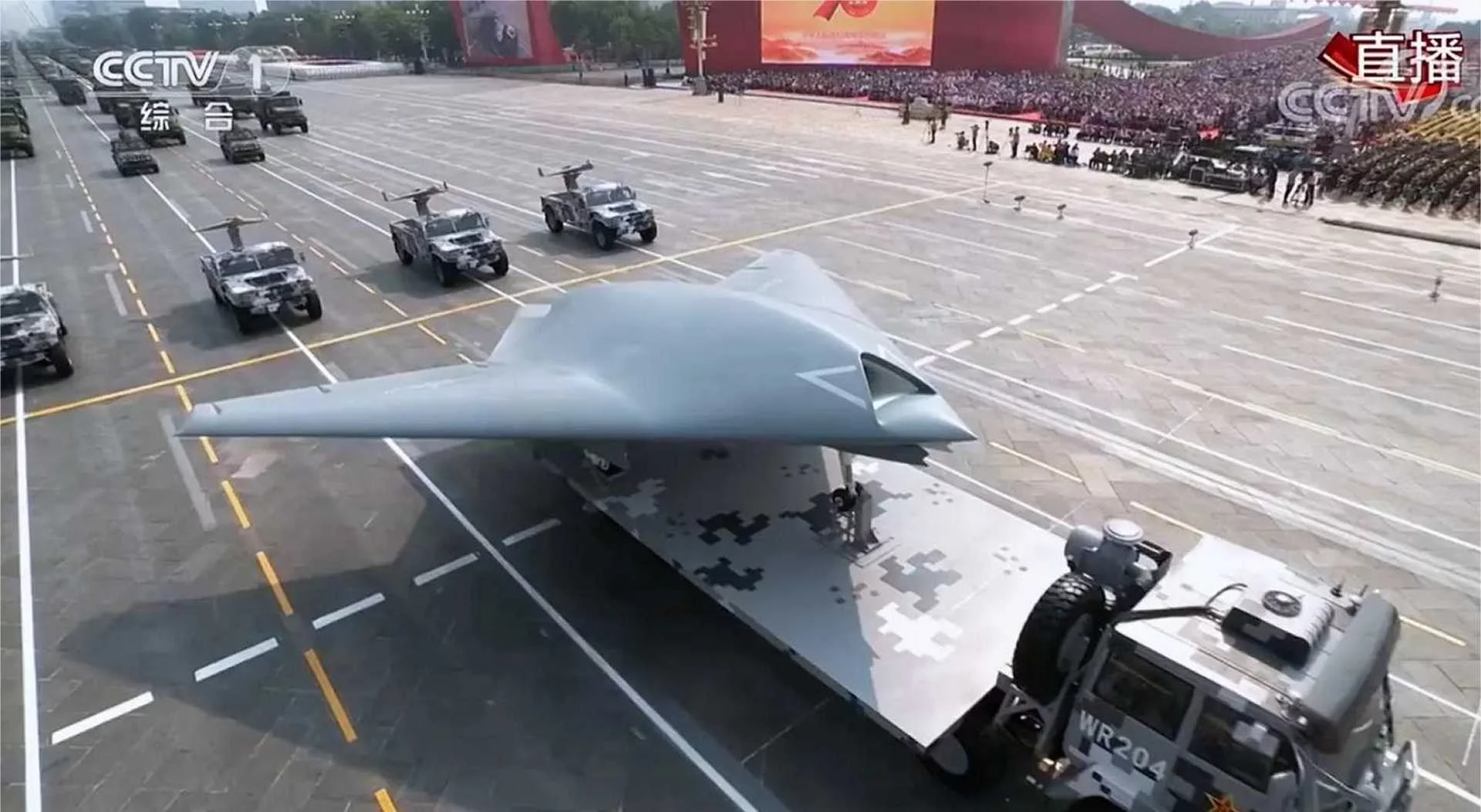
A GJ-11 “Sharp Sword” UCAV with visible folding-wing hinges led an unmanned formation during Beijing’s Victory Day parade on 3 September 2025—an appearance that has reignited speculation the type is being adapted for carrier or large amphibious-ship operations.
The GJ-11 initiative began in 2009 and first flew in 2013; a significantly revised version was publicly displayed in 2019. The design is a tailless flying-wing with blended body lines, S-shaped intakes and a shielded exhaust intended to reduce radar and infrared signatures. Reported dimensions and weights vary across sources, but the platform is consistently assessed as a medium-weight, low-observable strike UCAV.
Open-source performance estimates place the GJ-11 in the subsonic category with multi-hour endurance—commonly cited at about six hours—and a combat radius exceeding 1,500 km. Internal weapon bays are reported to accommodate roughly 2,000 kg of ordnance or sensor packages, enabling either deep-strike or ISR (intelligence, surveillance, reconnaissance) missions without altering external signatures.
Beyond the parade visuals, indicators of a naval role include AVIC concept art showing foldable variants for shipborne launch, full-scale mockups at carrier test sites around Wuhan, and trials infrastructure near Changxing Island—close to Type 076 construction. With electromagnetic catapult plans for Type 076 and Fujian, the technical conditions for fixed-wing drone operations at sea are being put in place, bolstering the hypothesis of a carrier-capable GJ-11.
If realized, a shipborne GJ-11 would extend the reach and sensor footprint of China’s carriers and amphibious ships, marking a notable development compared with other nations’ programs. The U.S. X-47B proved the concept but did not enter service; the MQ-25 is primarily a refueller; and many European demonstrators remained non-operational. China’s public demonstrations of swarming, decoy use and EW (electronic warfare) roles hint at possible operational concepts for coordinated UCAV groups.
That said, significant technical and operational challenges remain—deck handling, launch and recovery routines, electronic warfare resilience, and integration with carrier air operations are complex problems to solve. The public evidence points to serious preparation for a naval GJ-11, but whether that preparation equates to a deployable, carrier-operational stealth combat drone is not yet conclusively proven.
