

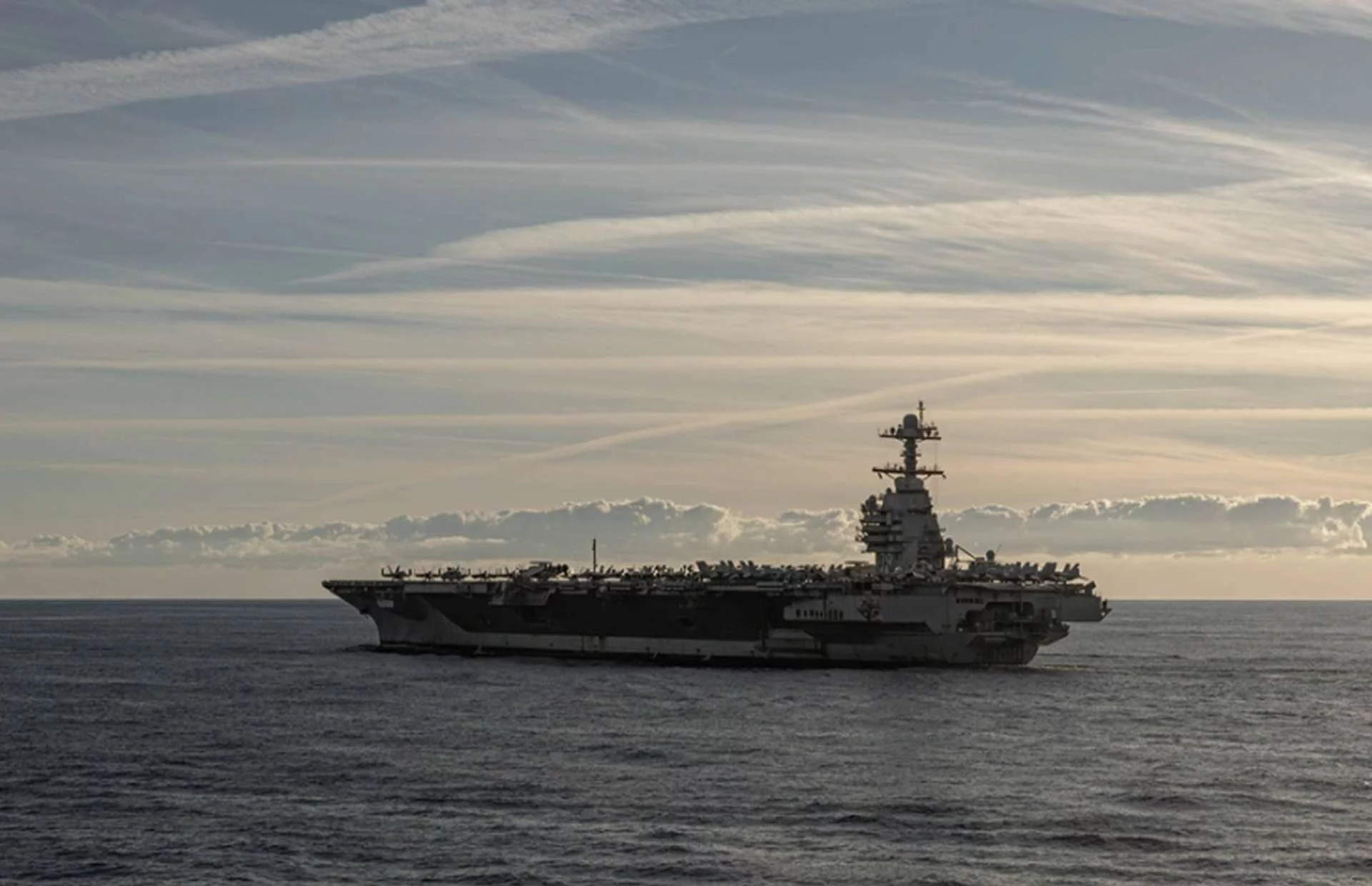
The USS Gerald R. Ford, the U.S. Navy’s newest aircraft carrier class, has been observed conducting full flight operations across European waters, signaling the ship’s transition into routine service. This milestone comes as the Navy balances shipyard delays, reliability upgrades, and rapid Chinese carrier aviation developments.
In August, Ford was seen conducting replenishment at sea and sustained flight operations with Carrier Air Wing 8 in the Mediterranean. By late September, the carrier returned to northern waters for NATO’s Neptune Strike exercises, launching Super Hornets and COD Greyhounds via electromagnetic catapults instead of steam. These operations highlight lessons learned from Ford’s first deployment and the growing CATOBAR competition with China’s Fujian.
Ford, the first U.S. carrier designed from a clean sheet since Nimitz, incorporates EMALS, AAG, a new radar architecture, and improved weapons-handling systems. Its eight-month cruise ending in January 2024 recorded 8,725 EMALS launches and an equal number of landings, though Pentagon testers note reliability data is still insufficient. DOT&E reports indicate hardware and software upgrades have yet to meet desired mean time between failures, with crews still relying on off-ship technical support.
The second Ford-class ship, USS John F. Kennedy, serves as a test for the shipyard’s learning curve. EMALS “dead-load” tests began in February 2024, with delivery now projected for March 2027, creating a temporary dip to ten carriers as Nimitz retires.
Enterprise (CVN 80) and Doris Miller (CVN 81) are central to production, with parallel construction stabilizing workforce and long-lead supply. Design focus on these hulls is on F-35 support and combat systems, with deliveries delayed beyond early projections.
The MQ-25 Stingray will extend strike aircraft range by reducing buddy-store refueling burdens on F/A-18E/Fs. F/A-XX is the Navy’s next-generation air dominance fighter designed for range, persistence, and teaming with unmanned platforms, with initial deliveries expected in the 2030s.
China’s Fujian carrier operations, including catapult launches and AEW aircraft, underscore the CATOBAR capability race.
Ford-class carriers continue intensive operational deployments. Eisenhower’s 2024 Red Sea cruise marked the Navy’s most demanding carrier operations since WWII, while Ford’s extended Mediterranean presence served as deterrence. The retirement of Nimitz and Kennedy’s delayed arrival intensifies fleet rotation challenges.
From an engineering standpoint, Ford’s success relies on EMALS, AAG, and weapons elevators sustaining high sortie rates with fewer crew and faster rearm cycles. DOT&E calls for clearer reliability data and AAG backup verification. The Navy points to months of operational flight as evidence that systems function while maturing.
