

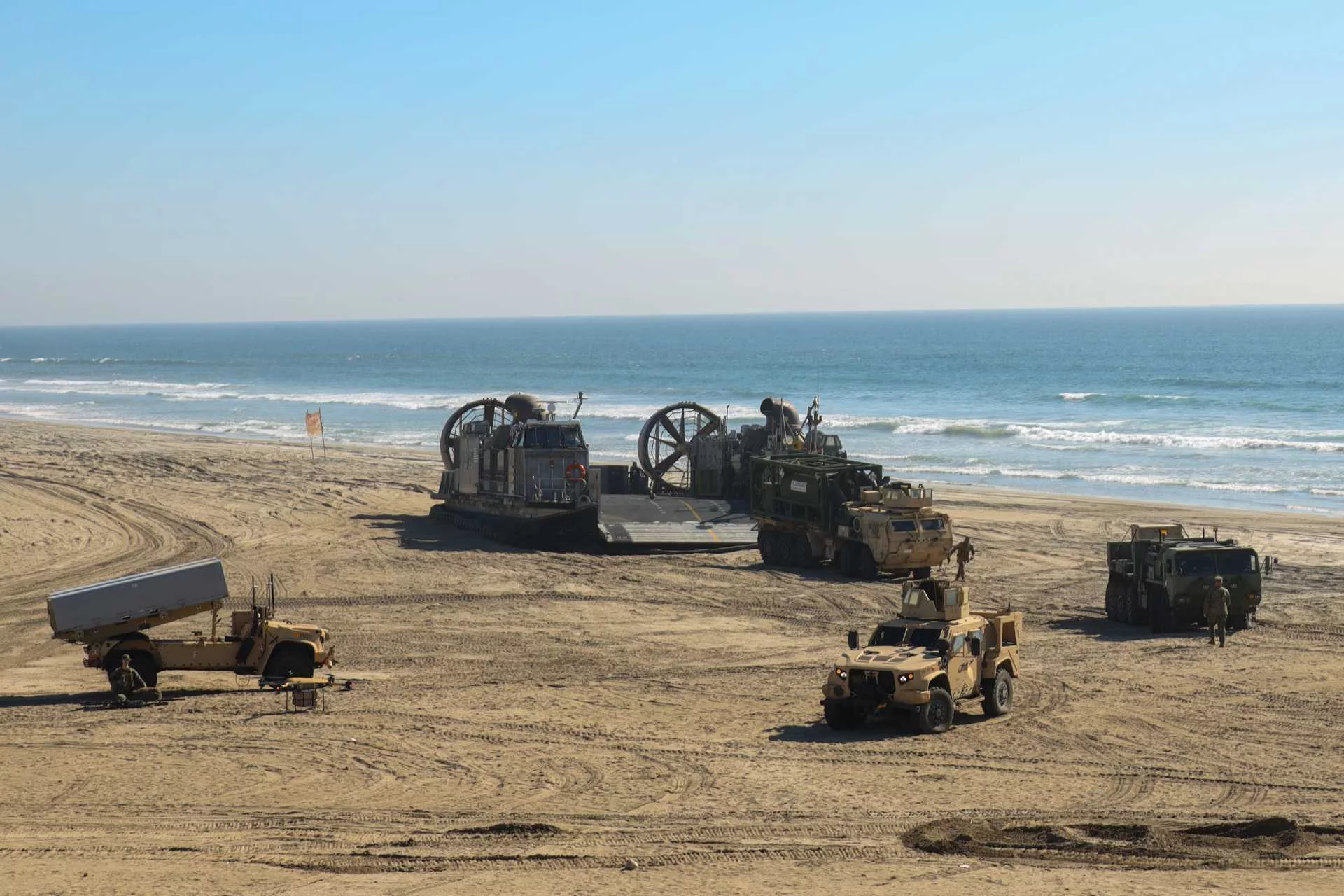
The NMESIS (Navy-Marine Expeditionary Ship Interdiction System) is a highly mobile, ground-based anti-ship missile system developed for the U.S. Marine Corps. Integrating the Naval Strike Missile (NSM) with the ROGUE Fires Carrier, an unmanned ground vehicle based on the Joint Light Tactical Vehicle (JLTV), NMESIS provides expeditionary forces with precision long-range strike capabilities from coastal and distributed positions. This system enhances littoral combat operations, giving Marines the ability to engage enemy ships without reliance on traditional naval assets.
Development and Operational Background
Initiated under the Force Design 2030 initiative, NMESIS was designed to strengthen the Marine Corps’ capabilities in anti-surface warfare, particularly in contested littoral zones. The system entered operational service in 2021, with the 3rd Marine Littoral Regiment officially receiving NMESIS in Hawaii and the 12th MLR integrating the system in Okinawa, Japan.
By combining land-based mobility with long-range strike precision, NMESIS introduces a new dimension of force projection. Its mobile nature complicates enemy targeting while allowing for rapid repositioning, persistent area denial, and coordinated strikes.
Key Components
- Launcher Vehicle – ROGUE Fires Carrier
- Based on the JLTV chassis by Oshkosh Defense, the ROGUE Fires Carrier is unmanned, highly mobile, and capable of traversing a variety of terrains including sand, mud, rocky surfaces, and forests.
- Each launcher unit carries a 4-cell vertical launch system for Naval Strike Missiles (NSM).
- Setup times are measured in minutes, enabling rapid deployment and repositioning.
- Dimensions: 5.5 m (L) x 2.5 m (W) x 2.3 m (H).
- Naval Strike Missile (NSM)
- Subsonic cruise missile with a range of 185 km (100 nautical miles) and speed ~0.9 Mach.
- Multi-mode guidance includes INS, GPS, and infrared homing for terminal targeting.
- Equipped with a high-explosive warhead capable of striking large warships and smaller vessels.
- Sea-skimming and low radar cross-section increase survivability against enemy air defenses.
- Command and Control (C2) Vehicles
- Coordinated management of NMESIS platoons and launcher units.
- Real-time data integration, targeting, and strike synchronization.
- Based on JLTV chassis for mobility parity with launch units.
Operational Structure
A NMESIS battery typically consists of two platoons, each containing three Medium-Range Missile System Launcher (MMSL) sections. Each MMSL section includes a leader vehicle, up to three ROGUE-Fires launchers, and a C2 vehicle. This distributed structure allows independent or coordinated operation, maximizing flexibility and responsiveness in coastal combat scenarios.
Combat and Strategic Advantages
- Provides coastal and expeditionary anti-ship strike capability from land-based positions.
- Enhances littoral combat effectiveness, enabling the Marine Corps to operate in contested areas.
- Rapid redeployment ensures launchers remain difficult to detect and counter.
- Integrates into broader naval/maritime kill chains for coordinated strikes.
- Supports distributed operations, creating a persistent, networked threat against enemy vessels.
Specifications
| Parameter | NMESIS System |
|---|---|
| Type | Ground-Based Anti-Ship Missile System (GBASM) |
| Missile | Naval Strike Missile (NSM) |
| Missile Speed | Subsonic (~0.9 Mach) |
| Missile Range | 185 km (100 nautical miles) |
| Launch Weight | ~400 kg (880 lbs) |
| Guidance | INS, GPS, Infrared Homing |
| Launcher | ROGUE Fires Carrier (JLTV chassis) |
| Accuracy | <10 meters CEP |
| Vehicle Dimensions | 5.5 m L x 2.5 m W x 2.3 m H |
| Operator | United States |
The NMESIS system represents a revolution in mobile anti-ship warfare, giving the U.S. Marine Corps the ability to project precision firepower from distributed, land-based positions. Its combination of mobility, precision, and networked operations makes it a critical capability for littoral combat, expeditionary warfare, and coastal defense, enhancing the Corps’ ability to dominate contested maritime environments.
