

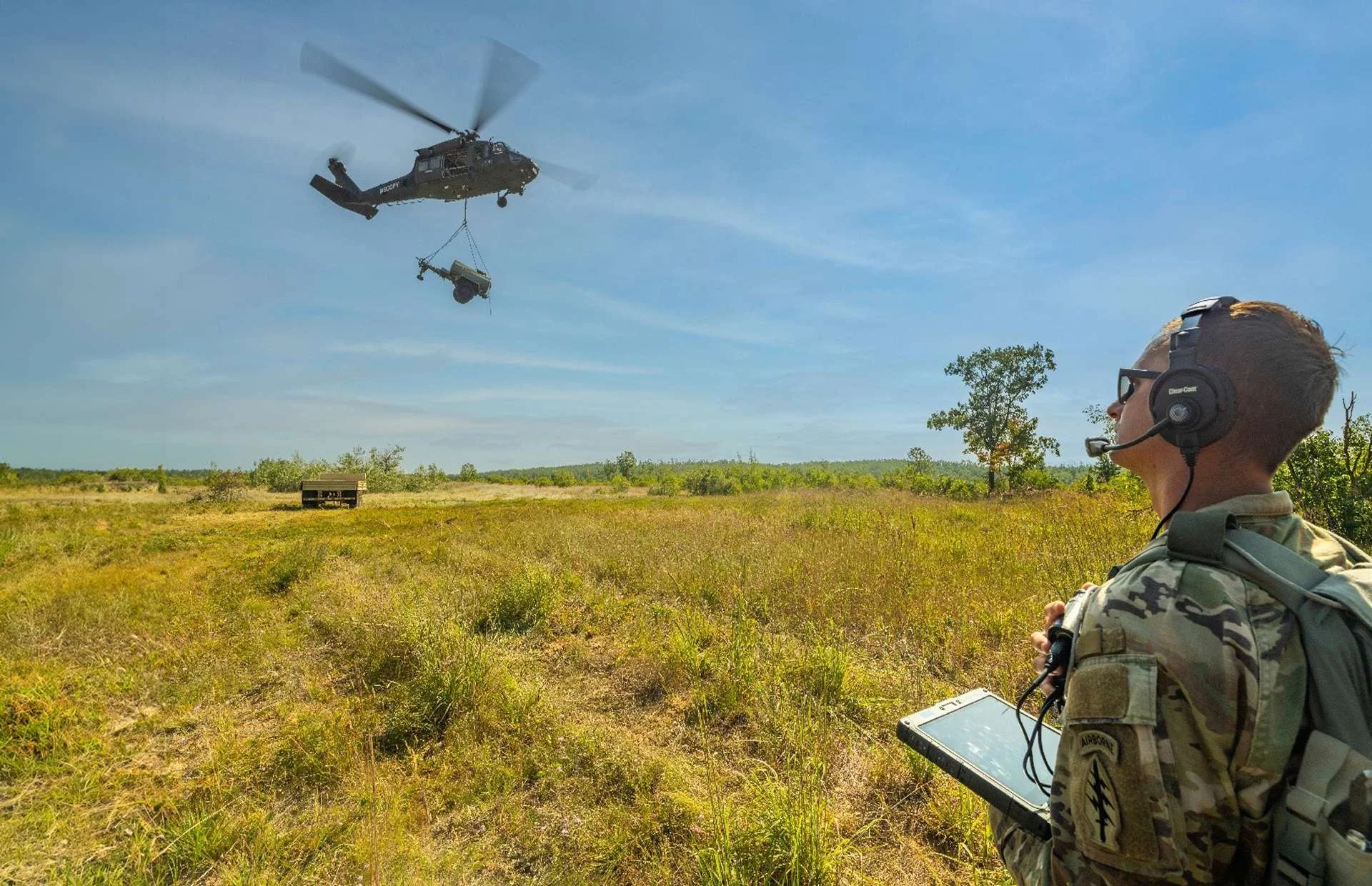
A U.S. Army National Guard sergeant has become the first non-aviator to carry out real missions using an Optionally Piloted Black Hawk helicopter equipped with Sikorsky’s MATRIX autonomy suite — marking a major step forward in autonomous military aviation. The milestone highlights how near-term autonomy could reshape logistics, medevac, and resupply missions for U.S. and allied forces.
Lockheed Martin announced that during Northern Strike 25-2 in Michigan, the soldier planned and executed a 70-nautical-mile resupply using only a handheld tablet. The missions included directing precision airdrops, supervising a 2,900-pound water tank hookup midair, moving HIMARS launch tubes through six autonomous sling loads, and performing a simulated casualty evacuation in austere terrain. Training required less than an hour, with no test pilots or engineers involved.
Northern Strike provided a realistic environment for large-scale contested logistics. The MATRIX autonomy system functioned as a digital copilot — launching, hovering, and executing precision maneuvers with minimal human oversight. The system enables commanders to use the Black Hawk as a large, survivable drone capable of performing critical resupply or medevac operations while keeping aircrews out of harm’s way.
The achievement aligns with the U.S. Army’s Future Vertical Lift (FVL) modernization strategy, which focuses on crew-optional operations to sustain tempo and enhance survivability in complex environments. Originally unveiled in 2013, Sikorsky’s MATRIX system demonstrated full uncrewed flight in 2022 under DARPA’s ALIAS program and was later integrated into a UH-60M test platform for expanded experimentation.
With over 4,000 Black Hawks operating in 36 countries, Sikorsky’s MATRIX offers a cost-effective upgrade path that extends existing fleets’ capabilities without replacing airframes.
The Northern Strike demonstration represents more than a technical success — it shows that even a non-pilot soldier can safely command a complex helicopter through a tablet interface, signaling a fundamental shift in how rotary-wing operations may be conducted in future battlefields.
