

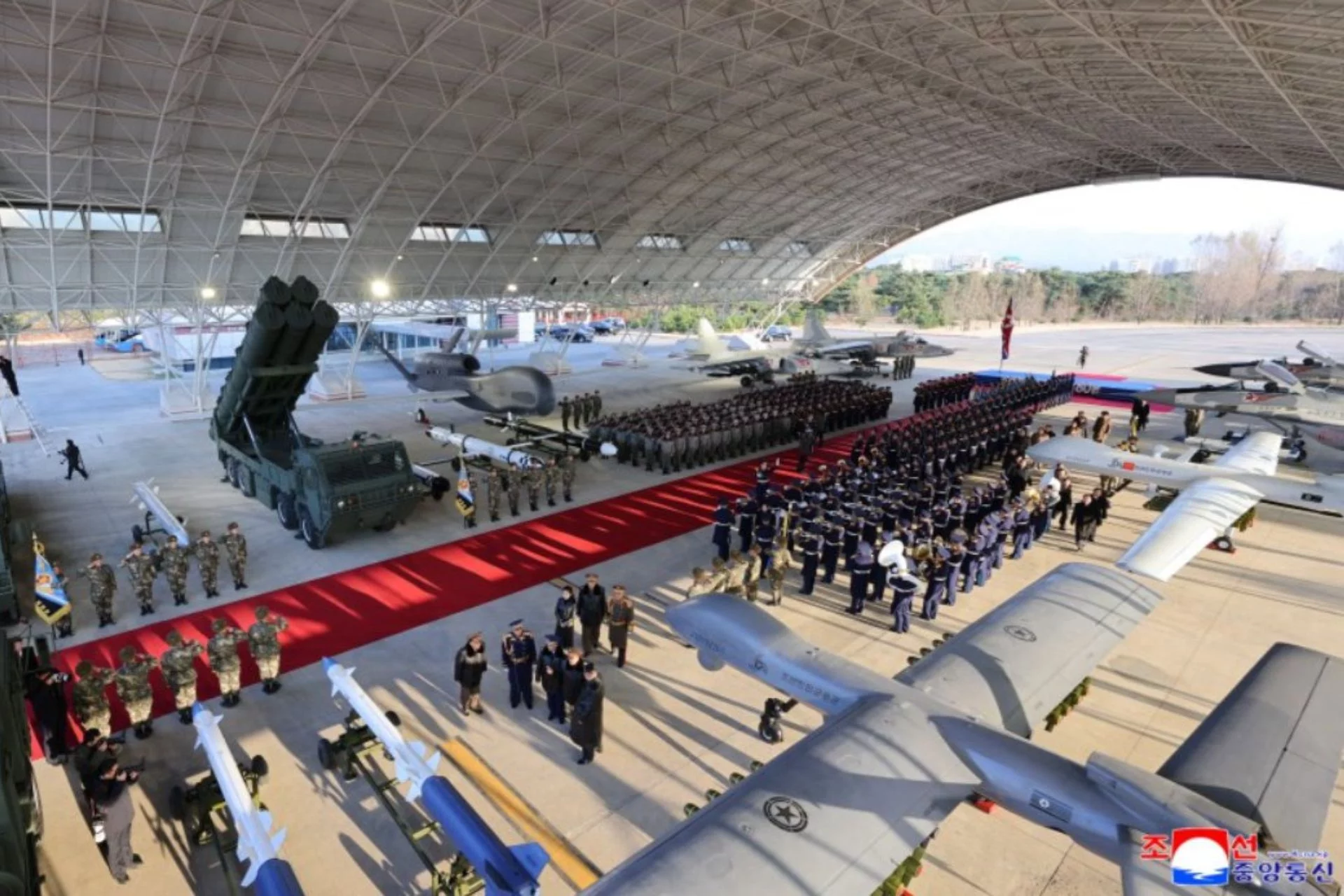
North Korea has publicly showcased its Saebyeol-4 reconnaissance drone and Saebyeol-9 strike drone during celebrations marking the 80th anniversary of the Korean People’s Army Air Force, signaling that long-range unmanned aircraft inspired by U.S. models have become central to Pyongyang’s air strategy.
State media images from the November 28 ceremony at Kalma Airbase show both drones in operational markings under the 59th Gil Yong Jo Hero Regiment. The designs, which mirror the U.S. RQ-4 Global Hawk and MQ-9 Reaper, suggest that North Korea now considers endurance-class surveillance and strike UAVs as deployable assets rather than experimental programs.
Saebyeol-9: Pyongyang’s Most Advanced Strike Drone
First spotted via satellite imagery in 2022 and publicly displayed since 2023, the Saebyeol-9 resembles the MQ-9 Reaper in both scale and configuration. Measuring roughly 9 meters long with a 20-meter wingspan, it features under-wing hardpoints for air-to-surface weapons or mission payloads.
Multiple variants have appeared, differing in wing structure, fuselage color, dorsal antennas, and air-intake shape—indicating that Pyongyang is still refining the aircraft. Endurance is estimated to exceed ten hours, though real-world performance and data link reliability remain unclear.
Saebyeol-4: A Global Hawk-Style High-Altitude Surveillance UAV
The Saebyeol-4 design follows the outline of the U.S. RQ-4 Global Hawk, with an estimated 30–35 meter wingspan and 10–15 meter length. Intended for long-endurance surveillance, it could monitor coastal sectors, aerial corridors, or maritime movements for extended periods.
The landing gear, reportedly adapted from the J-7/MiG-21 lineage, shows North Korea’s reliance on repurposed parts. Although its weight limits the integration of heavy SAR radars, the presence of satellite antennas suggests ambitions for long-range remote control beyond national airspace.
Kim Jong Un’s Guidance: Strike Range of 500 km or More
The development trajectory of both drones aligns with Kim Jong Un’s direction during the 8th Party Congress in 2021, in which he called for unmanned platforms capable of engaging targets at 500 km+. Test activity around Panghyon since 2023, including observed impact zones, reinforces the view that Pyongyang is investing heavily in strike-oriented UAV capability.
Kim’s September 2025 visit to the UAV production complex further highlighted efforts to establish a domestic ecosystem of sensors, satellite communication systems and airframes reverse-engineered from foreign designs.
Operational Impact on Regional Security
If fielded effectively, the Saebyeol-4 could provide persistent high-altitude surveillance above 10,000 meters—challenging to intercept for older air-defense systems. The Saebyeol-9 could conduct limited precision strikes on fixed sites such as radars or artillery positions, or pressure South Korean defenses through repeated intrusion tracks.
Despite uncertainties in avionics quality and data-link stability, the drones broaden North Korea’s operational reach and introduce new variables into planning for Seoul, Tokyo and Washington.
A Growing Asymmetric Air Capability
The renewed display of these UAVs shows that North Korea is consolidating an asymmetric air power approach centered on long-endurance ISR and limited strike roles. Even if their performance falls below U.S. or Chinese equivalents, any improvement—especially with potential Russian technological support—could further destabilize the security balance in Northeast Asia.
