

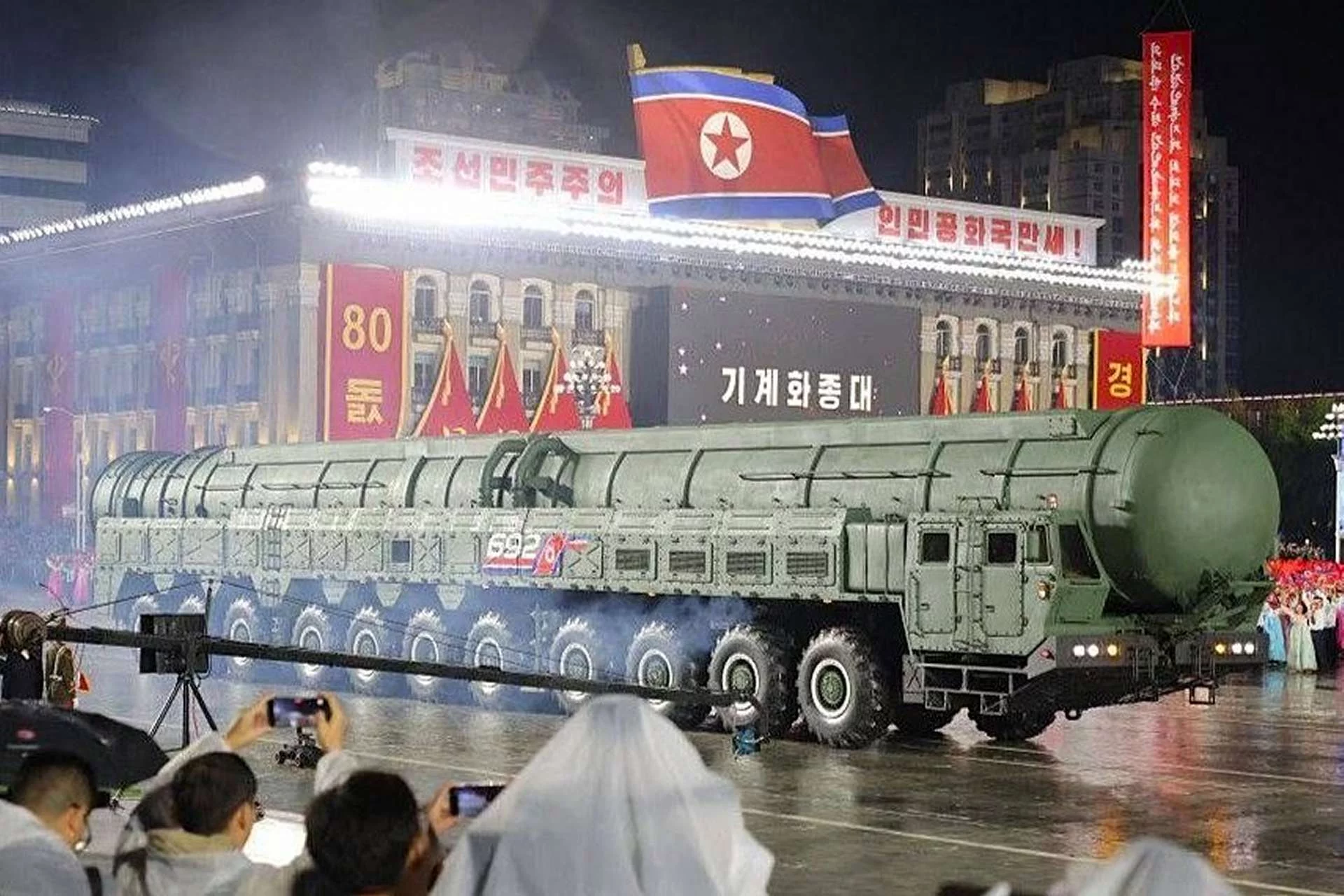
North Korea has showcased its newest intercontinental ballistic missile, the Hwasong-20, during a grand military parade on October 10 marking the 80th anniversary of the Workers’ Party. The debut, attended by leader Kim Jong Un and a senior Russian security official, is being interpreted as Pyongyang’s clearest signal yet of its transition from developing symbolic prototypes to fielding a survivable and credible nuclear force capable of striking the entire U.S. mainland.
The strategic significance of the Hwasong-20 lies in its advanced technical features. Its adoption of a solid-propellant motor is a critical leap forward, drastically reducing launch preparation time compared to its liquid-fueled predecessors. This enhances its survivability by making it less vulnerable to preemptive strikes. Furthermore, the missile’s wider and blunter nose cone strongly suggests an expanded payload capacity, likely designed to accommodate Multiple Independently targetable Reentry Vehicles (MIRVs) or a suite of penetration aids to deceive missile defense systems. This potential capability would allow a single missile to threaten multiple cities or overwhelm defensive interceptors.
The Hwasong-20 represents a calculated evolution in North Korea’s missile arsenal, appearing to merge the high payload potential of the liquid-fueled Hwasong-17 with the mobility and rapid-launch readiness of the solid-fueled Hwasong-19, which was first tested in 2024. North Korea’s claimed range of 15,000 km, if proven, would enable it to target any location in the United States from secure launch sites deep within its own territory.
The unveiling carries profound strategic implications. For the United States and its allies, Japan and South Korea, the Hwasong-20 represents a more complex threat profile that compresses warning and decision timelines. For Russia and China, it underscores the growing capability of a regional partner that can challenge and stretch U.S. strategic defense architecture. While key performance claims such as range, accuracy, and MIRV functionality remain unverified through full-scale testing, the message from Pyongyang is deliberate: it is determined to build a modern, mobile, and scalable nuclear deterrent designed to alter the geopolitical calculus in its favor.
