

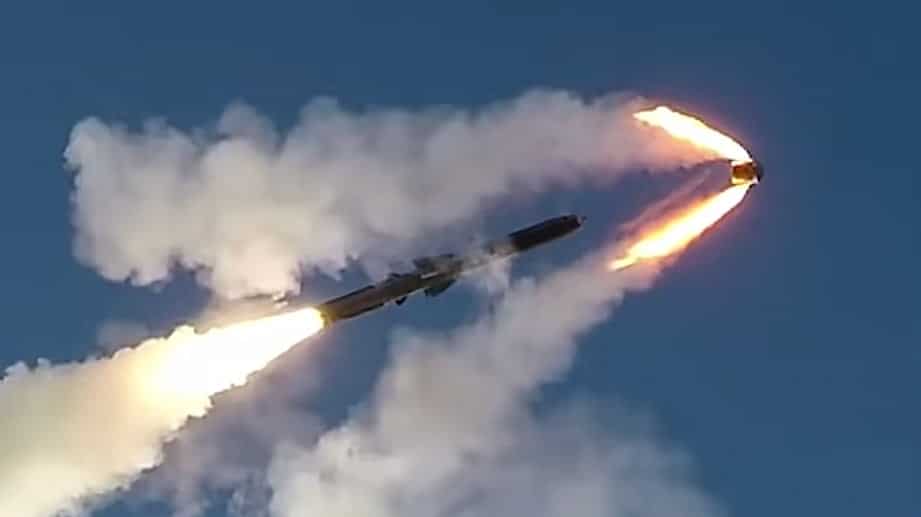
The P-800 Oniks 3M55, known by its NATO designation SS-N-26 “Strobile”, is a Russian supersonic cruise missile developed by NPO Mashinostroyeniya. Introduced in 2002, it serves as a versatile weapon capable of anti-ship, land-attack, submarine, and surface-to-surface operations. Recognized for its speed, precision, and modular design, the P-800 Oniks remains a cornerstone of modern Russian missile technology and a key component of naval, aerial, and land-based defense platforms.
Development and Variants
Development of the P-800 Oniks began in 1987 in the Soviet Union, targeting high-value naval assets such as aircraft carriers and heavily defended warships. Operational deployment started in 2002 aboard Nakat-class missile ships, and by 2015 the missile was integrated into the Bastion-P coastal defense system, providing mobile, land-based strategic capabilities.
Export variants include the Yakhont (ground and naval launch, 120–300 km range), Yakhont-M (air-launched for aircraft), and Oniks-M (extended-range up to 800 km). Notably, the BrahMos missile, a joint Russian-Indian project, was developed from the Oniks platform, reflecting its influence on global missile technology. Countries operating the P-800 include Russia, India, Indonesia, Syria, and Vietnam.
Design and Specifications
The P-800 Oniks features a modular and aerodynamic design, with a length of 8.3–8.6 meters depending on the variant, a diameter of 0.67 meters, and a wingspan of 1.7 meters. The missile weighs approximately 3,000 kg, with stabilizing fins and a solid-fuel rocket booster for initial acceleration. Once boosted, a kerosene-fueled ramjet engine propels the missile at supersonic speeds up to Mach 2.2 at high altitudes and Mach 2 at low-altitude, sea-skimming approaches.
The missile supports multiple warhead types: domestic Oniks variants carry a 250 kg semi-armor-piercing warhead, while export Yakhont versions carry a 200 kg high-explosive warhead, both capable of neutralizing heavily armored naval and land targets.
Guidance and Combat Use
The P-800 employs a dual-mode guidance system, combining inertial navigation for mid-course flight with an active radar seeker for terminal homing. Updated variants include imaging infrared (IIR) seekers for higher precision against small, low-contrast, or moving targets, achieving a circular error probable (CEP) of approximately 1.5 meters.
The missile can be launched from ships, submarines, fixed-wing aircraft, and ground-based Bastion-P launchers. Its terminal phase typically uses sea-skimming at 10–15 meters to evade radar detection and air defense systems. The missile has been combat-proven in conflicts such as the Syrian Civil War and the 2022 Russian invasion of Ukraine.
Strategic Significance
The P-800 Oniks is a high-speed, multi-platform missile capable of engaging naval formations, amphibious groups, and land-based targets. Its supersonic speed, precision guidance, and evasive flight profiles make it highly effective against advanced air defenses. The missile’s versatility ensures it remains a strategic asset for Russia and allied operators, and it continues to influence global cruise missile development.
Specifications Summary:
- Range: 120–300 km (Yakhont), up to 800 km (Oniks-M)
- Speed: Mach 2–2.2
- Warhead: 200–250 kg
- Guidance: Inertial navigation + active radar + IIR seeker
- Platforms: Ships, submarines, aircraft, coastal batteries
